
← Return to search results
Back to Prindle Institute

Reintroducing the Gray Wolf

photograph of two wolves stalking in the snow

Earlier this month, the citizens of Colorado passed Proposition 114, a measure that reintroduces gray wolves into the local ecosystem. The measure involves a plan to reintegrate the wolves by the end of 2023. It passed with 50.4% of votes in support and 49.6% in opposition; it was quite controversial. Some citizens of Colorado view the proposal as a way to honor the promises we made when we passed the Endangered Species Act. Others are concerned about the potential threats posed by reintroducing a predator into the community.

The story of the disappearance of wolves from their native habitats is the story of human western expansion and colonialism. Wolves didn’t simply disappear all on their own. During this time, many people hunted recklessly and decimated populations of elk, deer, and bison. The result was that the food source for predators like gray wolves became limited. Some populations of wolves turned to eating livestock to survive. In response, humans killed every last gray wolf in Colorado. In fact, they killed virtually every gray wolf in the contiguous United States.

As time progressed, humans stopped hunting deer and elk at the same rates that they once did. At this point, however, wolves, the natural predators of these species, no longer existed. This imbalance fundamentally changed ecosystems. Deer populations exploded and ended up harming forests in various ways. Forestry departments embarked on deer-culling missions — the practice of killing deer in order to keep ecosystems and the other living beings that participate in them in some kind of equilibrium.

The Endangered Species Act was passed in 1973. It required the Federal Wildlife Service to, if possible, restore animals that have been eliminated from ecosystems. All species of wolves in the contiguous United States were listed as endangered so, in keeping with the act, the FWS was obligated to restore them. In some areas they satisfied this obligation. For example, in 1995 the federal government reintroduced gray wolves into Yellowstone National Park. The findings in Yellowstone suggest that reintroduction of wolves into an ecosystem appears to lead to greater biodiversity in that system. The carcasses of the animals on which wolves feed also serve as a source of food for scavenger species.

Some concerns with Proposition 114 are procedural. Many felt that the issue should not have been up to voters to decide. Reintroduction of gray wolves will impact some areas of the state more than others. Critics are concerned that those who voted in favor of reintroduction are not the people who will have to face the consequences. For example, some rural voters argue that it was urban voters who dictated the trajectory of the vote. Urban voters won’t have to deal with the wolves.

Farmers and cattle ranchers are concerned about the impacts that the presence of wolves might have on their livestock. Ranchers are concerned about the well-being of their animals. Despite the fact that they are raising them to be slaughtered, ranchers would like to be able to allow cattle to freely graze without concerns that they will fall prey to wolves. They feel it is their obligation to protect their livestock up until the time when they send them to CAFOS and slaughterhouses, and the reintroduction of wolves into the ecosystem makes satisfying that duty more difficult. What’s more, because gray wolves are endangered, if a rancher actually witnesses a wolf threatening their cattle, they cannot kill or harass the wolf without risking jail time or a $100,000 fine. That said, there is no reason to believe that scaring the wolf off would expose the rancher to the threat of fine or jail time.

Another pressing concern is that cattle are an investment. To make a living, ranchers need that investment to pay off. If their animals die before they can be sold, the ranchers lose money. In response to this concern, however, advocates of the measure point out that it includes a commitment to offer compensation to ranchers who lose livestock to wolves.

Many ranchers also consider these kinds of environmental policies to be an existential threat to their way of life. They claim that the environmental movement, and conservationism in particular, needs rural allies. Some rural dwellers feel that urban environmentalists are not looking out for the interests of farmers and ranchers and as a result they feel little motivation to cooperate on issues related to public lands.

There are also concerns for the deer and elk populations who will be hunted by the wolves. When we reintroduce a predator into an ecosystem, we increase the extent to which that predator’s prey will experience fear. We also increase the likelihood that deer, elk, and other potential wolf prey will experience more painful deaths than they otherwise might have. It may be true that some of these animals will ultimately be killed by humans as part of wildlife management efforts, but deaths by these hunters are more likely to be fear and pain free.

There is also a metaethical question in play here. Do we have moral obligations only to individual, sentient beings who live in and have experiences of the world? Or do we have moral obligations to species, abstract groupings that are conceptual and not sentient?

Advocates of Proposition 114 argue that we have a moral obligation to protect endangered species. Arguments for this conclusion take several different forms. One is that we have a moral obligation to rectify harms and injustices that human beings have brought about. To the extent that wolves ever did humans any harm, they did so because of the changes that we made to their ecosystem. Advocates of Proposition 114 argue that it was unjust for us to kill off wolves en masse, so we now have an obligation to restore what we have diminished. Human beings are responsible for mass extinction events, and we need to take responsibility for that. The form that this responsibility takes should be more than feeling guilt and mourning the loss. We should actually do something about it, in those cases in which we still can.

Some thinkers, like ecologist and conservationist Aldo Leopold, have argued that species have intrinsic value. The continued existence of any given species is testament to the fact that it has endured the harsh tests of time and the ravages of nature. When the story of a species is brought to an abrupt end unnecessarily by humans, it’s a great tragedy.

Still others argue that it is best for ecosystems to manage themselves naturally. They contend that the equilibrium established by nature is usually more sustainable than a balance that human beings attempt to artificially establish. The reintroduction of the wolf renews the potential that the ecosystem has of attaining that natural balance. This is better, in the long run, for the ecosystem, and ecosystems are worth preserving.

At the end of the day, this case lays bare a fundamental tension in our country that is about more than just gray wolf populations. Environmental change, and what many would refer to as environmental justice, requires people to adapt their lifestyles. Making these changes is easy enough for some, but it is much more difficult for others. Some people’s livelihood, and, indeed, some people’s very identity, is tied up in practices that will be dramatically altered or even eliminated by efforts to protect and preserve the environment and the living creature that inhabit it. It’s no wonder the country is deeply divided.
Collective Action and Climate Change: Consumption, Defection, and Motivation

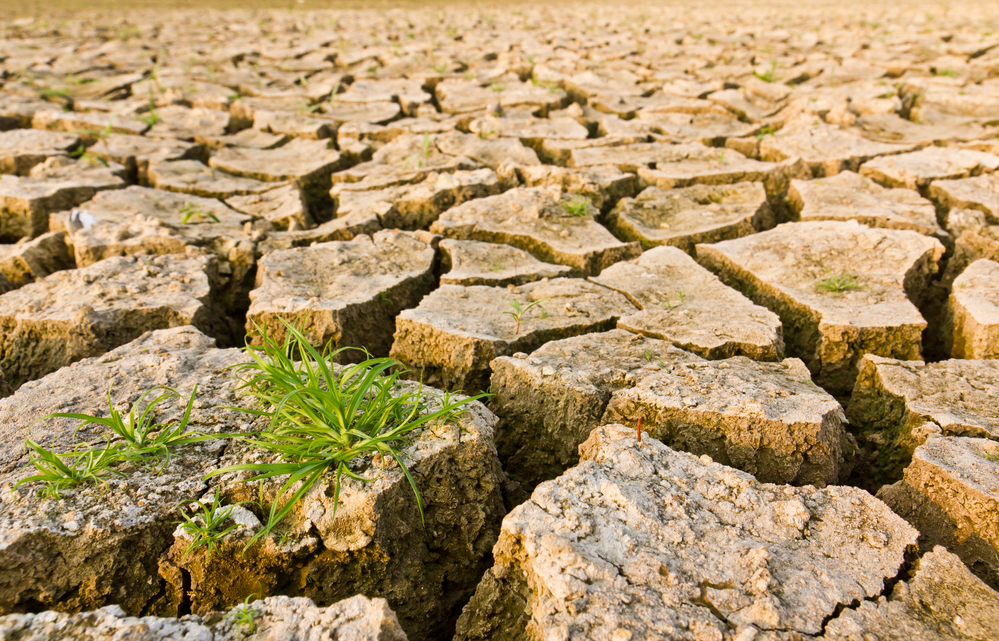
photograph of dry, cracked earth with grass growing on a few individual pieces

This article has a set of discussion questions tailored for classroom use. Click here to download them. To see a full list of articles with discussion questions and other resources, visit our “Educational Resources” page.


Last month, the United Nations held talks regarding international climate agreements in hopes to abate and adapt to the changes to our global environment due to the industrialization and emissions by humans. With the president of the United States vocally skeptical about the moral imperative to action, other countries have been considering defection from previous joint commitments. If the United States continues to consume resources at its current rate, the United Nations’ climate goals will not be possible. This is a feature of climate change agreements: they impact nations differently, irrespective of any country’s particular contribution to the problem. Thus, tied up with the responsibility to commit to taking action is the question of whether there should be different burdens depending on the level of industrialization and development (i.e., consumption) of the nation in question.

Environmental ethicist Martino Traxler distinguishes between two approaches in assigning the duties and burdens for responding to climate change. The first approach would be “just”, in that it takes into consideration the historical context in which we now find ourselves, as well as the power/structure dynamics at play. For instance, placing identical duties on all countries to reduce energy consumption equally doesn’t attend to countries’ differing ability to pay, varying causal contributions to the current state of things, and the extent to which various countries have unequally benefited from previous policies and activities that were environmentally damaging. For instance, some developing nations are improving economically by taking advantage of some less-clean technologies, and it is arguably hypocritical for developed nations with a history of colonialism, imperialism, or military interference/manipulation to intervene at this stage and charge the developing nations with the responsibility to reduce their pollution. Such a policy would slow the progress toward leveling the international playing field. Countries that are developing now and changing the shape of their economies in order to grow out of poverty may have greater claim to use resources that have damaging effects on the environment than countries that have put the globe in a place of climate crisis while at the same time creating conditions for global poverty that allowing the use of environment-damaging resources would go some distance to alleviate.

Thus, some examples just approaches to alleviating the impact of climate change would be to make:

  1. Benefiters pay (in proportion to benefits)
  2. Polluters pay (in proportion to responsibility)
  3. Richest pay (in proportion to their ability)

This would distribute burdens unevenly internationally, and typically nations that have more industrialized infrastructure would bear heavier burdens than those nations that are in the process of building their economies. This can be concerning for the most-developed nations and the nations that have experienced the most power and privilege historically. For nations that already have systems of infrastructure that involve emitting greenhouse gases, for instance, committing to being more environmentally responsible according to the just approach can amount to committing to a strikingly different way of life. Some still may recall George H. W. Bush’s declaration at the 1992 Earth Summit in Rio de Janeiro that “The American way of life is not up for negotiations. Period.” In 2012 in Rio de Janeiro, delegates noted that a child born in the developed world consumes 30 to 50 times as much water as one born in the developing world, emphasizing the different relations to resource consumption depending on the ways of life established in one’s society.

These features highlight how a “just” approach to burden sharing may disincentivize the richest, most internationally powerful nations from agreeing to combating climate change. The alternative approach style is a “fair” model of burden allocation, which has each nation share evenly in the responsibility to remain in a safe zone of resource consumption and emission standards. The fair approach presents a clean slate and looks forward, rather than backward at the contextual perspective of the just approach. The approach is fair in the sense that there is even distribution of responsibility, but most find the just approach more appropriate. Are there reasons why we might find the fair model appealing? The breakdown at the UN last month suggests several reasons why.

When we face an issue like climate change, nations need to determine how to act together. It’s difficult enough to determine the path for a single country or nation, but collective action like this requires agreement and commitment that structurally resembles classic dilemmas from game theory and economics. Traxler argues that because of these structural similarities, we should opt for fair rather than just allocations. In short, because the cost of the rich countries deferring is so great, we need to construct agreements that don’t over-burden them. As we see this year with countries like China and India hesitating to make commitments to change if the U.S. isn’t on board, Traxler may be onto something. In modeling climate change agreements in terms of incentivizing the related parties to not defer, Traxler is suggesting that we face an international Prisoner’s Dilemma.

The Prisoner’s Dilemma is a classic problem in game theory. The puzzle arises when what is in the best interest of a collective diverges from what is in the interest of an individual. The Prisoner’s Dilemma is set up as follows: two burglars (or criminals of some sort) are arrested and separated so they cannot coordinate. The authorities are attempting to get a confession from at least one of the burglars to aid in their investigation and conviction. If both burglars remain silent, they will each receive a sentence of 1 year. The authorities are attempting to incentivize cooperating with them because they would get information and successful convictions. However, the information will be most useful if one burglar cooperates and turns on the other, allowing the authorities to “throw the book” at one of them. Therefore, if one of the burglars betrays their comrade and gives information to the authorities while the other remains silent, this would result in the betrayer going free and the silent conspirator getting a 3 year sentence. If both burglars attempt to achieve this end (confessing in hopes that the other remains silent), the authorities have information on both of them and neither can go free. Instead, both will serve 2 years. Each burglar thus faces the decision of whether to cooperate with their conspirator or betray them and confess to the authorities. The possible combinations and outcomes are displayed in the table below.

The reason this poses a game theoretic dilemma is that the ideal outcome for each burglar is to exploit the cooperation of the other (i.e., to betray while the other stays silent). This creates a scenario where what is in the individual’s best interest is at odds with what is in their collective interest; if we consider the burglars together as a group and evaluate what would get the best outcome overall, then they should both remain silent. If, however, the individual aims for his or her best individual outcome, then there is great pressure to defect so as to potentially receive the best individual outcome (go free) and always avoid the worst (3 years).

As individual nations, it is in our best interest to over-consume and hope that the rest of the international community behaves responsibly and attempts to save the planet. That way we enjoy the benefits of our consumption of resources AND the benefits of the rest of the international community’s conservation efforts. BUT! If everyone in the international community behaves this way (parallel to both burglar’s betraying their partnership), we end up in a bad scenario. What is in the interest of the collective is for everyone to cooperate, but individual interests encourages us to over-consume.

The structure of the Prisoner’s Dilemma arises in a few areas of public life, not just among police bargaining with alleged criminals. The key to the dilemma is that what is collectively rational comes apart at times from what is individually rational. This is also the tension in Tragedy of the Commons cases. The Tragedy of the Commons describes cases in economics or scenarios in shared-resources situations where the best thing to do from an individual level is to consume more than others, but this focus on immediate use leads to a situation such that our shared ability to use the resource over time is undermined.

Described by William Forster Lloyd in the 19th century, we could imagine a case of the Tragedy as a river by a village that sustains an ecosystem containing fish. If the village fishes in the river some reasonable amount over time, the river is sufficient to replenish itself and feed the village. So, collectively speaking, it’s rational for the village to maintain fishing levels at this restrained rate. However, at an individual level, each villager is in a position where they have access to a resource that is potential income, and though it undermines the future use of the river and the other villagers’ potential use of the resource, overfishing to get more food and more resources is in the individual’s best interest. Thus in a similar way that the burglars have conflicting strategies in the Prisoner’s Dilemma, in shared-resource scenarios, there is tension between individual and collective interests.

In order to avoid countries defecting and not living up to the commitment to abate climate change, we may need to “sweeten the deal” a bit, according to Traxler and not go with the just approach that would perhaps be too burdensome to the richest, most industrialized nations. This would give them fewer reasons to over-consume and ignore the agreements. However, it would also perhaps produce less pressure for the richest and most able countries to aggressively researching “cleaner” alternatives to the technology so that they may continue something like their current ways of life.

Climate Justice: Whose Responsibility?

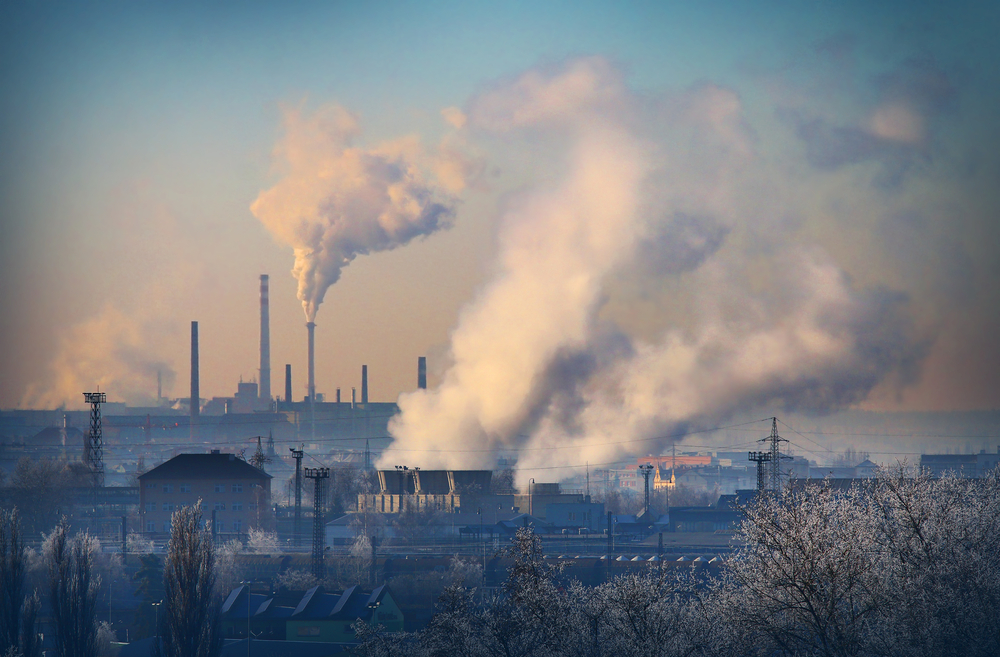
photograph of power plant smoke stacks

Now that the effects of global heating are happening and ecological collapse has begun, we are confronted with a set of urgent questions about justice and moral responsibility in responding to our climate emergency. Climate heating is of course a global problem – and one that is already disproportionately affecting the world’s poorest and most disadvantaged people. It is also a problem caused by people in rich countries continuing the unfettered consumption of resources and the failure of our governments to create policies and laws to curb this consumption, to safeguard the environment, and to transition to green economies through the decades of warnings leading up to this crisis.

The moral question of whether we must act is surely answered in the affirmative, and yet a set of questions remain about how to understand that imperative in relation to the issues surrounding disproportionate greenhouse gas outputs of developed, industrialized countries compared to the minuscule contribution of many smaller or less industrialized countries, who are often those experiencing the worst effects.

This is important because the way we understand our responsibilities has the potential to influence how solutions are pitched to the public and how policy might be implemented. Some of the arguments traditionally used to ground the moral duty of people in affluent countries giving money to the poor of the Global South are transferable, with little adjustment, to the area of climate policy.

Firstly, it is a common feature of normative moral systems that ethical ‘rules,’ ‘duties,’ or, more broadly, ethical actions are universalizable. That is, what is right for one person is right for all, and that when a rule prescribes that we act in a certain way towards one person, that is also a general rule, that we act in that way with respect to all persons.

In a globalized world, we often assume the moral community extends to all people. This ‘cosmopolitan’ argument maintains that the sphere of moral concern is global, that no individual falls outside of it. This means that where moral duties or requirements can be shown to exist, they would also extend to include people in different socioeconomic and geographical situations from our own.

Since the 1980’s Australian philosopher Peter Singer has been advocating for what he calls the expanded moral circle, using this basic idea to challenge some of our behaviors. In particular, Singer argues for the alleviation of poverty by those with the means to do so. Using his now famous drowning child example, Singer has argued that if we have a moral duty to save a drowning child who we might otherwise pass by, without sacrificing something of comparable moral value, then we have an equal duty to save a child dying from poverty-induced disease and malnutrition halfway across the world. The only difference is proximity and that, argues Singer, constitutes a logistical, not a moral, difference.

This is the expanding circle of moral concern that our moral duty to alleviate suffering is as strong for children in far away places as it is for our own children or the children next door. On Singer’s view, it would be immoral to spend our disposable income on expensive clothes, toys, or games that we do not need when there are children elsewhere dying in poverty.

Singer’s argument is a version of the argument from humanity, which says that, no matter our relationship to that suffering, whether or not we in some way caused it, our moral duty to alleviate it inheres in the fact that we are able to help. That, without sacrificing something of comparable moral worth, we can send aid to the world’s poor means we have a duty to do so. This humanitarian argument has broad application: our moral duty exists regardless of the cause of the suffering.

There is a different kind of argument a duty of justice according to which we have a moral duty to help others in need only where, and to the extent that, our actions have caused their suffering. This is an argument from responsibility; the exploitation of the Global South has enriched those in the Global North, and the moral imperative for those in rich countries to alleviate poverty is derived from causal responsibility we have a moral duty to provide redress in the form of reparations as a matter of justice.

This argument is narrower in scope. One only has a moral duty, here, according to the extent to which one has been responsible (directly or indirectly? knowingly or unknowingly?) for the suffering of others in far-flung places. But, on the other hand, this argument does embed the need to change our behavior in a way that the humanitarian argument does not.

It should be clear how this is directly transferable to the climate crisis. From a justice perspective, rich, industrialized nations have been burning fossil fuels to power their citizens’ lifestyles at such a rate that the whole global climate system is now tipping out of control. Those least responsible and least able to cope with the effects are already being disproportionately impacted. Therefore rich countries have a moral duty to alleviate the suffering of those in poor countries. (From a humanitarian perspective, rich countries have the capacity to alleviate the causes and provide aid, therefore the moral onus exists because the capacity exists.)

Whether we recognize a duty based in justice because of “polluter pays” kinds of arguments or on humanitarian grounds we owe reparations on the basis of being most able to help could make a significant difference when we start talking about managing aid and paying reparations to those affected by the climate crisis. It might, for instance, be possible to argue, along the lines of a duty from justice, for diminished responsibility based on the argument that no country meant to cause global heating and that those who have are not, or not entirely, culpable. This can be countered by reminding ourselves that there have been enough warnings, and claims about intentions are at best moot, and at worst false. What’s important to note is that these justice arguments rely upon the extent to which responsibility is admitted or can be established.

On the other hand, it might be at least as important to ask which is more likely to persuade people into action. Though for both these questions the best answer would surely be a combination of both, it is worth pursuing the implications of each a little further.

The question of which argument will be most persuasive might just seem like a pragmatic question, not necessarily a moral one. But it could easily be made to work as a moral argument, framed in terms of the moral imperative to get people to act, and act fast.

For example, Philosopher Holly Lawford-Smith argues that there are reasons to believe that people are more likely to be motivated to act by the justice argument. The humanitarian argument tracks a correlation between the existence of suffering and a moral duty to alleviate it. Everywhere there is suffering, there is also a duty to minimize it. But one might object that this is too morally demanding, and that some may not be willing to accept it. Lawford-Smith suggests this argument relates to people’s intuitions about moral omissions versus moral acts. Research shows that people are inclined to think of omissions as morally less serious than actions in scenarios where an action and an omission have the same outcome. (For example, people tend to think that killing someone through an act is morally worse than letting a person die because of an omission.)

On the other hand, according to the justice argument, the moral duty derives from culpability. The way people act and benefit from unjust institutions makes them culpable for creating the suffering in the first place. Lawford-Smith argues that people are more motivated to act if they feel that some behavior of theirs has caused the suffering. As such, she suggests that it may be more efficacious to argue from justice than from humanity to make a case to the public for why they are duty-bound to act (lobby, agitate, strike, vote, or whatever) on the climate emergency, and for appropriate aid and reparation schemes to achieve global climate justice. If the ultimate moral outcome here is, in fact, urgent action, then the moral and the pragmatic line up, and we must get on with the business of explaining to governments and citizens of rich, industrialized countries why they are, and will be, the cause of massive untold global suffering.

One final observation: at this crucial time, the need to motivate a critical mass of the world’s citizens to rise up and push for change is dire. This is the proverbial eleventh hour. If people cannot be motivated by the moral arguments for humanity or for justice, they may be motivated by arguments from self-interest which are of course not moral arguments at all. In that case, one might point out this is already no longer a crisis affecting just other people in other places. If the climate emergency has not affected you yet, it soon will. If it does not affect you, it will affect your children. Moral arguments should work, because we are a moral, altruistic, and cooperative species, by and large. But if they don’t, let’s hope that existential self-interest ones will. Sadly, though, if only these kinds of reasons will persuade people to act, those people on the planet who are not in a position to cope with the crisis, will find neither humanity nor justice.

Are Green Burials an Ethical Good?

image of burial mound in field

Roughly 7000 years ago a group of hunter-gatherers in Chile began to mummify their dead. According to Helen Thompson, the evidence suggests that this change was locally driven rather than being introduced from elsewhere. In fact, this cultural practice may have been influenced by climate change, which has spurred other past cultural developments as well. With climate change now becoming a major concern, there are those who argue we now have good ethical reasons to rethink what we should do with the dead. Several new environmentally-friendly ways of dealing with the dead have developed in recent years and this raises a moral question about what we should be doing with dead bodies.

Generally, there are two ways dead bodies are commonly dealt with; they are either buried or they are cremated. Cremation has become far more popular over the last century, and in some countries it is the far more common method. In Canada, for instance, cremation occurs roughly 65% of the time. In the United States the rate of cremation is far lower (only 47%), but this is an increase from only 25% in 1999. One of the reasons cremation is a popular method is because it is fairly cost-effective. In especially populated regions the difference between the cost of a burial and the cost of cremation can be several thousands of dollars. Cremation can also be less wasteful since it doesn’t inherently require cemeteries, headstones, or concrete burial vaults.

However, arguments have made about the moral superiority of burial over cremation. In an article published in the journal The New Bioethics, Toni C. Saad argues that cremation deprives a local community of a shared memory of those who were once apart of it and made the community what it was. He notes,

“of course, gravesite maintenance and location might become tiresome, but the continuing possibility of family memory-pilgrimage is not negligible. Additionally, since the memory of private loved ones is permanently tied to a public physical location, there remains a visual reminder to all, not merely relatives, of the significance of this person who is now dead.”

He suggests that private cremation contributes to a privatization of memory whereas a public cemetery allows us to connect to our local ancestry and allow us to better process the idea of death and mortality.

Both practices of the standard burial and cremation have become socially-engrained and there may be an argument that they are both morally important as part of our culture. However, there is a growing argument that these practices, as typically performed, are not environmentally friendly. Every year 90,000 tons of steel, 1.6 million tons of concrete, and 800,000 gallons of embalming fluid are used to bury the deceased. In addition, cemeteries take up large amounts of land and require pesticides in their upkeep. A single cremation requires two SUV tanks worth of fuel. It can also release substances like dioxin, hydrochloric acid, sulfur dioxide, and carbon dioxide into the atmosphere. Such practices do contribute to climate change, and if we have moral obligations to do something to reduce the threat of climate change, then we may be morally obligated to reconsider our rituals regarding death.

In the last few years several eco-friendly alternatives have been presented. For example, instead of an expensive wood casket, biodegradable caskets are now available and can ensure that bodies that decompose over time will become part of the local ecosystem. Instead of burial in a traditional cemetery, burial options are now available in more natural landscapes. Instead of a headstone, a tree may be planted over the burial site. A similar option is available for those who are cremated; ashes are placed into a biodegradable urn that contains a seed. Or, ashes can be placed underwater as part of an artificial reef.

Even the embalming process offers new possibilities. As opposed to formaldehyde, natural and essential oils may be used to preserve the body. In place of the standard cremation one alternative allows for the use of pressure and chemicals to dissolve the body. This process called alkaline hydrolysis uses 90% less energy than traditional cremation. There are new technological possibilities as well. Promession involves freeze-drying a corpse with liquid nitrogen and then breaking the body apart. Mercury fillings and surgical implants are removed and the powdered remains are buried in a shallow grave. This allows water and oxygen to mix with the remains and turn them into compost.

The fact that there are these alternatives and the fact that they may be more environmentally friendly does not necessarily mean that they are more ethical. However, given the climate crisis, there may be ethical reasons to adopt such new practices. In an article for the Journal of Agricultural and Environmental Ethics, Chen Zeng, William Sweet, and Qian Cheng argue that green burials reflect a number of ecological values including a harmonious relationship with nature, recognizing the worth of nature, the rights of all living things, and the limits of resources. They note,

“Green burial offers a way to minimize ecological pollution during the process of funeral, interment, and related religious rituals; it offers a means by which the affected environment can return to its prior, ‘natural’ state in a short time. Thus, the practice of green burial manifests a positive environmental and ethical attitude towards life.”

This only raises more questions. If it is more ethical to adopt eco-friendly practices than traditional practices for dealing with the dead, should we carefully study which practice is the least harmful the planet, and if so, are we then morally obliged to adopt that practice uniformly? As I began, climate change has affected the way humans deal with death. But how exactly should climate change today affect how we deal with death? Are we obliged to change our usual practices regarding death and would be it be morally wrong not to?

Procreative Autonomy and Climate Change

photograph of father walking with daughter in the water on the beach

This article has a set of discussion questions tailored for classroom use. Click here to download them. To see a full list of articles with discussion questions and other resources, visit our “Educational Resources” page.


From record-setting wildfires raging the Amazon to rising sea levels and melting ice caps, the devastating effects of climate change are becoming ever more apparent. Scientific data maintains that much of the rise in average global temperature is a direct result of human activities that emit heat-trapping greenhouse gases. The effects of climate change that we are currently facing are a consequence of a one-degree Celsius increase in average global temperature when compared to pre-industrial times. At this rate, we will experience up to a 4°C increase in average warming by 2100, which will only exacerbate and magnify the already rampant environmental degradation.

Fortunately, this future is avoidable as long as mitigating measures are rapidly implemented at the individual, community, and national levels. Recent analysis suggests that if immediate changes to halt climate change are made, carbon emissions can be lessened within 12 years, which will keep the rise in average temperature to 1.5°C above pre-industrial levels. Given that our actions now are crucial to the future of the biosphere and consequently the future of all people, climate-conscious individuals recognize the urgent need for change.

Even though scientific consensus asserts the existence of climate change, to global warming and climate change skeptics, this is still a point of contention. But to the rest, the numerous impacts of climate change can raise valid concerns over the sustainability of natural resources, and the kind of dystopian reality future generations will be grappling with in their lifetime if we do not act now.

A contentious resolution that has been proposed is factoring in climate change when deciding whether or not to have children and how many, if at all. Climate change has forced people to contemplate the ethics of having children in a consistently warming and thereby deteriorating world. Curtailing the population means the environment will suffer a reduced impact due to human activities, which will translate to a higher standard of living for the remaining population in terms of an increase in per capita availability of natural resources. Earlier this year, Rep. Alexandria Ocasio-Cortez faced criticism from conservatives following her Instagram live stream in which she pondered, “Basically, there’s a scientific consensus that the lives of children are going to be very difficult. And it does lead, I think, young people to have a legitimate question: Is it okay to still have children?”

For BirthStrikers, the answer is decidedly tough but evident. UK-based environmental activist Blythe Pepino set up BirthStrike, a voluntary organization for people who have made the decision to not have children given the inevitable environmental deterioration looming in the future. Pepino maintains that BirthStrike does not aim to dissuade people from bearing children but to instead spotlight the exigency of the ecological crisis. BirthStrikers are a part of a growing movement of people who have made this decision and the movement continues to gain momentum as conversations regarding the ethics of bearing children are fostered in groups of climate-conscious people.

On the other hand, some are quick to dismiss the notion of limiting procreation due to climate change as absurd, such as Republican Sen. Mike Lee of Utah who in March, stated that the solution to climate change is having more babies. On the Senate floor, Lee shared his solution in a presentation, declaring that, “More babies will mean forward-looking adults, the sort we need to tackle long-term large-scale problems.”

Tyler Cowen, a professor of economics at George Mason University echoes Lee’s thoughts on climate change and bearing children. Cowen argues that having more children and increasing the population of a nation would also increase the chances of nation coming up with innovative solutions to climate change. Cowen states, “If progress on climate change is at all possible, someone will need to contribute to it,” and goes on to explain that the most promising people who will do so is our potential children, especially if we are climate-conscious.

However, Lee and Cowen’s reasoning does not account for the series of carbon footprints our descendants will be producing which will collectively continue to add to the problem we are aiming to solve. Lee and Cowen also fail to address scientific data that deals with decisions made at the individual level, with recent research pointing to having children being detrimental to the environment given its already fragile state. Researchers calculated that having one less child would result in a family in an industrialized nation conserving 58.6 tons of carbon dioxide each year, which is much more efficient than other proposed solutions to limiting carbon dioxide production such as giving up cars (saving 2.4 tons) and flying (saving 1.6 tons per transatlantic flight).

Discussing the prospect of not having children as a legitimate solution to climate change gives rise to other ethical concerns such as our right to bear children and the innate value of procreation. Procreative autonomy is one of many forms of autonomy people can employ to govern their lives and an extension of one’s right to liberty. In the context of human reproduction, exercising procreative autonomy means having total freedom in their choices regarding bearing children and, ultimately, retaining dominion over one’s body. Implementing policies to curb procreation interferes with individual procreative autonomy. While this value is of great significance, we might wonder whether whatever right we might have to it is absolute. If every individual possesses an inherent right to bear children, does this right also mean that an individual should have as many children as they want without any regard for the environmental consequences of their decision?

The instinct theory of human procreation states that all animals including humans have an inherent and fundamental desire to procreate, which is why almost all animals reproduce. This theory goes on to explain that if humans do not procreate, having left their purpose unfulfilled, will be unhappy. This theory is not without its flaws – the notion of an intrinsic desire for progeny lacks supporting empirical data. The urge to procreate is not universal amongst humans – people have and still choose not to experience parenthood simply because that is not what they want. In this light, the procreation-instinct theory comes across as an oversimplification of human nature.

If population growth is to be regulated to resolve climate change, can governmental restrictions on the number of children one can bear ever be justified? Sarah Conley, a philosophy professor at Bowdoin College argues it can indeed be justified in her 2005 journal article, The Right to Procreation: Merits and Demerits. Conley explains that if procreative autonomy is considered a right or an extension of the freedom to live life on our own terms, then restricting the number of children one can have would be an encroachment of this right. But Conley also notes that, “Imposing one’s children on an overpopulated world is also a kind of interference […] in the lives of others in that world. Whose desire should trump?” Comparing the significance of different people’s rights, Conley points out how one person’s right to something can outweigh another person’s right to something else, and how the more basic a right is, the more difficult it would be to supersede. Even though it would be repressive for a government to regulate the number of children one can bear, it may be even more repressive to rob others of the right to basic needs of life by contributing to overpopulation, which would deplete finite natural resources. Hence, Conley believes that governmental restrictions on childbearing is ethically admissible because unlimited procreation would impinge on others’ fundamental rights even more so than governmental limitations on procreation would interfere with one’s procreative autonomy.

Regardless of where one stands on this issue, decisions about bearing children remain deeply personal. While all people have the right to bear children, the fact is that overpopulation and the resulting increase in human activities are contributing to climate change. Whether you regard the climate impact of having a child an important consideration or not, taking action to remedy climate change is becoming ever more pressing and contemplating the ethical concerns climate change presents can serve as a driver to help us arrive at an equitable solution.

The Amazon Fires: Responsibility, Obligation, and the Limitations of the State

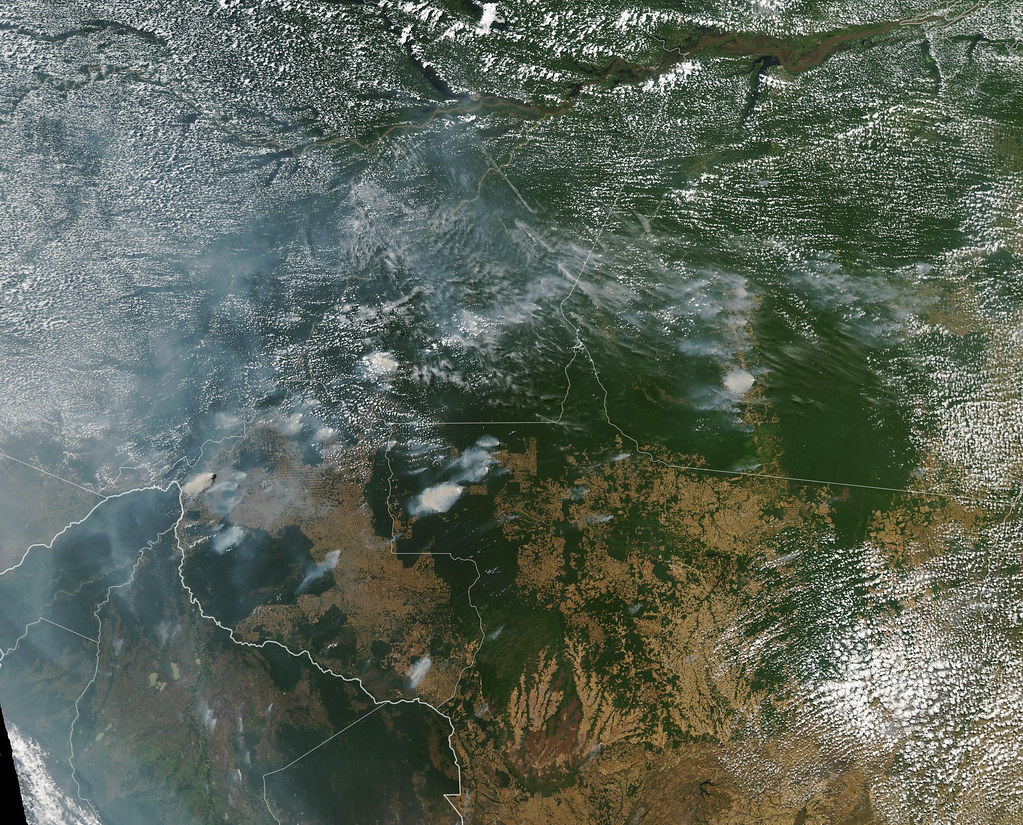
satellite image of amazon fires

This article has a set of discussion questions tailored for classroom use. Click here to download them. To see a full list of articles with discussion questions and other resources, visit our “Educational Resources” page.


President Jair Bolsonaro of Brazil refused to accept proposed aid from members of the G7 for the Amazon fires, in part because of a personal feud with President Emmanuel Macron of France about the respective leaders’ wives. Yet the Amazon rainforest continues to burn. Another concern of the Brazilian government is the implication that accepting foreign aid has for the country’s sovereignty. President Bolsonaro alleged that the French president “disguises his intentions behind the idea of an ‘alliance’ of the G7 countries to ‘save’ the Amazon, as if we were a colony or a no-man’s land.” But should President Bolsonaro’s refusal for aid continue and the burning of the Amazon continue, what is the next step? Who, if anyone, has an obligation to put out the fires? When is it justified to defy national sovereignty?

To violate a country’s sovereignty is a dramatic move; the cause would have to be of great importance. In 1999, the then-UN Secretary-General Kofi Annan defined the modern state as “instruments at the service of their people.” Failure of the state to deliver services to its people would warrant external aid. The UN Charter states that member states should refrain from “the threat or use of force against the territorial integrity or political independence of any state, or in any other manner inconsistent with the Purposes of the United Nations.” 

But the definition of the modern state and Purposes of the UN speak only to human concerns; nowhere is there an acknowledgement of environmental concerns. Even though conventions have been devised, the impasse regarding aid for the fires reveals a hole in the recommendations of international organizations. Even the recommendations about natural disasters do not apply given that the fires were apparently ignited by farmers clearing land for agriculture.

While the United Nations is not an authority on ethics in international relations, its charter is a useful touchstone given that its prescriptions often advise the international community’s response to global events. The burning of the Amazon, however, presents a non-standard case. Violating national sovereignty is often justified by protecting the lives of humans. But how should the international community respond to threats to non-human life?

Celebrities, NGOs, and political leaders alike have called the Amazon “the lungs of the world” given the amount of oxygen it produces. For that reason alone, it would appear that this fire is directly affecting the livelihood of humanity; thus, falling under the umbrella of justifications of acceptable international intervention. But some individuals have cast doubt on the claims about the rainforest’s contribution to the planet’s oxygen. 

“The Amazon produces about 6 percent of the oxygen currently being made by photosynthetic organisms alive on the planet today,” writes Peter Brannen. “[F]rom a broader Earth-system perspective, in which the biosphere not only creates but also consumes free oxygen, the Amazon’s contribution to our planet’s unusual abundance of the stuff is more or less zero.” Speaking to Forbes, Dr. Dan Nepstad of the Earth Innovation Institute called the popular descriptor of lungs “bullshit”, saying that the Amazon uses as much oxygen as it produces through respiration. The significance of the photosynthetic production of air and the Amazon’s instrumental value may be exaggerated. 

Even so, the Amazon basin contains incredible biodiversity, housing a staggering 10% of the known species on Earth despite occupying only 1% of the planet’s surface area. The rainforest is the largest of its kind in the world. The river that slices through the rainforest is the longest in the world. By any measure, the Amazon is a natural wonder, irrespective of its relationship with humans. And some argue that it possesses its own intrinsic value. 

Writing on one view of the intrinsic value of nature, Professor Ronald Sandler states: “[N]atural entities, including species and some ecosystems, have intrinsic value in virtue of their independence from human design and control and their connection to human-independent evolutionary processes.” Proponents of this view would argue that the Amazon ought to be protected not because of its value to us–be that in the form of oxygen or bewonderment–but because it has value without us.

Suppose then that the Amazon has intrinsic value and is, thus, worthy of protecting: is anyone obligated to protect it when the government in which it is in is failing to do so? Some may reference the dictum that those with the means to help are obligated to help. But the ethical expectations for individuals may not seamlessly apply to the ethical obligations of organizations. The discussion becomes more complex when considering non-state actors, such as NGOs, which do not operate under the same responsibilities.

NGOs whose cause it is to protect and encourage the biodiversity of different natural environments may see the perceived inaction of the Brazilian government as moral permission to intervene and provide aid. In some cases, non-governmental intervention occurs without any controversy, such as when an NGO delivers assistance to a developing country that is unable to provide clean water to its people. These organizations are likely in a better position to avoid the claims of sovereignty violation that have hampered the acceptance of foreign state aid simply because they are not pursuing a national state agenda. 

Yet while NGOs are able to help, there are some disadvantages to having them do so. They lack the democratic accountability of a state actor; they are not responsible for anything but pursuing their cause. Because of that they could feasibly maintain a presence in the country past the point that it is necessary and undermine the government’s ability to act. 

States, however, do not suffer from the same disadvantages and are constrained by international norms.  But if they are indeed “instruments at the service of their people,” states would appear to be obligated only to serving their people. It is not clear that states have the obligation to intervene in the destruction of a natural environment in another country. Furthermore, it is not clear if it would even be permissible to do so. International agreement on the notion that nature has intrinsic value may prove elusive, leaving the question of who should put out the fires unanswered, even if everyone agrees the fires should be put out. Perhaps the burning of the Amazon illustrates the growing obsolescence of our modern definition of the state.

Discussing Scientific Consensus on Climate Change

close-up photograph of dried lakebed

This article has a set of discussion questions tailored for classroom use. Click here to download them. To see a full list of articles with discussion questions and other resources, visit our “Educational Resources” page.


Concerns about the climate are becoming more pronounced in politics and policy discussions with each year. In the recent E.U. election, Green parties witnessed a marked increase in support. In Canada, the Green Party recently doubled their national caucus and managed to come second in a recent provincial election. In the U.S., there is hope of a Green New Deal. However, the federal administration in the U.S. has issued new directives to various national agencies to strip references to climate change or to omit worst-case emission scenarios. Public debates and media coverage emphasize the near universal consensus of climate scientists, but, on specific issues, this level of consensus simply does not exist. The nature of scientific consensus on the issue of climate change makes public discussion difficult, and this has ethical implications for how the public should be educated on matters of science. 

Studies show that the American public tends to believe that the consensus on climate change is around 72%, while many in the media (John Oliver’s Last Week Tonight being a good example) focus on the point that 97% of climate scientists agree on the issue of human-caused climate change. Getting the public to understand the degree of scientific consensus is important; it allows the public to be better able to address the dangers of climate change and assess the merits of various policy proposals. However, an important issue that is often not discussed is what exactly is meant by “scientific agreement.” The degree of scientific consensus isn’t constant given different questions and projections. While there may be a risk in underemphasizing the degree of current consensus, there may also be a risk in overemphasizing it as well. Is it worth it to potentially muddy the waters and attempt a more complex and nuanced public discussion about the nature of this consensus and the implication of climate change? 

Consensus on reports by the Intergovernmental Panel on Climate Change (IPCC) is often considered important. However, a 2007 paper by Oppenheimer et al. warn policymakers about the extreme possibilities of climate change that are downplayed or excluded for the sake of consensus. It notes that the report tends to minimize uncertainty by excluding less understood processes. Because of this, various models may be subject to a “premature consensus.” 

Similarly, a 2010 paper by Dennis Bray discusses surveys of climate scientists and found even amongst IPCC participants there is not uniform consensus. On topics ranging from future changes to precipitation, only 54% of IPCC respondents state that the IPCC report reflects a consensus view. Bray’s paper also mentions a 2008 survey which examined participant agreement with official IPCC projections on extreme event projections of climate change, almost 50% indicated that they disagreed or strongly disagreed.  

As the papers suggest, the issue of scientific consensus is more complicated than it is often described in public discussion. While there is broad agreement between climate scientists, that consensus evaporates when considering the finer details. Given the seriousness of global climate change, it is obviously beneficial that the public takes the threat seriously and that they are confident in what scientists are telling us. No doubt this is why the “97% consensus” point is so compelling. 

But emphasizing consensus at the expense of considered disagreement and uncertainty comes with risks. This is important knowledge for policy debates; the public has a vested interest in knowing if official projections are under- or overestimating the potential harm. This may be especially important at the local and regional level since, for example, coastal regions are likely to be disproportionately affected by the effects of climate change. Vigorous public input in these regions may be both desirable and necessary. 

Appreciation of scientific consensus is important for depoliticizing the facts around climate change. But the more the details and limitations of this consensus are discussed, the greater the risk that the facts become politicized by a public who may not have the time or expertise necessary to process the information. Is it worth it then to have the public be informed about disagreement when there is concern that the consensus view may underestimate projections about extreme events? More specifically, is it worth it if the result is that in the public eye scientific consensus is weaker than originally thought and ultimately less is done about climate change overall? Even if there is broad consensus on the notion of human-caused climate change, climate change deniers would likely use the opportunity to use reports on disagreement on specifics to undermine the broad consensus that climate change is human caused. 

Deliberately not covering cases of climate scientists diverging from the consensus view can make for a less informed public and we generally consider this a bad thing.  It can undermine public trust in science and in the public’s ability to make well informed democratic decisions. However, if there is greater coverage of scientific disagreement the facts could become twisted. If public confidence in scientific consensus falls then the public may be more inclined to be skeptical of climate change and thus such actions may result in an even less informed public overall. 

These questions pose a moral problem for both those who report on scientific findings as well as  members of the public who may have a moral obligation to be as informed as possible. Perhaps the long-term answer is to focus on science education, but that can take time. Plato’s Republic advocated for a “noble lie” in order to ensure social cohesion and harmony. Reporting only on consensus and glossing over areas of disagreement may constitute a lie of omission, but is it noble to do so?

Fixing What We’ve Broken: Geoengineering in Response to Climate Change

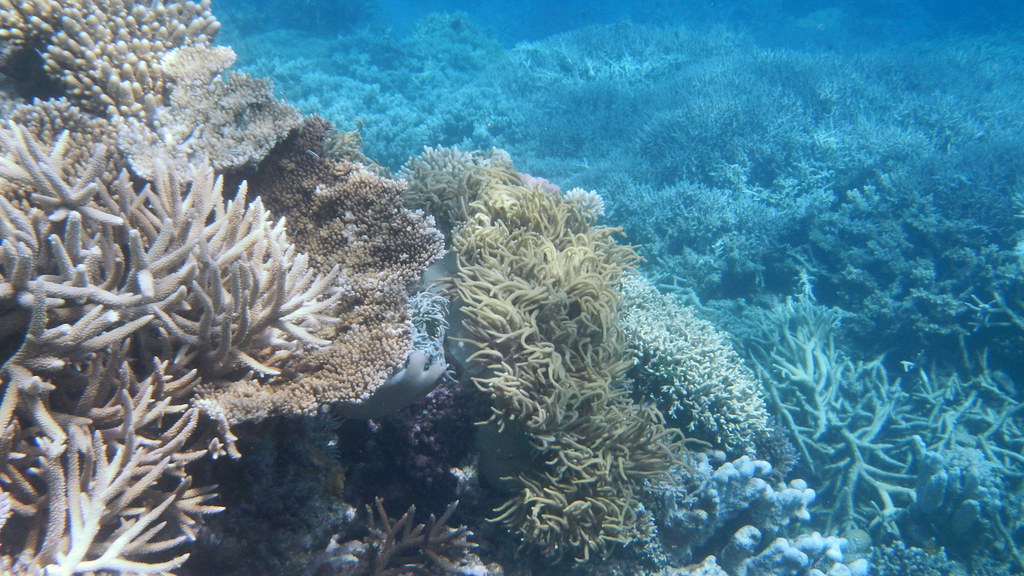
underwater photograph of reef

This article has a set of discussion questions tailored for classroom use. Click here to download them. To see a full list of articles with discussion questions and other resources, visit our “Educational Resources” page.


Extending over 1,200 miles, the Great Barrier Reef is the largest reef system on the planet. It is the only system of living beings visible from space and is one of the seven wonders of the natural world. The reef is home to countless living beings, many of which live nowhere else on the planet.

The Great Barrier Reef is valuable in a number of ways. It has tremendous instrumental value for the living beings that enjoy its unique features, from the creatures who call it home to the human beings that travel in large numbers to experience its breathtaking beauty. One also may think that functioning ecosystems have intrinsic value. This is the position taken by notable 20th century environmentalist Aldo Leopold in his work Sand County Almanac. Leopold claims that “A thing is right when it tends to preserve the integrity, stability, and beauty of the biotic community; it is wrong when it tends otherwise.” The idea here is that the ecosystem itself is valuable, and ought to be preserved for its own sake.  

When something has value, then, all things being equal, we ought to preserve and protect that value. Unfortunately, if we have an obligation to protect the Great Barrier Reef, we are failing miserably. The culprit: anthropogenic climate change. As David Attenborough points out in his interactive series Great Barrier Reef, “The Great Barrier Reef is in grave danger. The twin perils brought by climate change – an increase in the temperature of the ocean and in its acidity – threaten its very existence.” One result of this process is what is known as “coral bleaching.” Coral has a symbiotic relationship with algae. Changes in ocean temperatures disrupt this relationship, causing coral to expel algae. When it does so, the coral becomes completely white. This is more than simply an aesthetic problem. The algae is a significant source of energy for the coral, and most of the time, coral does not survive bleaching. Devastatingly, this isn’t just a problem for the Great Barrier Reef — it’s a global problem.

One general category of approach to this problem is geoengineering, which involves using technology to fundamentally change the structure of the natural world. So, as it pertains specifically to the case of coral bleaching, geoengineering as a solution would involve using technology to either cool the water, lower the acidity levels, or both. For example, one such approach to rising ocean temperatures is to pump cooler water up from the bottom of the ocean to reduce surface temperatures. To deal with acidity, one suggestion is that we use our knowledge of chemistry to alter the chemical composition of ocean water.

Geoengineering has been proposed for a broader range of environmental issues. For example, some have suggested that we send a giant mirror, or a cluster of smaller mirrors, into space to deflect sunlight and reduce warming. Others have suggested that we inject sulfuric acid into the lower stratosphere, where it will be dispersed by wind patterns across the globe and will contribute to the planet’s reflective power.

Advocates of geoengineering often argue that technology got us into this problem, and technology can get us out. On this view, climate change is just another puzzle to be solved by the human intellect and our general propensity for using tools. Once we direct the unique skills of our species toward the problem, it will be solvable. What’s more, they commonly argue, we have an obligation to future generations to develop the technology that will give future people the tools they need to combat these problems. Preventing climate change from happening in the first place requires behavioral changes from too many agents to be realistic. Geoengineering requires actions only from reliable scientists and entrepreneurs.

Critics raise a host of problems for the geoengineering approach. One of the problems typically raised concerns the development of new technologies in general, but is perhaps particularly pressing in this case: How much must we know about the consequences of implementing a technology before we are morally justified in developing that technology? The continued successful function of each aspect of an ecosystem depends in vital ways on the successful function of the other aspects of that ecosystem. There is much that we don’t know about those relationships.  In the past, we’ve developed technologies under similar conditions of uncertainty; we tried to control the number of insects in our spaces through the use of pesticides to devastating and deadly affect. We don’t have a great track record with this kind of thing (as the phenomenon of anthropogenic climate change itself demonstrates). There is potential for good here, but also the potential for great and unexpected harm.

Another problem has to do with which parties should be responsible for implementing geoengineered approaches. Who should get to decide whether these approaches are implemented? All life on earth will be affected by the decisions that we make here. Should such decisions be made through a mechanism that is procedurally just, like some form of a democratic process? If so, representative governments might be the appropriate actors to implement geoengineered strategies. That may seem intuitively appealing, but we must remember that our actions here have consequences for global citizens. Why should decisions made by, say, citizens of the United States have such substantive consequences for citizens of countries that, for either geographic or economic reasons, are more hard hit by the effects of climate change? What about the sovereignty of nations?  

An alternative approach is that entrepreneurs could pursue these developments. Often the most impressive innovations are motivated by the competitive nature of markets. This approach faces some of the same challenges faced by the governmental approach—it is counterintuitive that people who have primarily financial motivations should direct something as critical as the future of the biosphere.

Finally, critics argue that the geoengineering approach is misguided in its focus. What is needed is a paradigm shift in the way that we think about the planet. The geoengineering approach encourages us to continue to think about biosphere as a collection of resources for human beings to collect and manipulate any way that we see fit. A more appropriate approach, some argue, is for human beings to make fundamental changes to their lifestyles. They must stop thinking of themselves as the only important characters in the narrative of the planet. Instead of focusing on fixing what we break, we should be focusing on avoiding breaking things in the first place. Toward this end, they argue, our primary focus should be on reducing carbon emissions.

Passing the Mirror Test and the Wrong of Pain

Photograph of a striped fish called a cleaner wrasse in front of coral with another different species of fish in view behind

This article has a set of discussion questions tailored for classroom use. Click here to download them. To see a full list of articles with discussion questions and other resources, visit our “Educational Resources” page.


In mid-February, scientists announced progress in developing an understanding of consciousness. An international team collaborating in four countries discovered patterns of brain activity that coincide with awareness. Consciousness has long been a mystery, and there are many reasons to explore and figure it out. It seems like creatures who have some form of consciousness make up a special club, experiencing the world with more layers, perhaps with more complex agency, perhaps uniquely making up the moral community.

These potential steps forward in understanding our brain-based and embodied consciousness come alongside a purported broadening of the group of animals that scientists claim pass the mirror-test for self-awareness. As we try to put our fingers on what it means to be conscious, in the last century Western philosophers have become open to the idea that there is a rich arena of animal perspectives alongside our own. The variety of ways that we can imagine experiencing the world has grown with our study of human and non-human animal experiences. This has interesting implications for who we include in our understanding of our moral community and how we understand the ways we can harm these members.

Though it is pretty intuitive that causing harm is bad, explaining why can be notoriously difficult. One route is appealing to the negative experience of harm – primarily how bad experiencing pain is. This focus unites human and non-human animals that can feel pain into one morally relevant domain. If what is bad about causing harm is that it brings about this negative experience of pain, then we need to identify the sorts of creatures that experience pain and avoid bringing about those states without outweighing reasons. Thus, consciousness will be morally relevant insofar as it delineates those creatures that are in some way aware of their experiences.

There are two responses to this line of thinking. One direction argues that this grounding of the badness of causing harm is too narrow: there are harms that we don’t experience, so this understanding misses morally relevant behaviors. Another direction claims that this line of thinking is too broad: not all pain is morally relevant.

Consider the (false) common conception of the perspective of a goldfish, where their understanding of the world resets every 10 seconds. Would causing pain to a creature who would very quickly have no memory of it have the same moral relevance as causing pain to something that would incorporate it into its understanding of the world indefinitely? Take the faux-goldfish example to its conceptual extreme and imagine a creature that has the experience of pleasure and pain, but only has instantaneous experiences – it lacks memory. Presumably, it wouldn’t matter to the creature a moment after it felt pain that it felt pain a moment ago because it had no residual impact from the experience (unless prolonged damage was done). If you share this intuition, then something more than the mere experience of pain is involved in the morality of causing harm.  

The way to make pain morally relevant is to focus on the perspective of the creature experiencing the pain – that there is such a perspective extended in time that experiencing the pain will impact. We can imagine the fear of a non-human animal in unfamiliar circumstances and consider the anxiety that may develop over time if it is continuously exposed to such circumstances. Such creatures have a sort of “self,” in the sense that their experience of the world develops their mode of interacting with the world and understanding of the world over time.

There is an even more advanced way of being a creature in the world beyond stringing experiences together in order to have a perspective extended in time: a creature can be aware that it has such a perspective by being aware that it is a self.

A key experiment to check the development of a self-concept is the mirror-test, where an animal has a mark placed on their body that they cannot see by moving their eyes. If, when they see the mark on a body in a mirror, they come to the conclusion that their own body has the mark, then they “pass” the mirror test because in order to come to such a conclusion the animal must use an implicit premise that they are a creature that could be so marked. The mirror-test is thus meant to indicate that an animal has self-awareness. It relies on a variety of competencies (vision and figuring out how mirrors work, for instance), but has long been thought to be sufficient for indicating that a creature is aware that it exists in the world.

Humans don’t pass the mirror test until they are toddlers, and only some primates also are able to pass the test, along with sundry birds and other mammals. However, this past year a tiny fish – the cleaner wrasse – seemed to pass the test. It is a social animal, considered to be relatively cognitively advanced, but the scientists who advocated for the results of the mirror-test suggest that while yes, this is a smart and advanced fish, this may not mean that it is self-aware. The success of the small fish has raised issues in how we test for morally relevant milestones in non-human animals.

One interesting facet of the mirror test is that animals that perform well are social, which is often a morally relevant trait. If morality is a matter of treated others with the sort of deference they are due, then a sort of sociality for members of the moral domain makes some sense.

In defining our moral community, most theorists include some non-human animals, and most consider it relevant to identify the way creatures experience the world. These latest advances in mapping consciousness and advancing our interpretation of self-awareness tests will help us understand the spectrum of relationships possible in the animal world. 

Climate Change and the Philosophical Pitfalls of Grounding Duty to Future Generations

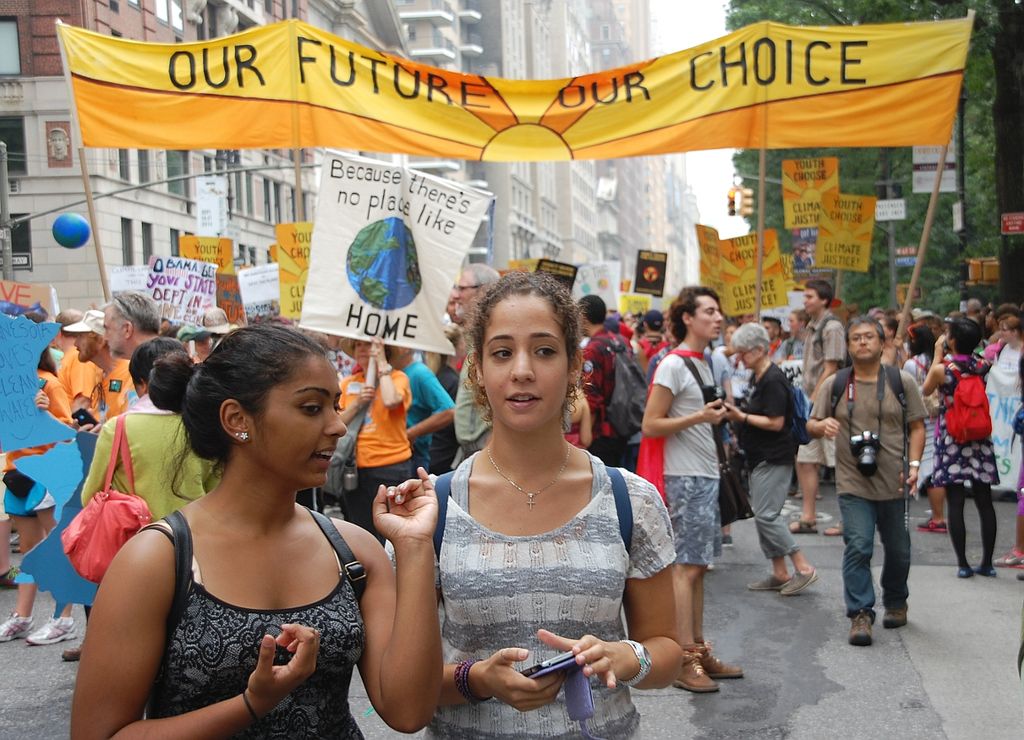
Two young women in the foreground of a protest march, with signs behind them saying "our future our choice"

This article has a set of discussion questions tailored for classroom use. Click here to download them. To see a full list of articles with discussion questions and other resources, visit our “Educational Resources” page.


Reports of mass extinction, extreme weather events, speedily melting ice caps and the inundation of low-lying islands by rising seas suggest that the environmental disaster scientists and activists have been warning about for several decades, has now begun.  

On the face of it, there isn’t really a good argument to be made against a moral imperative to fight climate change. Those who voice opposition to, and those who lobby against, climate action generally deny climate change is real rather than argue against an obligation to do something about it.

Governments across the world are nowhere near where they need to be on acting to prevent worst-case scenario outcomes, even where climate change is grudgingly acknowledged by the powers that be and even as its effects start to become difficult to ignore.

In January this year, David Attenborough told a cohort of business and government leaders, diplomats and influential celebrities at the Davos World Economic Forum that “What we do now, and in the next few years, will profoundly affect the next few thousand years,” and “Unless we sort ourselves out in the next decade or so we are dooming our children and our grandchildren to an appalling future.”

Few would now disagree that there is urgency about the issue of climate change; however, the question of our moral relation to future generations is philosophically complex. Does it make sense to claim that we have moral duties to persons who do not exist?  Do future persons, not already alive, have rights? How are the rights of future persons connected with moral duties that we have now?

There are some meta-ethical issues at play here (issues about what we take ethics to be centrally concerned with). A common foundation for morality is how the behavior of persons affects other persons (and sometimes other creatures/entities). The ‘moral community’ is that group to whom we owe moral consideration; whose well-being makes moral claims on us, or whose interests, or rights, provide imperatives and checks on our actions.

On one level, using a simple example given by Derek Parfit, we can see how, straightforwardly, the actions of someone now can harm an unknown, hypothetical person in the future. Parfit points out that, if I leave some broken glass in the undergrowth of a wood, which a hundred years later wounds a child, my act harms this child. This is of course familiar and quite intuitive reasoning; it forms the basis of things we tell our children every day, of the ilk: “don’t leave that there, someone could trip over it.”

Is it morally significant how far in the future that harm occurs? On one view it is not, as there is a direct causal relation between action of burying the glass and the child’s being cut by it. When I tell my child not to do something as it may harm someone, I am likely not to be thinking that far into the future as Parfit’s example, but this seems to be a result of the psychology, rather than the morality, of temporal distance.

However, it could be argued that moral accountability is weakened by temporal distance, because part of what it means to be in a moral community is that there is moral accountability, by virtue of reciprocity, between members – so that there is an in-principle possibility of the wronged party holding the other to account.

In response to Parfit’s example it should also be noted the person burying the glass is only causing a future harm as long as the child (or someone else) is later cut by it. That outcome is highly contingent. If the lack of reciprocity between individuals who are not one another’s contemporary, together with the contingency involved in any particular outcome, are problematic then it may be even more difficult to make decisions about the behaviour of a current population’s effect on a future population.

The question about how current people’s actions harm, or directly impact, future people encounters a paradox: because each person born is the product of so many and such complex contingencies, and all future persons are a product of actions taken in the present, a different set of actions (even one different variable) will produce a different human being.

Imagine two possible scenarios. In the first, no action is taken and climate change produces a disastrous future for all people on the planet. In the second, massive effort is undertaken, now with the outcome that disaster is averted and future generations are able to pursue happiness and have the opportunity to flourish.

Because of this paradox, it isn’t quite right to say that particular future persons will be better off if action is taken, since particular future persons who come into existence in the first scenario, if action is not taken, would not have existed in the second scenario. Can the people of the future in the first scenario really blame us, since had we made different choices they would not exist?

This line of thinking may appear to yield the conclusion that even if we do not conserve the environment for future generations of people, it cannot consistently be said that we have wronged them. But can we cogently argue that they cannot complain since in any other set of circumstances they would never have existed?

This is a difficult moral question – borne out in other problems or areas of practical ethics, such as whether to choose to have a disabled child. It opens up issues of how we value existence, what type of existence we value, and what level of difficulty we would be prepared to accept for the sake of existence itself. I shall not try to resolve this problem here – but it is not necessarily agreed that such future persons, in unbearable hardship, have no right to complain of the actions of their forebears that led to that hardship.

This paradox seems to arise in part where morality is taken to be centrally concerned with how actions of certain individuals affect other individuals – the problem here is that there is too much focus on particular individuals.  (Parfit himself thought that we should rescind the principle of morality being centrally concerned with individuals and employ a more impartial principle to ground morality in actions which produce the most wellbeing.)

But this solution creates another problem, which is encountered in consequentialist ethics of a utilitarian persuasion. Since utilitarianism is based on a principle of maximising happiness or wellbeing, it functions as a calculation of total possible happiness. This produces the counterintuitive outcome that a very large number of people who were borderline miserable would be preferable to a very small number of very happy people. Obviously this system cannot provide a foundation for a reasonable, binding, moral relation to future generations.

An argument from the notion of rights appears to fare better. If we acknowledge universal and inalienable human rights such as a right to life, liberty and security then, by virtue of their universality, we could extend them to future persons by including them in the moral community of holders of rights.

It has been noted by some philosophers, however, that the concept of rights is in some sense morally inadequate – it can fail to capture the moral seriousness of a situation. Imagine having to answer to future persons living with the devastation of our failure to act when we had the means and opportunity. It would not go all the way to the heart (so to speak) of their moral grievance to simply note that their right to live a full human life was violated – in the same way that the moral terribleness of murder is not adequately captured by noting that the murdered person’s right to life has been violated.

A still better grounding might be in a notion of moral duty as suggested by Immanuel Kant in the principle of universalisation: that we discover our moral duty by asking if we could will any action to be a universal law. Applying this principle our moral duty to future generations becomes clear when we simply ask what we would have endorsed were we to find ourselves in the same situation.

The window, we are being told by scientists, is closing fast. We may have little more than a decade to avoid unstoppable climate catastrophe. This means that the future is arriving. In a sense, the future is already here. Children born in this decade may be alive at the end of the century, and will be directly affected by our current actions or failure to act. Those future generations that appear in the abstract in the philosophical discussions of the past twenty to thirty years are already here. There are some hopeful signs; the new generation is starting to demand action as high-profile strikes by schoolchildren across the world put pressure on those in power to act to rescue the future they will inherit.

Facing the Synthetic Age with Christopher Preston

We’re in an age known as the Anthropocene, an era in which humans have been the dominant force on earth. We’ve impacted the climate, we’ve shaped the land and in recent years, we’ve made changes on the atomic and genetic levels. On this podcast, the philosopher Christopher Preston shares insights from his book The Synthetic Age, which explores the ethics of technologies that have the potential to radically reshape the world. We’re attempting to cool the surface of the earth by brightening clouds. We can introduce traits into wild species through gene drives and create entirely new organisms in the lab. While these new technologies are interesting and in many cases, potentially helpful, Christopher writes that we need to see them for what they are: a “deliberate shaping” of the earth and the organisms in it. He wants us to think carefully about what it might mean for humans to live in a world that they have intentionally manipulated.

For the episode transcript, download a copy or read it below.

Contact us at examiningethics@gmail.com

Links to people and ideas mentioned in the show


  1. Christopher Preston, The Synthetic Age
  2. Explaining the Anthropocene
  3. “We have 12 years to limit climate change catastrophe”
  4. Synthetic biology at the Venter Institute
  5. Malaria is a public health crisis
  6. Gene drives, mosquitoes and malaria
  7. More on living in a post-wild world
  8. 2015 fatality at Yellowstone National Park
  9. “Just 90 companies caused two-thirds of man-made global warming emissions”
  10. Joel Reynolds

Credits

Thanks to Evelyn Brosius for our logo. Music featured in the show:

Zeppelin” by Blue Dot Sessions

Soothe” by Blue Dot Sessions

A Certain Lightness” by Blue Dot Sessions

Heliotrope” by Blue Dot Sessions

Clean Energy Infrastructure, Environmental Justice, and the Ethics of NIMBY

Photograph of a field with wind turbines in the background

This article has a set of discussion questions tailored for classroom use. Click here to download them. To see a full list of articles with discussion questions and other resources, visit our “Educational Resources” page.


From DAPL to cancer-alley, sympathy to the opposition to industrial infrastructure and its harms are a cornerstone of the modern environmental movement. An important component of the movement has been the unified resistance of marginalized groups against powerful interest groups seeking to exploit the environment around them. Organized resistance to environmentally destructive projects are often no longer opposed under the guise of the environment’s inherent value alone, but also the rights of people to a healthy and safe environment. Prioritizing the interests of local citizens and the grassroots over special interests is not only fundamental to environmental justice but also to NIMBY-ism. NIMBY-ism, or “Not in my backyard”-ism, is an argument used commonly in disputes between citizen and government, or citizen and corporation, over the use of space on and around a person’s property. NIMBY-ism usually connotes negatively, as those who oppose the development often do so on the basis that it affects them personally, and not that the development is wrong in itself.

One striking example of NIMBYism used to oppose environmentally friendly infrastructure is that of wind farms in Indiana. Recently, Renewable Energy Systems pulled their development plan for large wind farms spanning across Cass and Miami counties due to technical difficulties. Many in the local community were pleased by this decision, with some even describing it as “fabulous news.” The project was estimated to generate 600 megawatts of electricity by establishing 150-225 turbines between the two counties. The project generated a great deal of controversy, with the local paper, the Pharos-Tribune claiming, “The debate and disagreements over placing wind turbines in Cass County had turned family members against one another and neighbor against neighbor.” And such opposition and controversy is not unique to Cass and Miami county. “Indiana Wind Watch” is an organization recently formed to “protect every Hoosier from the unfortunate fate of living near irresponsibly-sited industrial wind turbines.” The organization was founded in 2018, claims to be grassroots, and aims to provide resources to communities and individuals opposing wind farm developments. The reason Indiana Wind Watch opposes wind energy projects is because Indiana is “too populated.” Regardless of whether or not any of the information on Indiana Wind Watch is correct, the movement organized in Cass and Miami county demonstrates NIMBY-ism perfectly.

One could argue that if the opposition is based on false information, it should not be taken as true opposition. However, do members of Cass and Miami county truly need a reason to oppose development on and around their county by an international corporation?  This case parallels other environmental justice projects in that it centers around energy development and infrastructure. However, unlike cases such as Keystone XL and the Dakota Access Pipeline, this case involves building infrastructure that is positive for the environment. So would it be fair to call the opposition to wind farms in Cass and Miami county an environmental justice movement? According to the EPA, environmental justice “is the fair treatment and meaningful involvement of all people regardless of race, color, national origin, or income with respect to the development, implementation and enforcement of environmental laws, regulations and policies.” According to this definition, opposition to clean energy infrastructure could still constitute as environmental justice, which may seem somewhat counterintuitive. Though wind farms do have negative environmental impacts, such as killing birds and bats and low level noise, their impact is by and large less harmful than that of pipelines and energy plants.

However, it seems that though the citizens who opposed this project organized an environmental justice movement, the well-being of the environment did not seem to be a central motivator within the opposition. Much of the opposition to the turbines centered around concern about property rights and safety. Opposers argued that Harvest Wind Energy LLC’s plans for the placement of the turbines endangered those living near them and could potentially infringe on their property rights. Another potential concern about the project is that it was organized by a multi-national corporation, which might not have the best interests of small rural Indiana communities in mind. The Indiana Wind Watch emphasizes this concern in their opposition to wind development, and even described the situation in Cass County as “a truly David and Goliath battle for the protection of their county and homes.” Much of this rhetoric directly mirrors that of other environmental movements, particularly within the battle against “Big Oil” and fossil fuel interests. These types of arguments focus on the justice aspect of energy development and are critical of the difference in power between every day citizens and large corporate interests.

Even if a movement involves justice and the environment, is it necessarily an environmental justice movement, especially when its consequences lead to environmental degradation? If we reserve the right to withhold the distinction of environmental justice to movements that only have outcomes we deem as environmentally favorable, the way in which the environment is defined may become a force for exclusion and oppression.

It seems as though a level of NIMBYism is required in environmental justice, but perhaps it’s not only Not in My Backyard, but rather Not in Anybody’s Backyard. Moving toward a clean energy future will require totally new infrastructure and development, and as long as this infrastructure displaces people, it probably will not pass without controversy. The real question is how environmentalists should approach this issue, and whether they should critically reflect on the meaning of environmental justice.

Rethinking Modification of the Natural World

Photograph of people touring glass biospheres

This article has a set of discussion questions tailored for classroom use. Click here to download them. To see a full list of articles with discussion questions and other resources, visit our “Educational Resources” page.


Aristotle famously pointed out that humans stand out from other living beings because humans are rational.  To live a flourishing human life is to live in accordance with the dictates of reason. Much of the philosophical thought about the essence of man going forward was heavily influenced by what Aristotle had to say on this point.  It is hard to deny the importance of rationality for the survival of the human species. Because we can reason, we can use language, make plans, satisfy obligations, know things about the world, and, importantly, we can change the world as we see fit to meet our needs.  It would be an understatement to say that we took full advantage of that last part. It is important that we ask ourselves: Are there any constraints on how far we should take our ability to modify the world around us? Continue reading “Rethinking Modification of the Natural World”

Sip Carefully: Plastic Straws and the Individualization of Responsibility

Photograph of two iced Starbucks drinks with a wrapped straw in between them

This article has a set of discussion questions tailored for classroom use. Click here to download them. To see a full list of articles with discussion questions and other resources, visit our “Educational Resources” page.


In 2015 a video of a sea turtle took the internet by storm and set into action the public outrage over pollution caused by plastic straws. Since then, videos and articles including facts about plastic waste in the world’s oceans have been circulating the internet, and plastic pollution has been the topic of more than a few TED Talks. Many anti-plastic advocates made moral appeals to consumers to cut down on their straw usage, and these appeals have steadily grown into an anti-straw environmental movement. On July 9th, coffee mogul Starbucks announced they would be phasing out plastic straws in their cafes nationwide, eliminating plastic straws completely by 2020. However, it did not take long for the blowback to come. New videos and articles began circling social media, this time depicting people with disabilities explaining how the plastic straw ban in businesses, and cities like Seattle and San Francisco makes them feel unwelcome. Is banning plastic straws, like Starbucks did, really an ethical environmental choice? Should the responsibility be on companies or consumers to reduce plastic usage? And do appeals to morality through social media campaigns and public outrage truly effectuate positive change? Continue reading “Sip Carefully: Plastic Straws and the Individualization of Responsibility”

Ethical Concepts in the Age of the Anthropocene

photograph of floating ice in Antartica

This article has a set of discussion questions tailored for classroom use. Click here to download them. To see a full list of articles with discussion questions and other resources, visit our “Educational Resources” page.


We all know, more or less, that Planet Earth is in trouble, that there is an overwhelming scientific consensus that an environmental catastrophe systemic, complex, and more and more irreversible is already underway.

We are facing an unprecedented concatenation of changes to the Earth. Global warming from fossil fuel pollution is causing ice caps to melt and oceans to rise, threatening to inundate many coastal habitats within decades. Climate change is causing more frequent and more extreme weather events in the form of violent storms and severe droughts. Destruction of ecological systems is leading to the collapse of insect and bird populations which are necessary for the pollination of plants including human food crops. Oceans are filling up with plastic waste, and toxic synthetic substances can now be found in every part of the world. A “biological annihilation” of wildlife in recent decades shows that the sixth mass extinction in Earth’s history is underway and it is more severe than previously feared, according to new research.

Continue reading “Ethical Concepts in the Age of the Anthropocene”

Layered Landscapes with Marion Hourdequin and David Havlick

What is a layered landscape? How should we restore places with complex social and cultural legacies? Producer Christiane Wisehart traveled to Big Oaks National Wildlife Refuge in Madison, Indiana to explore how the former military site was restored into a landscape that is now home to many endangered species. She unpacks the concept of “layered landscapes” with philosopher Marion Hourdequin and geographer David Havlick, editors of Restoring Layered Landscapes. This idea is helping to re-shape how restorationists ought to approach their work.

For the episode transcript, download a copy or read it below.

Contact us at examiningethics@gmail.com

Links to people and ideas mentioned in the show

  1. Big Oaks National Wildlife Refuge Orientation and Safety Briefing
  2. Big Oaks National Wildlife Refuge
  3. Jefferson Proving Ground
  4. Restoring Layered Landscapes edited by Marion Hourdequin and David Havlick
  5. Marion Hourdequin
  6. David Havlick
  7. Ecological restoration
  8. Military to wildlife (M2W)
  9. Crawfish frog
  10. Rocky Mountain Arsenal
  11. Michael Slote, From Enlightenment to Receptivity
  12. Henslow’s Sparrow
  13. Kyle Whyte
  14. Little River Band Ottawa Indians — Sturgeon restoration

Credits

Special thanks to Joe Robb and the staff at Big Oaks National Wildlife Refuge for giving us their time and allowing us to record in the refuge. Thanks to Evelyn Brosius for our logo. Music featured in the show:

Swing 39” by Latché Swing from the Free Music Archive. CC BY-NC-SA 2.0 FR

A Catalog of Seasons” by Blue Dot Sessions

Hungaria” by Latché Swing from the Free Music Archive. CC BY-NC-SA 2.0 FR

Thread of Clouds” by Blue Dot Sessions

Climate Justice with Kyle Whyte

Many people think of climate change as something that will affect all of the world equally sometime in the distant future. But that’s not true. Some communities are already experiencing the effects of climate change. And many more communities will disproportionately suffer from a warming world. Join special guest host and philosopher Jen Everett and producers Christiane Wisehart and Sandra Bertin as we learn how to challenge our thinking about the environment with indigenous philosopher and climate justice scholar Kyle Whyte.

For the episode transcript, download a copy or read it below.

Contact us at examiningethics@gmail.com

Links to people and ideas mentioned in the show

  1. Kyle Whyte, Timnick Chair in the Humanities and Associate Professor of Philosophy & Community Sustainability at Michigan State University
  2. “Food Sovereignty, Justice and Indigenous Peoples: An Essay on Settler Colonialism and Collective Continuance” by Kyle Whyte
  3. Ethics of Caring in Environmental Ethics: Indigenous and Feminist Philosophies” by Kyle Whyte and Chris Cuomo
  4. Citizen Potawatami Nation
  5. Jennifer Everett, Associate Professor of Philosophy and Co-Director of the Environmental Fellows Program at DePauw University
  6. Criticism of Disney’s Pocahontas
  7. Jainism
  8. Feminist Perspectives on Power
  9. Aristotle

Credits

Thanks to Evelyn Brosius for our logo. Music featured in the show:

Badlands” by Cory Gray from the Free Music Archive. CC BY-NC 3.0

A Certain Lightness” by Blue Dot Sessions from the Free Music Archive. CC BY-NC 4.0

Heather” by Blue Dot Sessions from the Free Music Archive. CC BY-NC 4.0

Planting Flags” by Blue Dot Sessions from the Free Music Archive. CC BY-NC 4.0

One Quiet Conversation” by Blue Dot Sessions from the Free Music Archive. CC BY-NC 4.0

Big Because (Instrumental)” by Minden from the Free Music Archive. CC BY-NC 3.0

Can Animals Be Moral? with Mark Rowlands

Is it possible for animals to be moral? Philosopher Mark Rowlands challenges the idea that animals have no capacity for morality. He argues that not only do animals have emotions, those emotions can motivate them to make moral decisions.

For the episode transcript, download a copy or read it below.

Contact us at examiningethics@gmail.com

Links to people and ideas mentioned in the show

  1. Can Animals Be Moral? by Mark Rowlands
  2. Interview with Rowlands regarding his wolf-dog
  3. Dog Risks Life in Rescue” (YouTube, CBS)
  4. “Leopard Saves Baby Baboon” (YouTube)
  5. The Criminal Prosecution and Punishment of Animals by E. P. Evans (1906)

Credits

Thanks to Evelyn Brosius for our logo. Music featured in the show:

Badlands” by Cory Gray from the Free Music Archive. CC BY-NC 3.0

Hungaria” by Latché Swing from the Free Music Archive. CC BY-NC-SA 2.0 FR

Floating in Space” by Podington Bear from the Free Music Archive. CC BY-NC 3.0

“Spy Glass” by Kevin MacLeod from incompetech.com. CC BY 3.0

Serenity” by Podington Bear from the Free Music Archive. CC BY-NC 3.0

Songe D’Automne” by Latché Swing from the Free Music Archive. CC BY-NC-SA 2.0 FR

Visit us.

LOCATION

2961 W County Road 225 S
Greencastle, IN 46135
765.658.5857


PLAN YOUR VISIT

HOURS

Monday-Friday: 8AM-5PM
Saturday-Sunday: Closed

Daily; Dawn to Dusk