← Return to search results
Back to Prindle Institute

The Questionable Ethics of “Reselling”

In class this week, my students began a discussion of whether it can be wrong to do something even where I have a right to do that thing. The usual examples were given: it’s wrong for me to say something mean to my friend, even though I have a right to freedom of speech. It’s wrong for me to not visit my ailing relative, even though I have a right to spend my free time however I want. And then the conversation turned to an even more contentious topic:

Resellers.

The practice of buying low and selling high has existed since time immemorial. By all accounts, however, the practice was “supercharged” by the COVID-19 pandemic, when mass job-loss saw people looking for quick and efficient forms of alternative income. Many were able to turn this practice from a part-time “hustle” to a full-time job. In many cases, reselling isn’t merely a vocation, but a lifestyle – often accompanied by extensive documentation and posting on social media. But the practice comes at a cost. Last month, the Daily Dot detailed how resellers have co-opted Disney outlet stores, often to the exclusion of the very children these stores were designed for. From vintage clothing, to Pokémon cards, to instant soup mix, resellers have inserted themselves into almost every supply chain. And while it’s true that resellers have a legal right to do what they’re doing, we might nevertheless ask: is it wrong?

Some distinctions are necessary before answering this question. Certain resellers purchase low-value items with the intention of improving those items, and selling them for a profit. Consider someone who restores a neglected piece of furniture, or renovates a run-down home. We might call these “value-added resellers.” Other resellers, however, purchase items to merely resell at a higher price. These resellers make no improvements to the items in question, and simply generate profit by utilizing the rules of supply-and-demand. These are what we might call “mere resellers,” and their behavior gives rise to moral concerns that don’t exist for value-added resellers.

Generally, the activities of mere resellers fall into one of two categories. Some resellers generate profit by bulk-buying items at retail prices, then reselling those items at an inflated price. Such a practice involves a manipulation of supply-and-demand. By bulk-buying – and hoarding – a particular resource, resellers create an artificial scarcity. So long as there’s sufficient demand, this scarcity leads to an increase in the price that consumers are willing to pay for the resource in question. This is precisely what happened at the launch of the latest Pokémon trading card game earlier this year. Resellers went from store to store buying all available stock, then resold this stock to players at an inflated price, thus generating a profit in the process. As a result, many stores implemented purchase limits, and – in some cases – put the cards inside locked cabinets.

This kind of reselling is nothing new. In fact, it’s been the bane of concerts and sporting events for decades – what might have previously been referred to as “scalping” (though that term is itself morally problematic). But why is this kind of reselling wrong? The answer can be found in our consideration of similar problems – like the hoarding of toilet paper during the COVID-19 pandemic. Essentially, resellers are taking more than their fair share of a finite resource. And why is it wrong to do this? Well, there are several explanations we might give – but perhaps the simplest can be found in Immanuel Kant’s assertion that whenever we act, we must be acting in a way that we could will everyone else to act. We can’t carve out an exception for ourselves. When we see the reseller bulk-buying Pokémon cards, we might ask them “why do you get to do this – and reap the resulting profit – when it’s not possible for everyone else to do the same? Put simply; why do you get to be the exception?”

Some resellers operate according to a second, different, model. Generally, this involves buying high-demand items at a low price, then reselling at a higher price. This usually involves resellers combing thrift stores for “bargains” – desirable items that have been greatly undervalued – then reselling these items to buyers who do appreciate the item’s value.

The hunt for a thrifting “bargain” is a thrill enjoyed by many – myself included. Resellers are engaged in the same pastime. The only difference is that instead of using the item in question, they utilize it to generate profit. So why might this be wrong? The fair share approach is less helpful here. While “bargains” are a finite resource, the manner in which they’re distributed seems more fair. At the end of the day, thrift store finds are down to the “luck of the draw.” The avid amateur writer has just as much chance of stumbling across a cheap vintage typewriter as a reseller. But perhaps this form of reselling is wrong for different reasons. When my students raised this topic, their biggest complaint was that their main source of cheap, ethical clothing has been co-opted by those merely seeking to turn a profit.

For the most part, thrift stores offer vital resources to a particular socio-economic demographic. Put simply: these “bargains” might, in many cases, be the only items that certain individuals can afford. When seen in this light, what resellers are doing – buying these cheap items, and selling them at a mark-up – becomes problematic once again. While the reseller might argue that their revenue stream is vital, it’s not clear that the goods they gain from reselling outweigh the goods they’re taking away from others. And this is particularly concerning when those being deprived are among the most vulnerable members of our community.

Buyer Beware: The Myth of the All-Powerful Consumer

On Thursday, June 12th, a Boeing Dreamliner 787 piloted by Air India crashed, killing more than 260 people. But, for certain internet searches, Google’s Artificial Intelligence overview asserted (incorrectly) that the June 12th crash was actually an Airbus airplane — Boeing’s main rival company. This was especially true for searches that looked for a recent Airbus crash.

Google, for their part, does provide a warning: At the bottom of their AI Overview, in small print, “AI responses may include mistakes” can be seen. The reason for this is the enduring challenge of so-called “hallucinations.” The Large Language Models that compose today’s prominent AIs, don’t know true from false. Instead, they present an expected answer based on the data that was used to train them. Oftentimes the expected answer is the correct one, but it does not have to be. When an AI extrapolates from a pattern in the data to construct false claims, this is called a hallucination. The AI “sees” something that is not there. In this case, the AI overview — at least for certain searches — hallucinated that the recent crash was an Airbus plane.

Whatever one thinks of the adequacy of Google’s disclaimer in this particular case, it is indicative of a broader “buyer beware” approach, which relies upon consumers doing their due diligence. Don’t want heavy metal in your protein powder? Get tested versions. Don’t want BPA leeching into your food? Buy glass containers instead. Want to use Disney+? Then agree to their extensive terms and conditions. 

This follows from an ethics of individual responsibility in which consumers knows themselves best and are therefore best positioned to make the right decision. From this perspective, more options are always preferable to limited choice. If you don’t like what’s on offer, then don’t buy it. Unsurprisingly, the current Republican administration anti-regulation takedown of paper straws, electric cars, and energy star appliances has often used the rhetoric of consumer choice.

But even on this thin framework, consumer protection cannot be wholly abandoned. The conditions under which someone can make a free and authentic choice must still hold. For this we can pull from medical ethics, which has thought extensively about choice in the context of consenting to medical treatment. Just like patients, consumers need to have capacity (are cognitively able to make an informed decision), be informed, and consent voluntarily without excessive pressure or inducement.

By this same token, a company should not be able to force or coerce someone to buy their products, nor should a company engage in deceptive practices. Buyers need to know what exactly they are choosing.

If we are true believers in the power of consumer choice and individual responsibility, then almost any product can be brought to market as long as it is labeled responsibly and buyers can freely choose. If someone wants to buy slimy, week-old lettuce rinsed in raw sewage, that sounds like a personal problem – as long as they know what they are getting into. Other harmful substances, like drugs, can also be reasonably put up for sale. We might draw the line at products which hurt other people, but as long as the only person at risk is the customer themselves, then we can tell a tidy story about prioritizing the preferences of the consumer.

However, this neat story quickly encounters complications.

First, regulations are often not just about protecting the individual consumer. A more tightly regulated AI market would not only prevent Googlers from being led astray, but would also protect Airbus’s reputation. Environmental regulations, too, are not just about individual safety but about protecting the environment more broadly. The protection of others has long been a justification for curtailing individual rights and freedoms.

Second, the condition of “being informed” can be surprisingly hard to fulfill. Often customers will know very little about the product. How much does a company have to do to inform them? How big does a warning have to be? How much information should it provide? And even if they provide the information, how much research is it reasonable to expect consumers to do? It seems impossible to really have informed consent about a purchasing decision, without an in-depth knowledge of what is being purchased. Yet, we clearly cannot be expected to each do this level of research before every marketplace decision we make. Consider harmful chemicals in food. Third-party entities like government agencies or consumer watchdog groups can do the work to ensure people are informed. This role seems especially important as sellers often have an incentive not to disclose information. From a strictly profit-oriented perspective, Boeing would probably be quite happy to have Airbus share the blame.

Third, consumer decisions may not always be truly voluntary. Poorer people especially can be wedged into making decisions they would prefer not to because it is the cheaper option. Maybe they want to buy safer, more carefully raised and processed food, but simply cannot afford to do so. Is their cheap, factory-farm raised chicken truly voluntarily chosen? Moreover, some products distort consumer decision making. For addictive products like alcohol or social media, the decision consumers would make after careful consideration may very well depart from the decision they make in a moment of weakness.

Appealing to personal choice and individual responsibility is a powerful tool in ethics. All else being equal, we should try to respect people and their decisions. And yet, fundamentally, the modern consumer does not have the power to stand as an equal to big corporations like Alphabet (the parent company of Google) or Boeing. We all have constraints on our time, our pocket books, and our research skills. The fully autonomous consumer making fully informed decisions is a good aspiration, but it is ultimately just a fantasy. And simply appealing to that standard represents a problematic ethical shortcut. Why worry about what level of accuracy AI overviews have? There’s a disclaimer. If a consumer doesn’t read, that’s on them.

By offloading questions of AI accuracy, food safety, and environmental impact onto the individual, we can unintentionally undermine the necessary ethical work of deciding how responsible businesses should operate in our modern society.

Are Tipped Workers Less Free?

photograph of server being presented dollar bills

At a Las Vegas rally in June, Donald Trump floated a proposal to his crowd: No federal income taxes on all wages earned as tips. This was likely an attempt to appeal to local workers in the hospitality industry, which employs up to 26% of workers in the city. Nevada is a battleground state, after all. Regardless, the idea has gained traction. The Trump campaign has since formally adopted the policy, and Kamala Harris’ campaign has endorsed a similar policy.

Despite both major party presidential campaigns supporting this initiative, reaction to it has been mixed at best. Of course, those who would receive tax breaks are rarely opposed to them. Further, employees that earn part of their wages in tips are likely to be in lower income brackets, making this a tax break for the poor. However, economists are skeptical. Many tipped workers already earn so little income that they pay no federal income tax making this a tax break for them in name but not in practice. Others worry that this proposal is unfair; two workers who earn the same income may pay different tax rates simply based on the industry in which they work. Further, it could create a perverse incentive structure, leading employees to seek a greater portion of wages in tips, and to reclassify other kinds of wages as tips – a high-powered attorney may only earn minimum wage from her law firm, but receive very significant gratuities from clients at each stage of the legal process.

Ultimately, this conversation is taking place during a larger cultural flashpoint about tipping practices, at least in the United States. Many Americans feel that tipping is everywhere and the data support this feeling; tipping has become far more prevalent in recent years, due (in part) to increased tipping during the COVID pandemic, devices like tablets replacing traditional cash registers, and businesses seeking to increase workers’ wages without raising menu prices for consumers. Many of us feel confusion, anxiety, and anger at being asked to tip so often, even at self-checkout. 

However, I want to explore something that goes unprobed during these conversations about tipping. I think that receiving a significant portion of wages as tips is, in fact, bad for the tipped employee. And it may be bad in a way you might not expect – I contend that tipped workers are less free than workers with a regular wage. In order to explain this, though, I must first ask you to take what may seem like a detour.

Imagine an absolute despot, say, a king who rules over a nation with unquestioned authority. This king has a single favorite subject, the jester in his court. So long as the king is pleased with the jester’s performances, the king allows the jester to do whatever he pleases. Other citizens, however, are subject to laws which vastly restrict their life’s options. They lack freedoms such as freedom of speech, of assembly, and of religion. Further, the king changes the laws on a whim, leaving the citizens uncertain of what they will be able to do in the future, inhibiting their ability to form long-term plans and pursue what they find valuable. The jester occupies a unique position where he is never forced to comply with the king’s whims, and never punished if he violates the law. Of course, this could change. If the jester falls out of favor with the king, he will become just like any other subject.

Is the jester free? There are some senses in which he is. First, he has negative freedom, since the king does not interfere with him. Second, he has positive freedom – he is free to choose what he would like to do, and he can develop plans about his future, given that his options are not limited in the way that both the content and the unpredictability of the king’s orders limit others. Nonetheless, it seems like the jester is not completely free. His position is precarious, conditional on continuing to please the king. If one joke doesn’t land, if he has one off-performance, his freedom may be stripped away. In other words, his freedom is dependent on the arbitrary whims of the king.

The jester lacks what some call republican freedom. Having freedom in this sense deals with non-domination – you are free only when others do not wield power over you, such that they could interfere with your interests even if they are not actively doing so. In other words, you lack this freedom if your life and projects are subject to the whims and depend on the good graces of others. Philip Pettit describes republican unfreedom as follows:

The grievance I have in mind is that of having to live at the mercy of another, having to live in a manner that leaves you vulnerable to some ill that the other is in a position to arbitrarily impose… It is the grievance expressed by the wife who finds herself in a position where her husband can beat her at will and without any possibility of redress… and by the welfare dependent who finds they are vulnerable to the caprice of a counter clerk for whether or not their children will receive meal vouchers.

With this in mind, we can more clearly see the moral problem with allowing people to depend on tips for a significant portion of their income. Their wages are not wholly guaranteed, nor are they the product of a mutual agreement purely between employee and employer. Their livelihood depends on the arbitrary whims of customers. In most states, the minimum wage for tipped employees is at least five dollars per hour lower than the minimum wage for non-tipped employers – in some, there is a greater than ten dollar per hour difference. (Federal law requires that employers make up the difference should employees not make enough in tips to meet the federal minimum wage.)

This dependence on customers for wages leads to significant burdens for tipped employees. Since tips are at the discretion of customers, one may be denied their wages for wholly arbitrary reasons; for instance, attractive servers may receive greater tips and Black servers may receive fewer tips than white servers. The dependence tipped employees have on the whims of customers gives customers greater power, and this power may have concerning consequences. A study from Restaurant Opportunities Center United (ROCU) found that nearly 80% of female and a majority of male employees in the restaurant industry claim to have been sexually harassed by customers; tipped workers were more likely to experience sexual harassment than non-tipped workers, and sexual harassment was significantly more likely in states with the lowest non-tipped minimum wage of $2.13 an hour. One server, in describing her experience with sexual harassment stated that she has “more freedom” to tell co-workers to stop, but that harassment from a customer makes her “feel a lot more powerless. That’s when I’m, like, man, that’s where my money’s coming from.” Kundro et al. found in environments where staff have greater perceived dependence on tips, and perform more emotional labor, customers are perceived to have more power. Both customers and the staff themselves perceive this power difference. An increased perception of customer power is also correlated with greater frequency of sexual harassment by customers toward staff.

The more staff depend on tips for their wages, the greater power their customers have over them. The greater this power, the more vulnerable, both psychologically and physically, the staff are to the arbitrary whims of the customer. Tipped workers have their republican freedom lessened by their dependence on customers to directly provide their wages.

Of course, no one customer has domineering power over tipped workers in the way that the despotic king has such power over his subjects. A single customer cannot damage their finances in the way that a king can reshape one’s life. Nonetheless, this does not change the extent to which the tipped worker is subject to the arbitrary whims of others, it merely distributes this power across all of her customers. Unlike our jester, the tipped worker does not have to keep one person happy; she has to keep everyone happy. As a result, she is like a jester in all of our courts, at least for an hour or two at a time. Her lessened freedom and her lack of comparative power may damage her status as an equal and may even continue even when she no longer depends on tips – the same ROCU study sound that women who formerly worked as tipped employees were 1.6 more likely to tolerate inappropriate behavior in future employment than women who had not previously worked as a tipped employee.

There are many reasons to criticize the practice of tipping. It is often confusing when and how you should tip; even though it is meant to reward excellent service, its role in our service culture may leave you tipping despite inadequate service. It may have its roots in racist practices. And tipping is, ultimately, a hidden cost; when you tip, you are just paying the wages of the employee in lieu of the business.

Yet these criticisms obscure perhaps the most important point, the ways in which the practice is bad for tipped employees. Their wages are unstable, perhaps unpredictable, and they are subject to the arbitrary whims of customers if they are to earn those wages. When someone works for tips, they are made dependent upon their customers in a way which may make them less free. The practice may have no place in a society of equals.

Mergers, Monopolies, and Workers

photograph of Kroger's headquarters

In October of 2022, Kroger and Albertsons announced plans for a 24.6 billion dollar merger. This process was interrupted by the US Federal Trade Commission (FTC) and several states suing to halt the merger earlier this year. Consolidation of these two supermarket giants, they claim, will result in higher prices and hurt workers. The issue is now having its day in court.

The federal challenge continues the Biden administration’s muscular use of antitrust law to limit the consolidation of economic power in the hands of the few. It is, however, a marked departure from a more lax “consumer welfare” approach which has been ascendant since the pro-corporation Reagan administration.

Typically, our concerns about monopolies focus almost exclusively on consumers. How will fewer providers affect prices? The fear is that a corporation with a massive market share will use its power to jack up the prices of goods and services. But what about workers? We should expect workers to be one of the most affected populations in a merger. From a consumer perspective, even if the merger lowers prices (and most don’t), we’re talking about a small price decrease on some goods. Meanwhile, the effect on employees can be far more decisive, either through job loss, pay cuts, or increasing work demands.

First, there are so-called monopsony concerns. A monopoly is a situation with just one seller, by contrast in a monopsony there is just one buyer (or employer in this case). When monopsony occurs, a corporation may be able to lower wages because employees do not have an alternative. Additionally, mergers may lead to restructuring or the elimination of duplicate personnel. Finally, larger corporations may simply have more power to push back against unions or other forms of labor organizing as well as influence labor law and worker protections. This is not to say mergers can never benefit workers – the most obvious example is workers at a company that would otherwise go out of business – but it is uncommon.

And yet, until recently, worker considerations were largely absent from discussions of mergers. How did we get here?

American antitrust law began as a reaction to the industrial excesses of the Gilded Age, first through the 1890 Sherman Antitrust Act and then with the more exhaustive 1914 Clayton Antitrust Act and 1914 Federal Trade Commission Act. All were passed with overwhelming legislative support. Courts were granted wide latitude in evaluating monopolistic and anti-competitive practices, but there was a general suspicion of market consolidation and giant corporations. Supreme Court Justice Louis Brandeis, a legendary critic of monopolies, railed against the “curse of bigness.” His concerns were far reaching — yes, economic effects on price, but also the anti-democratic effects of wealth inequality, and power over workers.

Early antitrust thinking laid out a smorgasbord of considerations regarding competition, corporate power, the protection of small business, the price and quality of goods, and worker well-being. Especially central was whether a merger was seen as pro-competitive or anti-competitive. While American antitrust practices shifted with the broader political and economic winds, it is generally viewed as in the 1970s when a decisive change occurred. Although historians quibble about the finer details, it’s widely thought that the legal scholar Robert Bork served as a ferryman for the more anti-regulatory Chicago School of Economics helping bring the “consumer welfare” standard to American antitrust law.

Bork and others argued that the focus should not be on competition as such, but rather on broader considerations of economic welfare. The consumer welfare standard condenses the evaluation of mergers down to a single question: Does this merger help or hurt the consumer? Usually the primary consideration for consumer welfare is price, but one might also consider such factors as quality or product innovation. Bork also emphasized the efficiency gains that can result from mergers, e.g., by eliminating redundant infrastructure or increasing bulk buying.

Some critics, however, point out, that Bork got the terminology wrong and was actually advocating for what’s called the total welfare standard. What’s the difference? A consumer welfare standard cares specifically about consumers, so it’s only interested in efficiency gains if they are passed on to consumers, e.g., through lower prices. A total welfare standard is interested in both consumers and producers (where the producer is the corporation, not the workers). So a corporation saving money is seen to tell in favor of a merger on the total welfare standard.

What is there to say about these welfare standards? For one, the scope of interest is narrow. Bork and others of a similar mind focus only on consumer welfare and use quite a narrow understanding of welfare at that. It might be objected that an advantage of the “consumer welfare”/”total welfare” approaches is that they are more tractable, i.e., easier to do. However, tractability defenses become less and less compelling the further an approach is from our goals, so tractability alone cannot justify the approach. Someone like Justice Brandeis was broadly interested in questions of the distribution of wealth and power in society. For him, the aim of antitrust is to tackle the social, economic, and political effects of corporate power and monopolies. Bork’s approach, then, would simply miss the point. Workers are left out of the “welfare” discussion almost entirely. In fact, from the total welfare standard, if a company lays off a bunch of workers performing duplicate functions this justifies the merger as efficiency gains.

The Biden administration represents a break from narrow welfare standards and embrace of the so-called New Brandeisians. They are still decidedly pro-market, but believe considerations of corporate power and the more aggressive use of antitrust law are necessary to ensure the market functions to public (and worker) benefit. Kroger and Albertsons is a case in point.

Crucially, the shift should not be seen as a strictly economic one. Ultimately, it is about our values. Economists can help us understand the effect of mergers in different contexts, but they cannot tell us what social and economic effects we want. Likewise, while there are complex scientific questions about which antitrust laws and policies best realize our social, political, and economic goals, first we need to seriously consider what those goals are. Are we worried about consumer prices? About corporate power?  About worker well-being? All of the above?

Personalized Pricing: All the Rage

Who could have predicted that AI would return us to a land before price tags?

Last month, the Federal Trade Commission ordered eight companies (like Mastercard and JPMorgan Chase) to provide information regarding their “surveillance pricing” practices – that is, charging variable rates that shift according to the information gleaned from a client’s digital footprint. The FTC means to expose the “hidden ecosystem” of data brokers and middlemen who monitor user data, compile consumer profiles, and sell that information up the food chain. As more and more of those sneaky details and shady deals come to light, public animosity grows. Three-quarters of Americans object to online retailers charging different prices for the same product, and two-thirds mistakenly believe that the practice is illegal.

But we’ve been part of the personalized pricing experiment for a while now. (When’s the last time you paid sticker price on the car lot?) In 1996, Victoria’s Secret was already sending catalogs with cheaper prices to men. Amazon was first caught using the tactic in 2000 showing different people different prices for DVDs. Staples and Home Depot sell items and at different prices according to customers’ geographical location. Travel fare aggregator Orbitz directs Mac users to pricier lodgings. We also know that airline fares rise as you repeatedly search the same dates in your browser.

Further, mere dynamic pricing – rates that reflect the ebb and flow of supply and demand – has long been a staple of the workweek from early-bird specials to happy hour drinks. Hotel rooms cost more as the night progresses; airline fares rise as the date approaches. We seem to accept, daily, that some will pay more and some will pay less for the exact same good or service, so why the outrage now? Where does our sense of injustice come from?

So far, much of the chatter has focused on the digital privacy piece. We dislike the thought of someone sifting through our internet trash in order to paint our consumer profile. Worse yet, we feel violated by having our browser history used against us as a tool for coercion to buy that thing or book that trip. Despite regular warnings, we refuse to accept that we’ve consented to being spied on – an online presence has become a necessity of life, and it often feels that there is no reasonable exit option. The cost for remaining in the digital space can’t be resigning ourselves to constant monitoring and manipulation. The answer is not abstention, it’s legislation.

These are legitimate gripes. But lost in this discussion is any articulation of the precise problem we have with price discrimination – that is, the selling of identical products to different people for different amounts. If businesses catered to customers’ unique price points without this kind of data scraping would we still have reason to object? Public opinion suggests we would.

Consider Wendy’s, the most recent recipient of consumers’ wrath. Customers revolted when it was suggested that a Baconator would cost more during a demand surge than in off-hours. Lydia DePillis, writing in The New York Times, identified Wendy’s failure as a mistake of marketing: they weren’t upcharging rush-hour customers, they were incentivizing the off-hour passerby. This isn’t a new and nefarious way to overcharge customers, it’s just a means of attracting reluctant holdouts. Everyone has their price. It all comes down to whether people see the lower price as a discount or the higher price as a tax. Everyone loves a bargain.

Ultimately, the trick in rolling out these new automated pricing models lies in accentuating the positive: Catch that break. Grab that deal. Let your self-denial give way to a willingness to pay. We’ll unite buyers and sellers, desire with satisfaction. Let the bidding commence. Welcome to the flea market of the future.

So perhaps public opinion is mistaken. Perhaps our envy and fear of missing out has simply invented something new to be mad at. Jean-Pierre Dubé, an economist at the University of Chicago, offers a telling comparison:

If I literally tell you, the price of a six-pack is $1.99, and then I tell someone else the price of a six-pack for them is $3.99, this would be deemed very unfair if there was too much transparency on it. But if instead I say, the price of a six-pack is $3.99 for everyone, and that’s fair. But then I give you a coupon for $2 off but I don’t give the coupon to the other person, somehow that’s not as unfair as if I just targeted a different price.

Groceries stores and airlines regularly avoid the Wendy’s reaction by masking price differences in memberships and coupons. But our sense of injustice fails to flare in these cases. Doesn’t this mean we’re being inconsistent? Credit scores are used daily to determine different financing rates (i.e., the higher or lower cost consumers will end up paying for an item). What makes personalized pricing so different?

I think it comes down to three things:

Transparency. Consumers are routinely made aware of the perks membership offers. They are also aware of the (undemanding) steps required for them to transition from the out-group to the in-group. That kind of simplicity and stability is priceless. You can’t make a plan if you don’t know what dinner will cost you when you leave the house. But personalized pricing relies on obfuscation – businesses remove all reference points so that consumers can never find their footing. There is no “market” price.

Our post-pandemic world makes for a compelling test case. Today it’s impossible to anticipate what you’ll be expected to pay for everyday goods. Does anyone know what paper towels should cost? Whatever the buyer will bear.

Asymmetric Gain. Despite the promise of daily deals, the benefits of personalized pricing flow in one direction. As Lee Hepner, legal counsel for American Economics Liberties Project, explains, “personalized pricing is a transfer of wealth from consumer to the seller. Writ large, the goal and endgame is to maximize revenue.” By deducing each buyer’s specific pain point, sellers can extract the utmost value. They stand to reap all the gains that come with eliminating the gap between what consumers are willing to pay and what they actually pay. And there isn’t any social good created by charging different customers different prices (unlike the case of senior citizen discounts or letting kids eat free). This is pure profit maximization.

In practice, then, personalized pricing looks awfully similar to price-gouging – consideration of your unique circumstances (when you get paid, the date of your friend’s wedding, your expensive taste) generates inflated price tags. As customers’ need and ability to pay increase, so does the cost.

Consumer Impotence. Perhaps most damning, then, is what personalized pricing does to the already skewed power imbalance between customers and businesses. Rather than being price takers, sellers now become price setters. Armed with their marks’ financial details and search history, they can ensure every sale returns top dollar.

Buyers, meanwhile, find themselves in the dark, siloed from the experience of other customers, the price history of particular goods, and the unique deals of alternative vendors. But you can’t vote with your dollar if you don’t know your options. And without a shared experience of the marketplace, concerted action is all but impossible. Our ire may be warranted, but we may soon lack any ability to collectively express it. In the bazaar of tomorrow there is no signal, only noise.

Rolling the Dice: The Ethics of Randomized Research Funding

photograph of bingo balls in a lottery machine

There is only so much money to go around.

We hear this reasoning all the time in our personal and political lives. Want to buy a new car and a next-gen console? Tough. You can only afford one (or quite possibly, none). So, decisions must be made about where you spend your money. Do you forgo the essentials to get the luxuries? Probably not. It’s usually best to buy what you need before what you want, and for many, paying for the former leaves little for the latter.

The same is true for governments. They can’t simply print money without consequences, as they don’t have an unlimited balance from which to draw. Indeed, discussions about fiscal responsibility – being economically sensible by balancing the books – permeate political debates worldwide. As now infamously encapsulated by former U.K. Prime Minister Theresa May’s “magic money tree” speech, when it comes to deciding where money is spent, just like us individuals managing our household budgets, those in charge have to make decisions that mean some things we’d want to dedicate money to get shafted.

But it is not only in the personal and political spheres that this is a reality. It also occurs in philosophy and, more broadly, in academia. It costs money to employ people to ponder life’s great mysteries. It also costs money to train them so they have the required skills. It costs money to build and maintain the administrative systems required to employ them and those they work with, and it costs money to send them to conferences to share their research with others. And while philosophers don’t typically need much resources (there’s no large hadron collider for ethics or metaphysics), we need our basic needs met; we need to get paid to afford to live. So, those holding the purse strings make similar decisions about what projects to fund and who to employ as you and I do about what to spend our money on. They have a limited fund to divvy up. For every researcher – senior, established, early career, or even pre-PhD – who secures funding to run their project or fund their post, countless more aren’t so lucky.

This places funding bodies in a somewhat unenviable situation as they must decide, from amongst the numerous applications they receive, which ones they should award funding to and which they have to reject; and there are always more rejections than acceptances. For instance, the British Academy – one of the U.K.’s largest research funders – runs an early career fellowship scheme with a typical success rate of less than 10%. Similar stats can be attributed to comparable schemes run by other U.K. funding bodies like the Wellcome Trust and the Leverhulme Trust. I suspect the same is true for funders in other jurisdictions.

So, how do funders decide which projects to support? Typically (hopefully), these decisions are made based on merit. Applicants identify a scheme they want to apply for and submit a research proposal, a CV, and referee statements (and maybe some other documentation). The funding body then considers these applications, ranks them according to a set list of criteria, and rewards the lucky few with funding. Those falling short receive a nicely worded email and a “better luck next time” metaphorical pat on the head.

At least, this is how it is supposed to work. Recently, however, funding bodies have been increasingly vocal about how hard it is to distinguish worthy from unworthy proposals. Or, to be more accurate, they’re receiving so many proposals of top quality that they can’t rank them. When it comes to selecting worthy projects, according to those funders, even after a rigorous selection process, they still have more in the “yes” pile than the available funding permits, and they simply can’t choose which projects deserve to be greenlit.

The question, then, which touches upon themes of fairness and responsibility, is what to do about this. How should funding bodies respond when faced with more worthy projects than they can fund and seemingly no way to choose between them? Some have decided that the best way forward is to leave it up to chance.

This method, typically called randomization, is seen as a way for funders to offload the work of selecting between seemingly equally deserving projects onto Lady Luck. In essence, projects are put into a hat, and those pulled out receive funding. This sidesteps the messy work of picking favorites and the need for splitting hairs. Of course, an entirely random selection process would be unfair as it would entail all projects, regardless of merit, being given an equal chance at receiving funding. So, when employed, the randomization is only partial. Prospective projects still go through the same evaluation process as before, thus maintaining the quality of work; it is only at the final step when only worthy projects remain, and if there is a need for it, that randomization is employed.

The aforementioned British Academy was the first major funder to trial partial randomization, trying it out in 2022 for a three-year period as part of their Small Research Grants scheme. Since then, other funders have followed its lead, including the Natural Environment Research Council, the Novo Nordisk Foundation, the Wellcome Trust, and the Carnegie Trust. It is not unreasonable to expect that other funders, upon seeing the increasing use of partial randomization, might also follow suit.

However, the justification for its use goes beyond simply making the funder’s life easier. According to those same funders, it also promotes diversity and fairness. The envisioned mechanisms powering these proposed benefits are relatively intuitive. If all the proposals selected for random selection meet the necessary standards, other factors that might inadvertently influence funding decisions – such as perceived socio-economic or cultural backgrounds – would not be a factor. In other words, partial randomization removes a layer of human bias from the selection process. Indeed, there’s evidence to support such an idea, as the British Academy has already announced that since their trial started, there has been a notable increase in successful projects originating from scholars from previously underrepresented backgrounds. As noted by Professor Simon Swain, the British Academy’s Vice-President for Research and Higher Education Policy:

The increase in successful applications from historically underrepresented ethnic backgrounds and those based in Scotland and Northern Ireland, along with broader institutional representation, suggests that awarding grants in this way [via partial randomization] could lead to more diverse cohorts of Small Research Grant-holders.

So, not only does partial randomization relieve decision pressures on the funders, but it also benefits those who have historically faced exclusion from such opportunities, which, in turn, enhances the quality of academic research overall. This is undoubtedly a good thing.

Provided that partial randomization is genuinely random, I believe it can also provide solace to researchers whose projects do not get selected. This is because it makes the luck aspect of grant chasing explicit. Like much in life, luck plays a massive role in whether a project gets funding. Even if your work is as good as possible, success depends on multiple factors outside an applicant’s control: is the reviewer familiar with the project’s field? Has another applicant got better-written references? Is the reviewer hungry? Or ill? Or tired? All these things, which shouldn’t influence funding decisions, inevitably do. By building into the system a degree of randomization – a quantifiable stage in which luck is explicit – prospective applicants can (or I think should) be able to take solace from the fact that their project may not get selected not because of something they did or didn’t do, but because it just wasn’t their day.

However, while partial randomization might have some genuinely desirable benefits, it leaves me slightly uneasy because it has an air of abandonment (maybe even a dereliction) of duty on the funder’s behalf.

It is the funder’s job, or at least the job of those on the relevant selection committees, to rank the projects according to the relevant criteria and decide which should be awarded funding. By outsourcing the final part of this process to a randomized system – be that as complex as a dynamic, multifactored algorithm or as simple as a hat full of names – the funders avoid discharging this duty. They avoid deciding which projects should get funding and avoid responsibility for the outcome. They can wipe their hands of the final selection stage and so wipe their hands of the joy and, crucially, disappointment they bring to applicants. While I think prospective applicants can take solace from knowing their project might fail based on nothing but luck, this robs those applicants of a figure at which to be mad; you can be angry at an envisioned funder or selection committee if you know that, somewhere, a person said your project shouldn’t receive funding. But, when a project is rejected based on luck, you have no one at which to direct any anger or sadness. An algorithm isn’t as good a target for frustration as a person or group.

Ultimately, while the anticipated benefits of partial randomization (increased diversity and fairness) are desirable, the selection method’s usage has an air of avoidance and ease. It’s the funder’s job to pick the appropriate projects. If they can’t do this fairly, do we want them to take the easy way out, or would we prefer they worked harder to make a justifiable decision?

Should Sports Broadcasts Promote Gambling?

In May 2018, the Supreme Court of the United States ruled that the provisions in the Professional and Amateur Sports Protection Act – prohibiting states from authorizing sports betting – were unconstitutional. In the years that followed, many states began to legalize sports betting. According to the American Gaming Association, only 12 states have not yet legalized some form of sports betting. Additionally, in 30 states and the District of Columbia, bettors can place wagers using a mobile device like their phone. Since then, it has become a massive industry; about 20% of Americans in 2022 reported placing at least one sports bet in the prior year, and bettors have placed over 300 billion dollars in sports bets across the country since 2018.

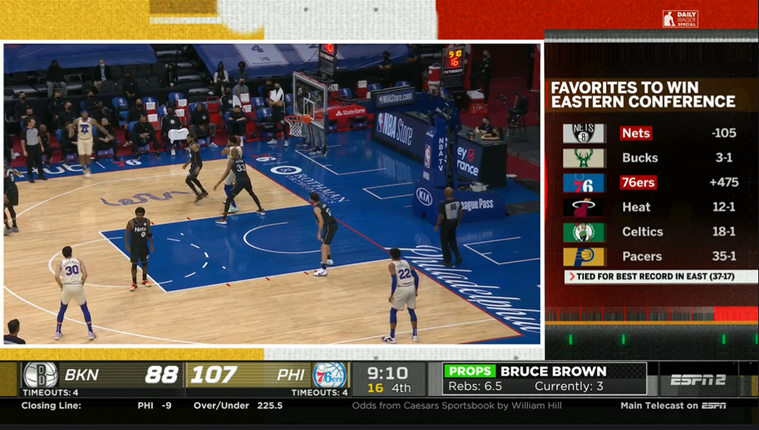
This has begun to radically change sports broadcasts. Whereas in years past commentators may have made sly comments about potential bets, gambling is now discussed openly; broadcasts may give live updates on the betting line and display the over/under on the scoreboard. Today, significant portions of sports broadcasts are dedicated to gambling. Just look at the broadcasts from ESPN, the largest exclusively sports broadcasting network. ESPN now even lends their name to a sportsbook. During the PGA Championship, the network offered an “ESPN BET” broadcast which discussed potential bets and saw analysts providing input on bets as the action progressed. Broadcasters may even suggest specific wagers; during broadcasts of the NHL’s Buffalo Sabres, the team I follow, on the MSG Network, panelists would propose a specific parlay of prop bets during the pre-game, note the payout of that parlay, then check in on its progress each intermission.

It is worth considering whether this promotion of gambling by broadcasters is something we should normalize or whether it ought to be limited. To be clear, this is different from assessing whether sports gambling itself should be restricted. I tend to think that our attitudes regarding permitting gambling ought to fall under the harm principle – the idea that unless one’s actions are directly harming others, then we generally ought to avoid interfering with others’ choices. Although gambling can have harmful consequences, it does not directly harm others. (Though some of the points I raise later may put pressure on this idea.)

So, what precisely do I mean by “promoting gambling”? I’ll use this phrasing as shorthand for, effectively, encouraging viewers to place bets. This may include namedropping specific sportsbooks during broadcasts, offering deals for first time gamblers to place bets, discussing potential bets and/or dedicating time for analysts to provide their input on specific bets. There may be other ways in which a broadcaster could promote sports betting, these are just a few that I have encountered regularly while watching sports. Note, too, that this is different from merely allowing an advertiser to purchase ad spots.

One obvious argument for the permissibility of promoting gambling stems from the kind of considerations I mentioned earlier – considerations about harmfulness. It is just not immediately obvious that promoting gambling harms anyone.

Further, broadcasters are private companies acting on the marketplace. They receive money from advertisers of other products to promote those goods. What makes a sportsbook any different? Additionally, given the popularity of sports betting, it’s very likely that viewers would be interested in these segments. Thus, market forces, both at the level of advertising and at consumer preferences, suggest that the promotion of gambling is nothing more than normal corporate profit seeking.

However, this argument fails to note the ways in which sportsbooks may be different from other products and services that broadcasters promote. Gambling is potentially addictive. A 2015 study from Welte et al. found that 4.6% of Americans demonstrate problematic gambling behavior at some point in their lives, with problematic behavior being defined as meeting three or more criteria in the DSM-IV’s description of gambling addiction. 1.4% experience pathological gambling, demonstrating five or more symptoms. While the rates seem low, if they are generalizable to the U.S. population of about 336 million, this means that about 15.5 million Americans will engage in problematic gambling behavior and 4.7 million will at some point demonstrate pathological gambling.

It also stands to reason that these figures could rise even higher in the current landscape. First, betting is easier than ever; you can just download an app and keep placing bets from your couch while watching games. Second, the promotion and discussion of gambling during broadcasts normalizes betting. As this becomes a more normal part of sports fandom, those with addictive tendencies who may otherwise not gamble may be drawn in and develop an addiction.

Yet one might argue that this should not prompt calls for regulation. Ultimately, people can become addicted to many things; shopping, video games, and alcohol for instance are potentially addictive but most people can enjoy these things responsibly. And responsible use can be fun! Admittedly, I was a lot more interested in last year’s Super Bowl after I had placed a parlay on a few prop bets. Thus, someone making this argument may see regulations on gambling as a form of perfectionism, an attempt by the state to encourage people to develop virtues and avoid behaviors that some label as vices. This is, after all, part of the reason why gambling was previously illegal in the United States. Yet it seems that a democratic state has, at best, a limited prerogative to promote virtue. So perhaps regulating gambling by limiting promotion of sports betting falls outside this prerogative.

It may be worth noting, though, that we limit the ways in which other sorts of behaviors can be discussed or promoted. For instance, since 2009 cigarette advertisements have been illegal in the U.S. Further, while alcohol consumption is a significant part of sports fandom culture, and alcohol manufacturers, particularly beer producers, frequently advertise during sports, sports broadcasts do not dedicate entire segments to discussing the best beer to consume during the game or offering promotions for first time drinkers. Limiting the ways in which sports betting may be promoted, in particular by sports broadcasters, may offer a middle ground between prohibition of gambling and the recent state of affairs.

Additionally, aside from the effects on bettors, one might worry about potential conflicts of interest. At the risk of sounding conspiratorial, the heavy promotion of sports betting may create perverse incentives for sports broadcasters. It is highly unlikely that this could trickle down to the level of competition – although it is worth noting that individual teams and leagues have created partnerships with sportsbooks. However, broadcasters may be able to shape bettor behaviors. Sportsbooks ensure profits, in part, by ensuring that roughly an equal number of bettors place wagers on opposite outcomes. To put it simply, they want the same number of people betting that the home team will win and that the visitors will prevail. Even if sportsbooks do not place pressure on the broadcasters with whom they advertise, these broadcasters have an incentive to make the partnership as lucrative as possible for the sportsbook. This could come in the form of encouraging bets that help balance the books, or perhaps even in the form of suggesting that incredibly unlikely bets will pay off. Once broadcasters begin taking money from sportsbooks, it gives them incentive to mislead or manipulate their views.

Of course, one may argue that the speculation above goes too far. It goes into the realm of conspiratorial thinking; surely if sportsbooks were working with broadcasters to help increase the profits, this secret would be difficult to keep. Regardless, just the appearance or potential for a conflict of interest may often be just as troubling as an actual conflict. Although sports broadcasters do not seem to have a robust moral obligation to be honest to viewers, they ought to carefully consider whether their choices may undermine the extent to which viewers think of them as trusted sources of information. The American public in general has little confidence in institutions, so perhaps we ought to be careful to give them more reason to distrust yet another institution.

The landscape of sports betting has rapidly changed in the United States. Previously treated as a kind of “open secret” that broadcasters only cheekily referenced, it’s now difficult to watch a game without seeing betting lines, an over-under or prop bets on a specific player’s performance. Given gambling’s addictive nature and this addiction’s potential to create great harms, it is worth taking a step back to consider the reasons for and against allowing this state of affairs to continue as is.

Why Care About Economic Inequality?

photograph of skyscrapers behind a favela

Imagine a society where everyone is economically flourishing. Beyond the basic goods required for subsistence, individuals have access to a host of luxury goods and services as well. Opportunities currently only afforded to the upper middle class or wealthy, such as world travel, home ownership, and access to cutting-edge medical care, are accessible to all within this imaginary society. Despite this, there remains radical economic inequality. The top one percent of society’s earners have exponentially more financial resources than the rest of the population. However, the only material difference that results from this inequality is the capacity to own a multitude of vacation homes instead of one, the ability to space travel instead of merely to travel around the globe, and the ability to pass down greater amounts of wealth to one’s descendants.

For the purposes of this article, the salient point is not whether such a society is an actual economic possibility, but whether the kind of economic inequality present in this society constitutes an injustice. What gives many reason to suspect something has gone morally awry in societies with massive economic disparity is the suffering of the lower classes, including the inability of many to meet basic needs. It’s at least plausible that a society where everyone can fulfill both their basic needs as well as many of their wants, can tolerate significant disparity between the economically worst off and the best off without threatening any injustice.

Thus, let’s grant for the sake of argument that economic inequality, even radical inequality, is not intrinsically unjust. This simply means that a disproportionate economic distribution amongst individuals can be just. Do we still have reason to care about large-scale inequality, even in cases where the overall economic distribution is just? This article outlines a few reasons why we might still have strong reason to avoid severe economic inequality.

One such reason concerns the psychological impacts of economic inequality. Studies have shown that as the disparity between the top 1% and the rest of the population grows, there is also an increase in negative emotional experiences across the population. Additionally, the average person’s self-reported life satisfaction tends to decline in response to growing inequality. There are, of course, immense complications when trying to draw causal inferences at this scale. For instance, one outstanding theoretical question is whether it’s actual economic inequality that generates negative psychological consequences, or rather the mere perception of inequality that does this. Despite these kinds of ambiguities in the data, there remains significant evidence suggesting severe economic inequality comes with certain psychological and emotional costs that are worth further evaluation.

Another non-justice-based reason to care about economic inequality is due to its linkage with social trust. One way of glossing the notion of social trust is to say it involves the propensity of individuals to assume basically good intentions in other people, groups, and societal institutions. Social trust is an invaluable resource for political communities, as it engenders a number of benefits, including the promotion of governmental efficiency and improvements to public health. The very notion of democratic liberalism is at least partially constructed on the possibility of social trust amongst very diverse groups of people.

There is some evidence pointing to economic inequality as a detriment to social trust. At least within the context of the United States, there is particularly strong evidence that economic inequality causes those with less education and/or those who fall within the bottom third of earners to experience less social trust. Others cast doubt on this conclusion, arguing for a merely correlative relationship between rising inequality and declining social trust. For instance, perhaps it’s not inequality itself causing the decline in social trust, but it’s the fact that stark economic inequality frequently coexists with higher levels of governmental/legal corruption. This corruption causes a drop in social trust, which we then misattribute to inequality — or so the thought goes. As with the discussion of the psychological ramifications of inequality, drawing definitive causal connections between these kinds of metrics is complex, but there is at least some compelling evidence that rampant economic inequality and social trust are at odds.

Another reason one might object to extreme levels of economic inequality is due to its potential impacts on the very long-term future. This line of objection is a bit more philosophically dense than the previous two we’ve examined, but the basic thought goes something like this: The negative impacts of economic inequality might compound with time, resulting in an increase in certain existential risks. Such risks are those severe enough to threaten the continuation of humanity, including environmental disasters, global warfare, and the misapplication of AI.

To paint a clearer picture of how inequality might increase certain existential risks, we can consider a concrete example. There is some evidence suggesting that increases in inequality cause decreases in the quality of public institutions (e.g., institutions of higher education, governmental agencies, etc.). Such institutions are plausibly highly important in preventing certain existential risks, and thus we have strong reason to care about their quality. This gives us an indirect reason to prevent radical economic inequality. If the trend towards increasing inequality continues in particular societies, it is reasonable to think the damage done to institutions will only continue to aggregate, putting us at greater existential risk.

Whether or not radical economic inequality is intrinsically unjust, it seems we have significant reasons to care about it. Importantly, there may still be countervailing reasons to tolerate stark economic disparity (considerations of economic freedom, overall economic growth, national productivity, etc.). Thus, it is imperative that policy makers weigh the full array of pros and cons when it comes to permitting widespread economic inequality.

Capitalist Humanitarianism with Lucia Hulsether

Ethnographer and historian of religion Lucia Hulsether is on the show today to talk about the strange phenomenon she calls “capitalist humanitarianism.” She studies the ways that corporations attempt to distance themselves from the harms of capitalism by doing things like by selling environmentally-friendly goods or promoting socially-responsible investing.

For the episode transcript, download a copy or read it below.

Contact us at examiningethics@gmail.com

Links to people and ideas mentioned in the show

  1. Lucia HulsetherCapitalist Humanitarianism

Credits

Thanks to Evelyn Brosius for our logo. Music featured in the show:

Single Still” by Blue Dot Sessions

Capering” by Blue Dot Sessions

Can We Justify Non-Compete Clauses?

photograph of a maze of empty office cubicles

In the State of the Union, President Joe Biden claimed that 30 million workers have non-compete clauses. This followed a proposal by the Federal Trade Commission to ban these clauses. Non-compete clauses normally contain two portions. First, they prohibit employees from using any proprietary information or skills during or after their employment. Second, they forbid employees from competing with their employer for some period of time after their employment. “Competing” normally consists of working for a rival company or starting one’s own business in the same industry.

Non-compete agreements are more common than one might expect. In 2019, the Economic Policy Institute found that about half of employers surveyed use non-compete agreements, and 31.8% of employers require these agreements for all employees.

While we often think of non-compete agreements as primarily being found in cutting-edge industries, they also reach into less innovative industries. For instance, one in six workers in the food industry have a non-compete clause. Even fast-food restaurants have used non-compete clauses.

Proponents of non-compete clauses argue that they are important to protect the interests of employers. The Bureau of Labor Statistics estimates that, in 2021, the average turnover rate (the rate at which employees leave their positions) in private industry was 52.4%. Although one might think the pandemic significantly inflated these numbers, rates from 2017-2019 were slightly below 50%. Businesses spend a significant amount of money training new employees, so turnover hurts the company’s bottom line  – U.S. companies spent over $100 billion on training employees in 2022. Additionally, the transfer of skilled and knowledgeable employees to competitors, especially when those skills and knowledge were gained at their current position, makes it more difficult for the original employer to compete against rivals.

However, opponents argue that non-compete clauses depress the wages of employees. Being prohibited from seeking new employment leaves employees unable to find better paying positions, even if just for the purposes of bargaining with their current employer. The FTC estimates that prohibiting non-compete clauses would cause yearly wage increases in the U.S. between $250 and $296 billion. Further, for agreements that extend beyond their employment, departing employees may need to take “career detours,” seeking jobs in a different field. This undoubtedly affects their earnings and makes finding future employment more difficult.

It is worth noting that these arguments are strictly economic. They view the case for and against non-compete clauses exclusively in terms of financial costs and benefits. This is certainly a fine basis for policy decisions. However, sometimes moral considerations prevail over economic ones.

For instance, even if someone provided robust data demonstrating that child labor would be significantly economically beneficial, we would find this non-compelling in light of the obvious moral wrongness. Thus, it is worthwhile to consider whether there’s a case to be made that we have moral reason to either permit or prohibit non-compete agreements regardless of what the economic data show us.

My analysis will focus on the portion of non-compete clauses that forbids current employees from seeking work with a competitor. Few, I take it, would object to the idea that companies should have the prerogative to protect their trade secrets. There may be means to enforce this without restricting employee movement or job seeking, such as through litigation. Thus, whenever I refer to non-compete agreements or clauses, I mean those which restrict employees from seeking work from, or founding, a competing firm both during, and for some period after, their employment.

There’s an obvious argument for why non-compete clauses ought to be permitted – before an employee joins a company, they and their employer reach an agreement about the terms of employment which many include these clauses. Don’t like the clause? Then renegotiate the contract before signing or simply find another job.

Employers impose all sorts of restrictions on us, from uniforms to hours of operation. If we find those conditions unacceptable, we simply turn the job down. Why should non-compete agreements be any different? They are merely the product of an agreement between consenting parties.

However, agreements are normally unobjectionable only when the parties enter them as equals. When there’s a difference in power between parties, one may accept terms that would be unacceptable between equals. As Evan Arnet argues in his discussion of a prospective right to strike, a background of robust workers’ rights is necessary to assure equal bargaining power and these rights are currently not always secure. For most job openings, there are a plethora of other candidates available. Aside from high-level executives, few have enough bargaining power with their prospective employer to demand that a non-compete clause be removed from their contract. Indeed, even asking for this could cause a prospective employer to move on to the next candidate. So, we ought to be skeptical of the claim that workers freely agree to non-compete clauses – there are multiple reasons to question whether workers have the bargaining power necessary for this agreement to be between equals.

One might instead appeal to the long-run consequences of not allowing non-compete agreements. The argument could be made as follows. By hiring and training employees, businesses invest in them and profit from their continued employment. So perhaps the idea is that, after investing in their employees, a firm deserves to profit from their investment and thus the employee should not be permitted to seek exit while still employed. Non-compete clauses are, in effect, a way for companies to protect their investments.

Unfortunately, there are multiple problems with this line of reasoning. The first is that it would only apply to non-compete agreements in cases where employees require significant training. Some employees may produce profit for the company after little to no training. Second, this seems to only justify non-compete clauses up to the point when the employee has become profitable to the employer – not both during and after employment. Third, some investments may simply be bad investments. Investing is ultimately a form of risk taking which does not always pay off. To hedge their bets, firms can instead identify candidates most likely to stay with the company, and make continued employment desirable.

Ultimately, these argument regarding what a company “deserves” lays bare the fundamental moral problem with non-compete agreements: they violate the autonomy of employees.

Autonomy, as a moral concept, is about one’s ability to make decisions for oneself – to take an active role in shaping one’s life. To say that an employee owes it to her employer to keep working there is to say that she does not deserve autonomy about what does with a third of her waking life. It says that she no longer has the right to make unencumbered decisions about what industry she will work in, and who she will work for.

And this is, ultimately, where we see the moral problem for non-compete clauses. Even if they do not suppress wages, non-compete agreements restrict the autonomy of employees. Unless someone has a large nest egg saved up, they may not be able to afford to quit their job and enter a period of unemployment while they wait for a non-compete clause to expire. Especially since voluntarily quitting may disqualify you from unemployment benefits. By raising the cost of exit, non-compete clauses may eliminate quitting as a viable option. As I have discussed elsewhere, employers gain control over our lives while we work for them – non-compete agreements aim to extend this control beyond the period of our employment, further limiting our ability to choose.

As a result, even if there were not significant potential financial benefits to eliminating non-compete agreements, there seems to be a powerful moral reason to do so. Otherwise, employers may restrict the ability of employees to make significant decisions about their own lives.

Queuing for the Queen and the Moral Limits of Markets

photograph of queue in front of Buckingham Palace

In the days before her funeral last week, more than 250,000 former subjects joined the 10-mile queue (line) to see Queen Elizabeth II lying-in-state in Westminster Hall. Some queued for 24 hours. Many slept on the street. More than 400 fainted. All this led The Economist to ask, “is queuing the best way to do things?” The problem, the magazine claims, is how to allocate scarce resources (limited slots to walk by the coffin). “An ideal system,” they write, “would give spots to those who value them the most.”

The free-for-all queue falls short by this metric. Why? It “effectively rations out the spots to those who turn up first—and who are willing to wait.” In other words, it allocates the scarce resource to those with more time, rather than those who value it the most. A devoted royalist with an inflexible job to go to is less likely to see the Queen than a tourist who feels like taking part in the experience. It also led to a lot of wasted time that could be better used. This is, in economic terms, an inefficient system.

So what other options are there, besides the mega-queue? The Economist article suggests a couple, including “some kind of market, with prices for each time slot set high enough to balance supply and demand.” They note that there is some precedence: “To visit Buckingham Palace,” for example, “one must buy a ticket.” Now, this system would also, admittedly, have disadvantages. It obviously benefits those with more ability to pay. And those who can pay most aren’t necessarily the same people who would value the experience most. In any case, the reporter’s suggestion of market allocation of tickets went down pretty poorly in the queue. Of course, there may be a selection effect at play. You wouldn’t expect to find people who dislike the queue system in a 10-mile queue.

But I think there are some reasons besides economic inefficiency to think that a market-based allocation would be a bad idea. “Suppose, on your wedding day,” writes the philosopher Michael Sandel, “your best man delivers a heartwarming toast, a speech so moving it brings tears to your eyes. You later learn that he bought it online. Would you care? Would the toast mean less than it did at first, before you knew it was written by a paid professional? For most of us, it probably would.” For some goods, their being bought or sold seems to affect their value to us.

Or take gifts. Economists have long railed against the economic inefficiency of gift-giving. In Scroogenomics: Why You Shouldn’t Buy Presents for the Holidays, economist Joel Waldfogel writes:

The bottom line is that when other people do our shopping, for clothes or music or whatever, it’s pretty unlikely that they’ll choose as well as we would have chosen for ourselves… Relative to how much satisfaction their expenditures could have given us, their choices destroy value.

Waldfogel acknowledges that cash is generally seen as a bad gift. But why is it? Are we simply being irrational, or is the narrow economic lens of analysis missing something important about gift-giving? Sandel suspects the latter. “Gifts aren’t only about utility,” he writes. “Some gifts are expressive of relationships that engage, challenge, and reinterpret our identities.” In other words, going out and choosing a gift that you think will be meaningful to the recipient says something about how you understand them. It can also say something about your relationship.

A scene from Seinfeld illustrates Sandel’s point. Jerry, not knowing where his relationship stands with Elaine now that they are sleeping together but not in a relationship, is struggling to choose a birthday present that sends the appropriate message. A music box is “too relationshippy,” candleholders “too romantic,” lingerie “too sexual,” waffle-maker “too domestic.” Jerry’s ultimate choice is revealed as Elaine opens her present.

Elaine: Cash?!

Jerry: What do you think?

Elaine: You got me cash?!

Jerry: Well this way I figured you could go out and get yourself whatever you want. No good?

Elaine: What are you, my uncle?

Elaine’s complaint is that the gift fails to reflect what is meaningful in their relationship. It may be economically efficient, as Jerry protests, but it is impersonal — something a distant relative would give. Despite the efficiency of cash as a gift, it has less value to her.

There is a similar case to be made for the rituals surrounding death, and, in the case of the British monarchy, political rituals. We may not always want the most efficient, market-based solution. Introducing market norms to some areas of life seems to devalue the very things we find precious and meaningful. So what, to put it in Sandel’s terms, does the inefficient queue “express?” How does it “engage” or “reinterpret” our identities?

In a deeply wealth-divided society (and perhaps somewhat ironically for a monarchical event) a queue, open to all and free for all, embodies a sense of moral equality. Theoretically, everybody has twenty-four hours in a day, even if practically, the demands on that time vary greatly from person to person. The queue does a better job of expressing this equality, the sense that we’re all in this together, than a system of paid time slots, even if it does benefit the time-rich.

Part of what many found moving about the queue was the degree of personal sacrifice it involved, of both time and comfort. Of course, a market-based system would also involve sacrifice — the money for the tickets. But spending money communicates less personal investment than spending one’s time, or enduring discomfort. Perhaps this communicates something: respect for the Queen, for the dead, or simply the historical significance of the moment.

Finally, we also can’t ignore that there is something very British about this way of mourning a monarch. Stephen Reicher, a social psychologist, writes in The Guardian that:

Time and again, queues, and this one in particular, have been described as quintessentially and uniquely British: polite, restrained and orderly, reflecting the timeless characteristics of our national identity. 

For a nation just stripped of its most powerful symbol of continuity, the longest-reigning monarch in British history, perhaps the familiar inefficiency of a long queue is precisely what we needed.

Should Work Pay?

Color photograph of Haines Hall at UCLA, a large red brick building with lots of Romanesque arches

“The Department of Chemistry and Biochemistry at UCLA seeks applications for an assistant adjunct professor,” begins a recent job listing, “on a without salary basis. Applicants must understand there will be no compensation for this position.”

The listing has provoked significant backlash. Many academics have condemned the job as exploitative. They have also noted the hypocrisy of UCLA’s stated support of “equality” while expecting a highly qualified candidate with a Ph.D. to work for free. For context, UCLA pays a salary of $4 million to its head men’s basketball coach, Mick Cronin.

UCLA has now responded to the growing criticism, pointing out:

These positions are considered when an individual can realize other benefits from the appointment that advance their scholarship, such as the ability to apply for or maintain grants, mentor students and participate in research that can benefit society. These arrangements are common in academia.

It is certainly true that such arrangements are fairly common in academia. But are they ethical?

The university’s ethical argument is that the unpaid worker receives significant compensation other than pay. For example, having worked at a prestigious university might advance one’s career in the longer term – adding to their “career capital.” The implication is that these benefits are significant enough that the unpaid job is not exploitative.

Similar arguments are given by organizations that offer unpaid internships. The training, mentoring, and contacts an intern receives can be extremely valuable to those starting a new career. Some unpaid internships for prestigious companies or international organizations are generally regarded to be so valuable for one’s career that they are extremely competitive, sometimes receiving hundreds of applications for each position.

Employers point out that without unpaid internships, there would be fewer internships overall. Companies and organizations simply do not have the money to pay for all these positions. They argue that the right comparison is not between unpaid and paid internships, but between unpaid internships and nothing. This might explain why so many well-known “progressive” organizations offer unpaid positions despite publicly disavowing the practice. For example, the U.N. has famously competitive unpaid internships, as does the U.K.’s Labour Party, a left-wing political party whose political manifesto promises to ban unpaid internships, and whose senior members have compared the practice to “modern slavery.” Not long ago, the hashtag #PayUpChuka trended when Chuka Umunna, a Labour Member of Parliament, was found to have hired unpaid interns for year-long periods.

Besides the sheer usefulness of these jobs, there is also a libertarian ethical case for unpaid positions. If the workers are applying for these jobs, they are doing so because they are choosing to. They must think the benefits they receive are worth it. How could it be ethical to ban or prevent workers from taking jobs they want to take? “It shouldn’t even need saying,” writes Madeline Grant, “but no one is forced to do an unpaid internship. If you don’t like them, don’t take one—get a paid job, pull pints, study, go freelance—just don’t allow your personal preferences to interfere with the freedoms of others.”

On the other side of the debate, the opponents of unpaid jobs argue that the practice is inherently exploitative. The first Roman fire brigade was created by Marcus Licinius Crassus:

Crassus created his own brigade of 500 firefighters who rushed to burning buildings at the first cry for help. Upon arriving at the fire, the firefighters did nothing while their Crassus bargained over the price of their services with the property owner. If Crassus could not negotiate a satisfactory price, the firefighters simply let the structure burn to the ground.

Any sensible homeowner would accept almost any offer from Crassus, so long as it was less than the value of the property. The homeowner would choose to pay those prices for Crassus’ services. But that doesn’t make it ethical. It was an exploitative practice – the context of the choice matters. Likewise, employers may find workers willing to work without compensation. But that willingness to work without compensation could be a sign of the worker’s desperation, rather than his capacity for autonomous choice. If you need to have a prestigious university like UCLA on your C.V. to have an academic career, and if you can’t get a paid position, then you are forced to take an unpaid adjunct professorship.

Critics of unpaid jobs also point out that such practices deepen economic and social inequality. “While internships are highly valued in the job market,” notes Rakshitha Arni Ravishankar, “research also shows that 43% of internships at for-profit companies are unpaid. As a result, only young people from the most privileged backgrounds end up being eligible for such roles. For those from marginalized communities, this deepens the generational wealth gap and actively obstructs their path to equal opportunity.” Not everyone can afford to work without pay. If these unpaid positions are advantageous, as their defenders claim, then those advantages will tend to go toward those who are already well-off, worsening inequality.

There are also forms of unpaid work which are almost universally seen as ethical: volunteering, for instance. Very few object to someone with some spare time and the willingness to help a charity, contribute to Wikipedia, or clean up a local park. The reason for this is that volunteering generally lacks many of the ethical complications associated with other unpaid jobs and internships. There are exceptions; some volunteer for a line on their C.V. But volunteering tends to be done for altruistic reasons rather than for goods like career capital and social connections. This means that there is less risk of exploitation of the volunteers. Since volunteers do not have to worry about getting a good reference at the end of their volunteering experience, they are also freer to quit if work conditions are unacceptable to them.

On the ethical scale, somewhere between unpaid internships and volunteering are “hidden” forms of unpaid work that tend to be overlooked by economists, politicians, and society more generally. Most cooking, cleaning, shopping, washing, childcare, and caring for the sick and disabled represents unpaid labor.

Few consider these forms of unpaid work as directly unethical to perform or request family members to help carry out. But it is troubling that those who spend their time doing unpaid care work for the sick and disabled are put at a financial disadvantage compared to their peers who choose to take paid forms of work instead. An obvious solution is a “carer’s allowance,” a government payment, paid for by general taxation, to those who spend time each week taking care of others. A very meager version of this allowance (roughly $100/week) already exists in the U.K.

These “hidden” forms of unpaid work also have worrying implications for gender equality, as they are disproportionately performed by women. Despite having near-equal representation in the workforce in many Western countries, women perform the majority of unpaid labor, a phenomenon referred to as the “double burden.” For example, an average English female 15-year-old is expected, throughout her life, to spend more than two years longer performing unpaid caring work compared to the average male 15-year-old. This statistic is no exception. The Human Development Report, studying 63 countries, found that 31% of women’s time is spent doing unpaid work, as compared to 10% for men. A U.N. report finds that, in developed countries, women spend 3:30 hours a day on unpaid work and 4:39 hours on paid work. In comparison, men spend only 1:54 hours on unpaid work, and 5:42 on paid work. Finding a way to make currently unpaid work pay, such as a carer’s allowance, could also be part of the solution to this inequality problem.

Is unpaid work ethical? Yes, no, and maybe. Unpaid work covers a wide bandwidth on the ethical spectrum. At one extreme, there are clear cases of unpaid work which are morally unproblematic, such as altruistically volunteering for a charity or cooking yourself a meal. And, at the other extreme, there are cases where unpaid work is clearly unethical exploitation: cases of work that ought to be paid but where employers take advantage of their workers’ weak bargaining positions to deny them the financial compensation to which they are morally entitled. And many cases of unpaid work fall somewhere between these two extremes of the moral spectrum. In thinking about these cases, we have no alternative but to look in close detail at the specifics: at the power dynamics between the employers and the employees, the range and acceptability of the options that were available to workers, and the implications for equality.

When Should You Boycott?

close-up image of Benjamin Franklin on a hundred dollar bill

Public calls to boycott companies are increasingly common. Recently, musicians and podcasters have pulled their content from Spotify, and a member of Congress urged people to cancel subscriptions, due to the company’s relationship with Joe Rogan. Republican figures in the U.S. have called for boycotts of “woke” corporations. There is a rich history of calls to boycott Starbucks, from reasons ranging to the design of holiday cups to their recent removal of employee vaccine requirements. The examples go on, but I’ll stop for the sake of brevity.

Given the frequency and intensity of calls to boycott, slowing down and analyzing this practice may be useful. My goal here is to briefly reflect on the nature and purpose of boycotts to determine criteria for when one ought to join a boycott.

My analysis here will be somewhat limited. First, I won’t directly consider international boycotts – the refusal to purchase goods that are produced in some foreign nation due to policies of that nation. Second, this analysis will only look at consumer boycotts rather than practices like diplomatic boycotts. However, what I present below may nonetheless have bearing for non-consumer boycotts.

We should start by considering the purpose of a boycott. Each boycott should have specific goals and aims. There must be a motivation that differentiates a boycott from matters of mere convenience, say, shopping at store A rather than store B because store A is around the corner while store B is on the other side of town.

One might think that a boycott serves as punishment. Namely, a punishment that consumers inflict on companies for engaging in wrongdoing. Corporations aim to make profits. So, refusing to consume their wares is a way to make them worse-off. In contrast, it hardly seems like I am trying to punish other grocers when I shop at the store closest to me.

Although some might view boycotts as a form of punishment, this does not capture the whole picture. This is apparent when we consider the idea of expected consequences. Suppose that my friends and I decide to stop buying clothes from a manufacturer who we believe uses exploitative sweatshop labor. This is a classic example of boycotting.

What consequences can we expect to follow from this choice? Well, practically none. If this clothing company is of any significant size, the choices of a few consumers will have little, if any, impact on their profits. The choices of a small collective are just proverbial drops in the bucket compared to their billions of dollars in sales each year. If a boycott is supposed to be a form of punishment, then perhaps my friends and I should abandon this boycott; we can’t hope to put a dent into their profits.

So, we’d be better served by abandoning the conception of boycotts as punishments. Instead, we might see them as a form of expression. The U.S. Supreme Court has ruled that spending money is a speech act. So, consumers who choose to engage in a boycott might be seen as performing a speech act in the marketplace. Vote with your dollar. Namely, their economic behavior and choices are meant to express opposition to some action, behavior, or policy of a corporation.

Viewing boycotts as a matter of expression can change our understanding of the circumstances under which we should join a boycott. Specifically, I think that we ought to join a boycott if it a) aims to express the right kind of message and b) if it has a reasonable chance of succeeding at this. A note of clarification about the later criteria is necessary, though. By “succeed” I do not mean that a boycott must bring about change. Rather, this requirement is less rigorous. When we view boycotts as being about expression, a boycott is successful simply if it sends the message. These criteria taken together give rise to at least three conditions that a boycott should meet before we ought to join it.

First, the boycott should be organized. The marketplace can be chaotic. A variety of reasons determine consumer choices. Businesses are left with raw sales figures and must determine the reasons behind any changes. Suppose many joined in on our clothing boycott. Unless our messaging is organized, the corporation may never attribute the sales decline to consumer outrage and thus our message will not be received. So, our boycott should be organized in some form, whether this is through petitions, messaging on social media, etc.

Second, the boycott must have a clear goal. For a behavior to be wrong, there must be something else that one could perform. This is one implication of a principle that philosophers call “ought implies can.” If I told you that breathing was wrong due to the chance that you might inhale and kill a small insect, you’d be right to respond incredulously – you cannot stop breathing, so breathing cannot be wrong. By having a clear goal (which it sends through its organized messaging) a boycott makes the case that the behavior of the corporation is wrong by showing the morally superior alternative.

The organization and goal requirements have an additional benefit – they may allow us to avoid frivolous boycotts. For instance, some have boycotted vodka over Russia’s invasion of Ukraine, despite the fact that almost no vodka consumed in the U.S. is a Russian product. A more organized boycott would target specific, actually Russian-produced brands. Further a boycott with clear goals would not merely expressing outrage at a product due to its association with a particular culture – it would aim to send a message to an authoritarian regime, not condemn the people suffering under it.

Third, boycotts should send the message that a behavior is morally unacceptable, rather than merely disagreeable. This stands in contrast to actions that one merely finds displeasing or does not agree with. Unlike the previous two criteria, this is not a practical consideration. Rather, the concern involves the message we send when we join boycotts motivated solely by disagreement.

Imagine the owner of a local pizza shop made a series of posts on a personal social media account supporting a particular candidate for office. Screenshots of these posts then circulate, maybe on a sub-Reddit. Members of the community who support a different candidate begin questioning whether they should continue to order pizza from here. They should ask themselves: What message might a boycott send?

Well, the boycotters might be seen as expressing the sentiment that they refuse to support others whose political beliefs run counter to their own. This is not an incoherent position to take. However, it is antithetical to the attitudes that enable the functioning of a democratic society. To live somewhere with a free, deliberative, and collective decision-making process requires accepting that others will not always share your outlook. So, we should not engage in boycotts simply due to political disagreements. Instead, the positions and behaviors worthy of boycott should be those that cross the line from merely contentious into morally unacceptable.

Of course, the line between the political and the moral is blurry. Indeed, political ideology may determine moral beliefs. This leads to moralism in politics; the attitude that one’s political views are universal moral truths which cannot be compromised. Thus, for many, a Venn diagram of the politically disagreeable and the morally unacceptable may just be a circle.

And this could be why calls to boycott have become more common in recent years. As political disagreements become increasingly more morally charged, they are less about the merits of particular policies and more about how we should live our lives. In a capitalist society, our behavior on the marketplace is part of how we live our lives. Thus, it makes sense that our decisions about what we buy and where are increasingly shaped by our political preferences.

Thinking about Trust with C. Thi Nguyen

Many of us rely heavily on our smartphones and computers. But does it make sense to say we “trust” them? On today’s episode of Examining Ethics, the philosopher C. Thi Nguyen explores the relationship of trust we form with the technology we use. We not only can trust non-human objects like smartphones, we tend to trust those objects in an unquestioning way; we’re not thinking about it all that much. While this unquestioning trust makes our everyday lives easier, we don’t recognize just how vulnerable we’re making ourselves to large and increasingly powerful corporations.

For the episode transcript, download a copy or read it below.

Contact us at examiningethics@gmail.com

Credits

Thanks to Evelyn Brosius for our logo. Music featured in the show:

The Big Ten by Blue Dot Sessions

Lemon and Melon by Blue Dot Sessions

Ethics and Job Apps: Why Use Lotteries?

photograph of lottery balls coming out of machine

This semester I’ve been 1) applying for jobs, and 2) running a job search to select a team of undergraduate researchers. This has resulted in a curious experience. As an employer, I’ve been tempted to use various techniques in running my job search that, as an applicant, I’ve found myself lamenting. Similarly, as an applicant, I’ve made changes to my application materials designed to frustrate those very purposes I have as an employer.

The source of the experience is that the incentives of search committees and the incentives job applicants don’t align. As an employer, my goal is to select the best candidate for the job. While as an applicant, my goal is that I get a job, whether I’m the best candidate or not.

As an employer, I want to minimize the amount of work it takes for me to find a dedicated employee. Thus, as an employer, I’m inclined to add ‘hoops’ to the application process, by requiring applicants to jump through those hoops, I make sure I only look through applications of those who are really interested in the job. But as an applicant, my goal is to minimize the amount of time I spend on each application. Thus, I am frustrated with job applications that require me to develop customized materials.

In this post, I want to do three things. First, I want to describe one central problem I see with application systems — what I will refer to as the ‘treadmill problem.’ Second, I want to propose a solution to this problem — namely the use of lotteries to select candidates. Third, I want to address an objection employers might have to lotteries — namely that it lowers the average quality of an employer’s hires.

Part I—The Treadmill Problem

As a job applicant, I care about the quality of my application materials. But I don’t care about the quality intrinsically. Rather, I care about the quality in relation to the quality of other applications. Application quality is a good, but it is a positional good. What matters is how strong my applications are in comparison to everyone else.

Take as an analogy the value of height while watching a sports game. If I want to see what is going on, it’s not important just to be tall, rather it’s important to be taller than others. If everyone is sitting down, I can see better if I stand up. But if everyone stands up, I can’t see any better than when I started. Now I’ll need to stand on my tiptoes. And if everyone else does the same, then I’m again right back where I started.

Except, I’m not quite back where I started. Originally everyone was sitting comfortably. Now everyone is craning uncomfortably on their tiptoes, but no one can see any better than when we began.

Job applications work in a similar way. Employers, ideally, hire whosoever application is best. Suppose every applicant just spends a single hour pulling together application materials. The result is that no application is very good, but some are better than others. In general, the better candidates will have somewhat better applications, but the correlation will be imperfect (since the skills of being good at philosophy only imperfectly correlate with the skills of being good at writing application materials).

Now, as an applicant, I realize that I could put in a few hours polishing my application materials — nudging out ahead of other candidates. Thus, I have a reason to spend time polishing.

But everyone else realizes the same thing. So, everyone spends a few hours polishing their materials. And so now the result is that every application is a bit better, but still with some clearly better than others. Once again, in general, the better candidates will have somewhat better applications, but the correlation will remain imperfect.

Of course, everyone spending a few extra hours on applications is not so bad. Except that the same incentive structure iterates. Everyone has reason to spend ten hours polishing, now fifteen hours polishing. Everyone has reason to ask friends to look over their materials, now everyone has reason to hire a job application consultant. Every applicant is stuck in an arms race with every other, but this arms race does not create any new jobs. So, in the end, no one is better off than if everyone could have just agreed to an armistice at the beginning.

Job applicants are left on a treadmill, everyone must keep running faster and faster just to stay in place. If you ever stop running, you will slide off the back of the machine. So, you must keep running faster and faster, but like the Red Queen in Lewis Carrol’s Through the Looking Glass, you never actually get anywhere.

Of course, not all arms races are bad. A similar arms race exists for academic journal publications. Some top journals have a limited number of article slots. If one article gets published, another article does not. Thus, every author is in an arms race with every other. Each person is trying to make sure their work is better than everyone else’s.

But in the case of research, there is a positive benefit to the arms race. The quality of philosophical research goes up. That is because while the quality of my research is a positional good as far as my ability to get published, it is a non-positional good in its contribution to philosophy. If every philosophy article is better, then the philosophical community is, as a whole, better off. But the same is not true of job application materials. No large positive externality is created by everyone competing to polish their cover letters.

There may be some positive externalities to the arms race. Graduate students might do better research in order to get better publications. Graduate students might volunteer more of their time in professional service in order to bolster their CV.

But even if parts of the arms race have positive externalities, many other parts do not. And there is a high opportunity cost to the time wasted in the arms race. This is a cost paid by applicants, who have less time with friends and family. And a cost paid by the profession, as people spend less time teaching, writing, and helping the community in ways that don’t contribute to one’s CV.

This problem is not unique to philosophy. Similar problems have been identified in other sorts of applications. One example is grant writing in the sciences. Right now, top scientists must spend a huge amount of their time optimizing grant proposals. One study found that researchers collectively spent a total of 550 working years on grant proposals for Australia’s National Health and Medical Research Council’s 2012 funding round.

This might have a small benefit in leading research to come up with better projects. But most of the time spent in the arms race is expended just so everyone can stay in place. Indeed, there are some reasons to think the arms race actually leads people to develop worse projects, because scientists optimize for grant approval and not scientific output.

Another example is college admissions. Right now, high school students spend huge amounts of time and money preparing for standardized tests like the SAT. But everyone ends up putting in the time just to stay in place. (Except, of course, for those who lack the resources required to put in the time; they just get left behind entirely.)

Part II—The Lottery Solution

Because I was on this treadmill as a job applicant, I didn’t want to force other people onto a treadmill of their own. So, when running my own job search, I decided to modify a solution to the treadmill problem that has been suggested for both grant funding and college admissions. I ran a lottery. I had each applying student complete a short assignment, and then ‘graded’ the assignments on a pass/fail system. I then choose my assistants at random from all those who had demonstrated they would be a good fit. I judged who was a good fit. I didn’t try to judge, of those who were good fits, who fit best.

This allowed students to step off the treadmill. Students didn’t need to write the ‘best’ application. They just needed an application that showed they would be a good fit for the project.

It seems to me that it would be best if philosophy departments similarly made hiring decisions based on a lottery. Hiring committees would go through and assess which candidates they think are a good fit. Then, they would use a lottery system to decide who is selected for the job.

The details would need to be worked out carefully and identifying the best system would probably require a fair amount of experimentation. For example, it is not clear to me the best way to incorporate interviews into the lottery process.

One possibility would be to interview everyone you think is likely a good fit. This, I expect, would prove logistically overwhelming. A second possibility, and I think the one I favor, would be to use a lottery to select the shortlist of candidates, rather than to select the final candidate. The search committee would go through the application and identify everyone who looks like a good fit. They would then use a lottery to narrow down to a shortlist of three to five candidates who come out for an interview. While the shortlisted candidates would be placed on the treadmill, a far smaller number of people are subject to the wasted effort. A third possibility would use the lottery to select a single final candidate, and then use an in-person interview merely to confirm the selected candidate really is a good fit. There is a lot of evidence that hiring committees systematically overweight the evidential weight of interviews, and that this creates tons of statistical noise in hiring decisions (see chapters 11 and 24 in Daniel Kahneman’s book Noise).

Assuming the obstacles could be overcome, however, lotteries would have an important benefit in going some way towards breaking the treadmill.

There are a range of other benefits as well.

  • Lotteries would decrease the influence of bias on hiring decisions. Implicit bias tends to make a difference in close decisions. Thus, bias is more likely to flip a first and second choice, than it is to flip someone from making it onto the shortlist in the first place.
  • Lotteries would decrease the influence of networking, and so go some way towards democratizing hiring. At most, an in-network connection will get someone into the lottery but it won’t increase you chance of winning the lottery.
  • It would create a more transparent way to integrate hiring preferences. A department might prefer to hire someone who can teach bioethics, or might prefer to hire a female philosopher, but not want to restrict the search to people who meet such criteria. One way to integrate such preferences more rigorously would be to explicitly weight candidates in the lottery by such criteria.
  • Lotteries could decrease interdepartmental hiring drama. It is often difficult to get everyone to agree on a best candidate. It is generally not too difficult to get everyone to agree on a set of candidates all who are considered a good fit.

Part III—The Accuracy Drawback

While there are advantages accrue to applicants and the philosophical community, employers might not like a lottery system. The problem for employers is that a lottery will decrease the average quality of hires.

A lottery system means you should expect to hire the average candidate who meets the ‘good fit’ criteria. Thus, as long as trying to pick the best candidate results in a candidate at least above average, then the average quality of the hire goes down with a lottery.

However, while there is something to this point, the point is weaker than most people think. That is because humans tend to systematically overestimate the reliability of judgment. When you look at the empirical literature a pattern emerges. Human judgment has a fair degree of reliability, but most of that reliability comes from identifying the ‘bad fits.’

Consider science grants. Multiple studies have compared the scores that grant proposals receive to the eventual impact of research (as measured by future citations). What is found is that scores do correlate with research impact, but almost all of that effect is explained by the worst performing grants getting low scores. If you restrict your assessment to the good proposals, researchers are terrible at judging which of the good proposals are actually best. Similarly, while there is general agreement about which proposals are good and which bad, evaluators rarely agree about which proposals are best.

A similar sort of pattern emerges for college admission counselors. Admissions officers can predict who is likely to do poorly in school, but can’t reliably predict which of the good students will do best.

Humans are fairly good at judging which candidates would make a good fit. We are bad at judging which good fit candidates would actually be best. Thus, most of the benefit of human judgment comes at the level of identifying the set of candidates who would make a good fit, not at the level of deciding between those candidates. This, in turn, suggests that the cost to employers of instituting a lottery system is much smaller than we generally appreciate.

Of course, I doubt I’ll convince people to immediately use lotteries on major important decisions. Thus, for now I’ll suggest that for smaller less consequential decisions, try a lottery system. If you are a graduate department, select half your graduating class the traditional way, and half by a lottery of those who seem like a good fit. Don’t tell faculty which are which, and I expect several years later it will be clear that the lottery system works just as well. Or, like me, if you are hiring some undergraduate researchers, try the lottery system. Make small experiments and let’s see if we can’t buck the current status quo.

“Cruel Optimism,” Minimum Wage, and the Good Life

photograph looking up at Statue of Liberty

In early May, executives from the fast casual restaurant Chipotle Mexican Grill announced that the company would be raising its average hourly wage to $15 by the end of June. A few weeks later, Chipotle also announced that its menu prices would be increasing by about four percent to help offset those higher wages (as well as the increasing costs of ingredients). This means that instead of paying, say, $8.00 for a burrito, hungry customers will now instead be expected to pay $8.32 for the same amount of food.

While you might think that such a negligible increase would hardly be worth arguing about, opponents of a minimum wage hike jumped on this story as an example of the supposed economic threat posed by changing federal labor policies. During recent debates in Congress, for example, those resistant to the American Rescue Plan’s original provision to raise the federal minimum wage frequently argued that doing so could disadvantage consumers by causing prices to rise. Furthermore, Chipotle’s news exacerbated additional complaints about the potential consequences of the Economic Impact Payments authorized in light of the coronavirus pandemic: allegedly, Chipotle must raise their wages so as to entice “lazy” workers away from $300/week unemployment checks.

Nevertheless, despite the cost of burritos rising by a quarter or two, the majority of folks in the United States (just over six out of ten) support raising the federal minimum wage to $15 per hour. As many as 80% think the wage is too low in general, with more than half of surveyed Republicans (the political party most frequently in opposition to raising the minimum wage) agreeing. Multiple states have already implemented higher local minimum wages.

Why, then, do politicians, pundits, and other people continue to spread the rhetoric that minimum wage increases are unpopular and financially risky for average burrito-eaters?

Here’s where I think a little philosophy might help. Often, we are attracted to things (like burritos) because we recognize that they can satisfy a desire for something we presently lack (such as sustenance); by attaining the object of our desire, we can likewise satisfy our needs. Lauren Berlant, the philosopher and cultural critic who recently died of cancer on June 28th, calls this kind of attraction “optimism” because it is typically what drives us to move through the world beyond our own personal spaces in the hopes that our desires will be fulfilled. But, importantly, optimistic experiences in this sense are not always positive or uplifting. Berlant’s work focuses on cases where the things we desire actively harm us, but that we nevertheless continue to pursue; calling such phenomenon cases of “cruel optimism,” they explain how “optimism is cruel when the object/scene that ignites a sense of possibility actually makes it impossible to attain the expansive transformation for which a person or a people risks striving.” Furthermore, cruel optimism can come about when an attraction does give us one kind of pleasure at the expense of other, more holistic (and fundamental) forms of flourishing.

A key example Berlant gives of “cruel optimism” is the fallacy of the “good life” as something that can be achieved if only one works hard enough; as they explain, “people are trained to think that what they’re doing ought to matter, that they ought to matter, and that if they show up to life in a certain way, they’ll be appreciated for the ways they show up in life, that life will have loyalty to them.” Berlant argues that, as a simple matter of fact, this characterization of “the good life” fails to represent the real world; despite what the American Dream might offer, promises of “upward mobility” or hopes to “lift oneself up by one’s own bootstraps” through hard work and faithfulness have routinely failed to manifest (and are becoming ever more rare).

Nevertheless, emotional (or otherwise affective) appeals to stories about the “good life” can offer a kind of optimistic hope for individuals facing a bleak reality — because this hope is ultimately unattainable, it’s a cruel optimism.

Importantly, Berlant’s schemata is a paradigmatically natural process — there need not be any individual puppetmaster pulling the strings (secretly or blatantly) to motivate people’s commitment to a given case of cruel optimism. However, such a cultural foundation is apt for abuse by unvirtuous agents or movements interested in selfishly profiting off of the unrealistic hopes of others.

We might think of propaganda, then, as a sort of speech act designed to sustain a narrative of cruel optimism. According to Jason Stanley, a key kind of damaging propaganda is “a contribution to public discourse that is presented as an embodiment of certain ideals, yet is of a kind that tends to erode those very ideals.” When a social group’s ideals are eroded into hollowness — when stories about “the good life” perpetuate a functionally unattainable hope — then the propagandistic narratives facilitating this erosion (and, by extension, the vehicles of propaganda spreading these narratives) are morally responsible.

The case of Chipotle arises at the center of several overlapping objects of desire: for some, the neoliberal hope of economic self-sufficiency is threatened by governmental regulations on market prices of commodities like wage labor, as well as by federal mechanisms supporting the unemployed — with the minimum wage and pandemic relief measures both (at least seemingly) relating to this story, it is unsurprising that those optimistic about the promise of neoliberalism interpreted Chipotle as a bellwether for greater problems. Furthermore, consumer price increases, however slight, threaten to damage hopes of achieving one’s own prosperity and wealth. The fact that these hopes are ultimately rather unlikely means that they are cases of cruel optimism; the fact that politicians and news outlets are nevertheless perpetuating them (or at least framing the information in a manner that elides broader conversations about wealth inequity and fair pay) means that those stories could count as cases of propaganda.

And, notably, this is especially true when news outlets are simply repeating information from company press releases, rather than inquiring further about their broader context: for example, rather than raising consumer prices, Chipotle could have instead saved hundreds of millions of dollars in recent months by foregoing executive bonuses and stock buybacks. (It is also worth noting that the states that elected to prematurely freeze pandemic-related unemployment funding, ostensibly to provoke workers to re-enter the labor market, have not seen the hoped-for increase in workforce participation — that is to say, present data suggests that something other than $300/week unemployment checks has contributed to unemployment rates.)

So, in short, plenty of consumers are bound to cruel optimisms about “the good life,” so plenty of executives or other elites can leverage this hope for their own selfish ends. The recent outcry over a burrito restaurant is just one form of how these strings are pulled.

Is There an Ethical Duty to Buy American?

photograph of "Made in the USA" embroidered pillow will US flag pillow in background

For many years, the U.S. economy has been dominated by the services sector, a broad category that includes financial services, media, transportation and technology. Service industries account for about two-thirds of the U.S. GDP and eighty percent of all jobs. Manufacturing, by contrast, makes up only eight percent of all jobs and eleven percent of our GDP.

Yet if one consulted only the views of both major parties’ candidates, one would come away with the impression that the health of the entire economy depends upon subsidizing U.S. manufacturing. On July 9, 2020, Joe Biden rolled out his nationalist economic agenda in a speech in Pennsylvania. In it, he outlined policies aimed at reducing reliance on foreign manufacturing and creating domestic manufacturing jobs. “I do not buy for one second that the vitality of American manufacturing is a thing of the past,” he said. And economic nationalism is by now one of President Trump’s signature positions; on his Inauguration Day, Trump tweeted that “Buy American” and “Hire American” were two “simple rules” that would guide his administration. Since then, he has levied numerous tariffs on foreign goods, supposedly in order to encourage domestic manufacturing.

There are surely political calculations behind this emphasis on a tiny part of the economy — our electoral system endows residents of Rust Belt states with disproportionately powerful votes — but it might be argued that there are specifically moral reasons why ordinary people ought to support domestic industry. That argument can perhaps best be presented in the form of a parable, which I call the “Parable of the Tamales.”

My next-door neighbor makes his living by selling tamales from his porch at 50 cents per tamale. One day, I am driving across town and spot another person selling tamales from her porch for 25 cents per tamale. I buy a few and return to my home. As I pull into my driveway, my neighbor spots me contentedly munching my tamales. As I return his gaze, I can see the betrayal and anger in his eyes. I reflect that I ought to have bought my tamales from him.

There are a few reasons why I might believe that it was my duty to buy from my next-door neighbor. On a consequentialist view, the rightness or wrongness of my actions is solely a function of the goodness of their effects. It might be argued that the effects of buying from one’s neighbor are better than those of buying from the tamale-purveyor across town. It is true that both benefit from selling tamales to you. But you may benefit more from supporting your neighbor, and of course the beneficial effects to you of actions you perform are legitimate inputs into the consequentialist calculus. For instance, you may feel satisfaction from seeing your neighbor thrive and knowing you contributed to his well-being. More selfishly, you may want to live in a prosperous neighborhood where the houses and lawns are all well-kempt, the children well-fed, and the cars in the driveways well-maintained; helping your neighbor prosper may in this way be a means to satisfying your self-regarding desires. In these and other ways, the consequentialist calculus may require you to support your neighbor over the tamale-seller across town, particularly since your neighbor’s tamales are not unreasonably costly. Mutatis mutandis, it might be argued that the consequentialist calculus supports a duty to buy American, since most of us want to live in a prosperous society and see our fellow citizens thrive.

On the other hand, you may not care at all about the flourishing of your neighbor or the prosperity of your neighborhood. If so, the consequentialist case for the duty to buy from your neighbor collapses. Thus, consequentialism cannot support a universal duty to buy from one’s neighbor, since the case depends upon the content of people’s contingent desires. Moreover, in this kind of case consequentialism might be self-defeating. If you come to believe that it is your duty to buy from their neighbors, rather than something good but not obligatory, you may experience less satisfaction when doing it. But in that case, buying from your neighbor will not bring about better effects than buying from the tamale-salesperson across town, and the consequentialist case again collapses. Finally, if the analogy to the case of domestic manufacturing holds, then it is quite possible that the tamale-seller across town benefits more from each 25-cent sale than your neighbor benefits from each 50-cent sale, given that foreign workers tend to be poorer. Thus, consequentialism would appear to favor supporting foreign manufacturing, not domestic.

Another argument for buying from your neighbor is that it is a way of discharging a debt of gratitude. After all, your neighbor may babysit your kids occasionally, help you with home repairs, and myriad other small favors. Since spending 25 cents more per tamale is not an unreasonable cost, it seems that buying your tamales from him may be a good way of discharging your debt of gratitude. By the same token, it might be argued that one owes a similar debt of gratitude to one’s fellow citizens on the grounds that they contribute to your own well-being through taxation.

The trouble with this argument is that arguably, we owe a debt of gratitude to others only for benefits they freely confer upon us. If my neighbor helps me out with home repairs only because doing so fulfills his mandated community service sentence, I do not owe him anything. Similarly, while my fellow citizens may benefit me by contributing their tax dollars to programs that help me, these are not voluntary contributions.

A final argument for buying tamales from your neighbor is that your relationship with him, and in particular all of the mutual expectations that naturally arise from that relationship, ground a special moral duty to help him if doing so is not unreasonably costly. Similarly, it might be argued that the relationship of co-citizen, with all of the mutual expectations it entails, ground a special duty to buy American.

Unfortunately, this argument either proves too little or begs the question. On the one hand, the mere fact that my neighbor expects his neighbors to buy his tamales is not enough to ground a duty that I do so. My neighbor could, psychologically speaking, expect anything at all from me.  He might expect me to help him bury bodies in his yard, but nothing at all follows from this about what I ought to do. On the other hand, if it is claimed that his expectations are legitimate, then this argument simply assumes that I have a duty to buy from him. But that is precisely what the argument was supposed to establish!

Thus, it seems that there is no moral duty to buy American based on consequentialist considerations, debts of gratitude to our fellow citizens, or our roles as co-citizens. It does not follow from this, of course, that our government should not subsidize domestic industry. Such policy decisions rest not only on the moral relations amongst citizens, but the moral duties of government to its citizens, as well as non-moral considerations.

Nevertheless, the fact that there is no moral duty for ordinary citizens to buy American simply throws into starker relief the disproportionate attention that manufacturing receives by our political elites. As I suggested at the start of this column, government would probably do better to focus on helping workers in the services industry. Furthermore, if the various sectors of the economy have a claim to government largesse that is proportionate to their contributions, then it seems positively unjust to neglect services in favor of manufacturing. Presumably, an economic populism worth its name must be one that helps the industries that employ the vast majority of people.

U-Haul’s Anti-Smoking Workplace Wellness

photograph of overcrowded UHaul rental lot

This article has a set of discussion questions tailored for classroom use. Click here to download them. To see a full list of articles with discussion questions and other resources, visit our “Educational Resources” page.


U-Haul International recently announced that, beginning next month, the company will not hire anyone who uses nicotine products (including smoking cessation products like nicotine gum or patches). The new rule will take effect in the 21 states that do not have smoker protection laws. The terms of employment will require new hires to submit to nicotine screenings, placing limits on employees’ lawful, off-duty conduct.

The truck and trailer rental company has defended the new policy as nothing more than a wellness initiative. U-Haul executive Jessica Lopez has described the new policy as “a responsible step in fostering a culture of wellness at U-Haul, with the goal of helping our Team Members on their health journey.” But as the LA Times points out, “Simply barring people from working at the company doesn’t actually improve anyone’s health.”

U-Haul, however, is not alone, and employer bans on smoking are not new. Alaska Airlines has had a similar policy since 1985, and many hospitals have had nicotine-free hiring policies for over a decade. But there are important distinctions between these past policies and U-Haul’s new policy. Alaska Airlines’ ban was, at least in part, justified by the risk and difficulty of smoking on planes and in places surrounding airports; smoking simply isn’t conducive to that particular work environment. Meanwhile, hospitals’ change in hiring process was meant to support the healthy image they were trying to promote, and to demonstrate their commitment to patient health.

Interestingly (and importantly), U-Haul has not defended its new policy as a measure to improve customer experience or improve employees’ job performance. The (expressed) motivation has centered on corporate paternalism – U-Haul’s policy intends to protect their (prospective) employees’ best interests against their employees’ expressed preferences – and this has significant implications. This isn’t like screening for illicit drugs or forbidding drinking on the job. As Professor Harris Freeman notes, it “makes sense to make sure people are not intoxicated while working … there can be problems with safety, problems with productivity.” But in prohibiting nicotine use, U-Haul “seems like they’re making a decision that doesn’t directly affect someone’s work performance.” Unlike Alaska Airlines or Cleveland Clinic,

“This is employers exercising a wide latitude of discretion and control over workers’ lives that have nothing to do with their own business interests. Absent some kind of rationale by the employer that certain kind of drug use impacts job performance, the idea of telling people that they can’t take a job because they use nicotine is unduly intrusive into the personal affairs of workers.”

Similarly, the ACLU has argued that hiring policies like these amount to “lifestyle discrimination” and represent an invasion of privacy whereby “employers are using the power of the paycheck to tell their employees what they can and cannot do in the privacy of their own homes.” This worry is further compounded by the fact that,

“Virtually every lifestyle choice we make has some health-related consequence. Where do we draw the line as to what an employer can regulate? Should an employer be able to forbid an employee from going skiing? or riding a bicycle? or sunbathing on a Saturday afternoon? All of these activities entail a health risk. The real issue here is the right of individuals to lead the lives they choose. It is very important that we preserve the distinction between company time and the sanctity of an employee’s private life. Employers should not be permitted to regulate our lives 24 hours a day, seven days a week.”

Nicotine-free hiring policies or practices that levy surcharges on employees who smoke tend to rely heavily on the notion of individual responsibility: employees should be held accountable for the financial burden that their personal choices and behaviors place on their employers and fellow employees. But these convictions seem to ignore the fact that smoking is highly addictive, and 88% of smokers formed these habits before they were 18. Given this, the issue of accountability cannot be concluded so cleanly.

Apart from concerns of privacy or questions about individual responsibility, smoking bans on employment present a problem for equality of opportunity. According to the CDC, about 14 percent of adults in the U.S. smoke cigarettes. But smokers are not evenly distributed across socioeconomic and racial groups. For instance, half of unemployed people smoke; 42% of American Indian or Alaska Native adults smoke, 32% of adults with less than a high school education smoke; and 36% of of Americans living below the federal poverty line are smokers. It’s not hard to see that nicotine-free hiring practices disproportionately burden vulnerable populations who are already greatly disadvantaged. U-Haul’s low-wage, physical labor jobs, from maintenance workers to truck drivers to janitors, are restricted from those who may need them most (on grounds that have nothing to do with a candidate’s ability to perform job-related tasks).

This is no small thing; the Phoenix-based moving-equipment and storage-unit company employs roughly 4,000 people in Arizona and 30,000 across the U.S. and Canada. Lopez has claimed that “Taking care of our team members is the primary focus and goal” and that decreasing healthcare costs is merely “a bonus,” but it’s hard to separate the two. A recent study by Ohio State University estimated the cost employees who smoke pose to employers. Added insurance costs as well as the productivity lost to smoke breaks and increased sick time amounted to nearly $6,000 annually. Clearly, employee health, insurance costs, and worker output are all linked, and all contribute directly to a company’s profitability. The question is who should have to pay the cost for the most preventable cause of cancer and lung disease: employers or employees?

It may be that the real villain here is employer-sponsored insurance. By decoupling one’s employment from one’s healthcare, companies like U-Haul might be less invested in meddling with their employees’ off-duty choices. They have much less skin in the game if their employees’ behaviors aren’t so intimately tied to the company’s bottom line. Unless healthcare in the US changes, we may be destined to constantly police the line separating our private lives from our day jobs.

McKamey Manor: The House of No Consent

black-and-white photograph of silhouetted figure behind glass

Since 2005 Russ McKamey has been running McKamey Manor, an extreme horror attraction. When patrons sign-up for the tour they are signing-up for being physically and psychologically mistreated. Before participating, patrons must go through extensive interviews, a medical examination, and sign a long legal waiver. However some participants complain that the experience is too extreme and that the legal waiver does not excuse their behavior. The nature of the attraction brings up a host of issues concerning the nature and extent of consent.

A waiver is a voluntary surrender of a right or opportunity to enforce a right. Many horror attractions require patrons to sign a waiver before entering, in which the participants acknowledge that they are knowingly taking on the risk of various losses and relinquish the right to seek damages they may suffer while attending the attraction. For example, if a person who attended a horror attraction suffered from a heart condition and experienced a heart attack during their participation, they would not be able to sue that attraction for any medical expenses incurred as a result of that heart attack. In the case of McKamey Manor the waiver is reportedly about 40-pages long. In addition to the waiver, potential patrons are required to watch videos of other people’s experiences at McKamey Manor. The participants in these videos all ask to have their experience ended prematurely, and advise the potential participants that they “don’t want to do this.”

But does it follow that potential participants, duly informed of what may happen to them, truly consent to be buried alive, forced to ingest their own vomit, held under water, cut, struck, and verbally abused? Not necessarily. Not even a signed legal form, or other explicit signal of consent automatically creates genuine consent. There are several conditions which render void apparent consent such as when no genuine choice is available to participants or when the participant is offered something that undermines their ability to make rational decisions. McKamey Manor offers participants $20,000 if they can survive the entire experience (which is of variable length, ranging from 4 – 10 hours). Even in the longest scenario a successful participant would stand to make $2,000 per hour of their time — an inducement that undermines a person’s ability to think clearly.

While recent McKamey attractions allow participants to create safe words to automatically end their horror experience, this was not always this case. And McKamey patron Amy Milligan claims that even when she begged the actors to stop, they continued to torment her. If a person cannot end the experience at will — if they are at the mercy of the actors creating the experience — then that person has been robbed of their autonomy, even if only for a limited time. This creates another type of situation in which the explicit consent signal, in the form of the waiver, is a legal fiction. It is not possible for a person to fully waive their autonomy, as doing so would be to essentially sign themselves into slavery.

The idea that such “voluntary slavery” could exist is discounted as a possibility by philosophers with views and methodologies as different as Jean-Jacques Rousseau and John Stuart Mill. Rousseau argued that once a person becomes a slave by losing all autonomy, they cease to be a moral agent at all. As such to consent to being a slave would be to consent to no longer being a moral or legal person. Mill argued that voluntary slavery was an exception to his harm-to-others principle, which stated that any person could do as they pleased so long as they did not harm someone else. He claimed that although a person attempting to sell themselves into slavery may not be causing harm to anyone but themselves, it nonetheless stood in contradiction with the whole point of the harm-to-others principle — to maintain maximum individual liberty.

Though McKamey Manor residents do not sign themselves away into permanent slavery, they do “waive” their autonomy for a limited amount of time. Importantly, the effective duration of this “waiver” is determined not by the participants, but rather by the actors. Moreover some of the experiences patrons are subjected to are essentially torture. Here again the substantiveness, or, at least, relevance, of patrons’ consent is dubious. Consider waterboarding, a form of simulated drowning. (McKamey contends that no participants are waterboarded, but admits that they will be made to feel like they are drowning — a spurious distinction.) The problem with military detainees being waterboarded is not that they weren’t asked for their permission first. Indeed lack of permission is not the sole moral shortcoming of any form of torture. The problem is instead the nature of the activity and the relationship it creates between people: a relationship in which one person is inflicting suffering an another for enjoyment or profit.

McKamey and his defenders claim that the screening and waiver process creates a situation in which McKamey Mansion patrons consent to a prolonged period of physical and emotional abuse. However there are some things that no waiver, no matter how length and legalistic can create consent for. A person’s autonomy is inalienable. This doesn’t just mean that it cannot be taken away, but also that it can’t be given away.

Commodifying Activism

"Nike" by Miguel Vaca licensed under CC BY 2.0 (Via Flickr).

This article has a set of discussion questions tailored for classroom use. Click here to download them. To see a full list of articles with discussion questions and other resources, visit our “Educational Resources” page.


Recently, Nike aired an advertisement that sparked a lot of cultural and political buzz. This ad contained professional football player, Colin Kaepernick, a man who has become a household name in political discourse through his protest to police brutality, delivering a simple message: “Believe in something, even if it means sacrificing everything.”

Since the airing of this ad, there has been a considerable backlash with a variety of Twitter hashtags like #justburnit or #BoycottNike becoming increasingly popular. Despite this response to Nike’s use of Kaepernick’s controversial figure, the value of Nike’s stock has only risen and sales have increased. Nike’s promotion has helped spread awareness and increase support for Kaepernick, but what right do companies with a history like Nike’s have to be champions of social justice?

Nike has a notorious history of utilizing sweatshops and child labor and not only that, but they just signed a new contract with the same league that has collectively barred Kaepernick from playing. This amalgam of good and bad aspects of Nike’s support for social justice begs the question: is it ethical for companies to commodify social and political activism? And what are its effects on our societal norms? In the following paragraphs, I will explore how similar ad campaigns have informed their respective social justice movements and if there is an ethical way to market these movements within a consumerist economy.

Activism within consumerism can play many valuable roles: the increased awareness that marketing campaigns offer represents one of the most powerful ways for a social justice movement to take flight. One prominent example is the #LikeAGirl movement in 2015. In a commercial that was popularized after its airing during Super Bowl XLIX, children were asked to perform actions “like a girl.” According to Alana Vagionos of the Huffington Post, when the young boys acted out these things, “Instead of simply doing these actions, each person weakly reenacted them, by accidentally dropping the ball or slapping instead of punching,” making it clear that in American culture femininity is often synonymous with weakness. As Vagionos notes, the phrase “like a girl” is similar to saying something is “gay” — both are used in a derogatory manner. But when little girls were asked to complete the same actions “like a girl,” they did so with vigor, strength, and confidence.

Efforts like this, while ultimately designed to generate more profit, can be very productive in shifting public opinion on social issues. According to a case study done by D&AD, almost 100 million people viewed the commercial on YouTube alone and prior to watching the clip, just 19% of 16-24 year-olds had a positive association toward the phrase “like a girl.” After watching, however, 76% said they no longer saw the phrase negatively. So, from the standpoint of publicity and raising awareness of the larger issues at play, this type of activism seems fruitful.

However, there are many who object to commodifying activism. While there is potential for positive change, there is also the possibility of further reinforcing inequality and exacerbating damaging societal norms. Using movements like #BlackLivesMatter to promote a new product line or a special offer dilutes the meaning and value of these symbols and covers over systemic power inequalities.

One campaign that demonstrates many of the faults in retail activism is the “NIKE(RED)” campaign put on during the 2010 World Cup. This movement sought to increase awareness and funding for programs that combat the AIDS epidemic through a new line of merchandise emphasizing the color red. But Spring-Serenity Duvall and Matthew C. Guschwan believe that this “retail activism” reinforces colonial norms, asserting in Communication, Culture and Critique that this campaign simplifies an extremely complex global health predicament.

They claim that it further reinforces the way that Western consumers view the people in need of aid. It exacerbates the perceived divide between the aid recipients and the consumers and does nothing to increase solidarity between them. Ultimately, the “NIKE(RED)” movement,

“perpetuat[es] images of hierarchies that privilege Western consumers and marginaliz[es] African peoples whom the organization seeks to aid […] The ‘us’ and ‘them’ dichotomy positions Western consumers as a powerful force and Third World peoples as passively in need of aid. So, a major contradiction within (RED) is that while consumer-based campaigns use rhetorics of unity, they ultimately rely on the individual, private, and personal expenditure of money that does not promote substantial social solidarity.”

Additionally, the simplified view that these campaigns perpetuate merely pacifies consumer bases rather than helping to resolve the issue. It breeds ignorance about the power structures in play and distorts the fact that these powerful brands are often contributors to the problem. Guil Louis of the Lawrentian says that “it seems as if social consciousness has become something that not just these celebrities can commodify, but so too can their sponsors.” The truth of the matter is that when it comes to retail activism, there is always an ulterior motive: the profit-making potential of the issue brought about in the advertisement. When meaningful change is a positive externality instead of the primary goal, Louis says that it will “pacify us and make it even more difficult to identify oppressive structures or conditions.”

It is clear that there are both benefits and detriments to this type of approach to activism, but it is important to be aware of the effects that this commercialization has on the movements themselves. Ultimately this approach to activism, while beneficial in some ways, is not enough if it is the only approach to activism. There are a variety of meaningful and effective ways to sway positive social change, and ultimately awareness, especially if diluted by a profit-making incentive, can only go so far without action.