← Return to search results
Back to Prindle Institute

What Public Bathrooms Can Teach Us About Justice

One of the criticisms that is often thrown at philosophy, and by extension philosophers, is that it spends too long on abstract issues that, at the end of the day, have little impact on the “real world.’” For example, in a Nerdist podcast, Neil deGrasse Tyson suggested philosophy is a useless pursuit that distracts from the questions with which we should concern ourselves today. He thinks, unsurprisingly, that science is where the intellectual action is. Similar perspectives on the “queen of the sciences” as Kant called it (although to be fair, he was talking just about metaphysics) have been expressed by Stephen Hawking, Richard Feynman, and, perhaps surprisingly, Thomas Hobbes. Indeed, it is not uncommon for those who study philosophy to regularly be faced with the question “why?”

And, if I’m being honest here, I get it. As someone who has made a career doing philosophy, I sometimes look at the work to which philosophy lays its claim and think what the point of that is. If I’m being really honest, I struggle to grasp the point of metaphysics at times. While I enjoyed thinking about the problem of universals when I studied metaphysics at undergrad, it never struck me as something that would be helpful in life or had too much value beyond mere mental mastication.

It should come as no surprise then that my first philosophical love, and the one with which I am still enamored, is ethics. Normative and metaethical questions – how we should behave and why, how we know what right is, how it differs from wrong – are to me the best of philosophical traditions. It is also this area that I think has the easiest job of bringing those skeptical of philosophy’s value on board. It can be hard to demonstrate the value of the substantivalism (space exists independent of the objects within it) versus relationalism (space only exists as a relation between objects) debate to the average Joe on the street. But, if you ask them whether abortion should be criminalized, whether torture is permissible, whether they should help others at a cost to themselves, or simply whether they think they lead a good life, then, my intuition and experience tell me, it is far more interesting for them. They can more easily see the value of such study and contemplation.

It is this aspect of philosophy, to be action-guiding not just on the grandest scales but also the personal and practical ones, that I find most engaging. It is also in those aspects that I spend most of my time thinking and writing about; hence why I’m a bioethicist and why I like, or at least am unable to stop, thinking about philosophy as I go about my life. And, as a true standard bearer for grounded and applicable philosophy, I think it works its way down to the humblest and, for lack of a better word, messiest areas of life.

It is with all this in mind, the idea that philosophy should go where the people are and be embedded in the very real aspects of how we live our lives, that I want to talk about something which, although I have no evidence, I am willing to hazard a guess, doesn’t get talked much about in academic or public philosophy: public bathrooms.

Now, I know what you’re thinking: we talk about bathrooms all the time, specifically when discussing who and who does not get to use which bathrooms. And you’re right, that aspect of the discussion is well trodden, although not done well, in the public arena. But I want to turn our gaze not to the bathroom’s use but to its existence and its maintenance.

The reason for this is rather simple. I travel a lot. Thus, I tend to use public bathrooms. About a week ago, I was in Bristol Temple Meads station and needed to use the facilities. While in there, as with any busy train station, many people were coming and going. There was also a member of the station facilities team working hard and cleaning the bathroom. And as I was washing my hands, it struck me that this individual was getting a raw deal. They had the not-so-enviable job of cleaning up the messes of other people, and I’m assuming, if you’ve ever been in a public bathroom and know what state they can sometimes become, they were not getting paid enough to do so.

What’s more, there is an echo of the tragedy of the commons about the situation. Public toilets are a public good. However, their use deteriorates them. Thus, without continual maintenance, cleaning, and resupplying, that public good will eventually become depleted. This ruins that good for all.

This then started me thinking about a more just system. After all, the work of cleaning the bathroom needs to be done. If not, then the only option would be to leave the public toilet to fester or shut it, neither of which is viable in a busy train station. So, if we assume that it is not fair for those who have not made the mess in the bathroom to be expected to clear it up, even when they are financially compensated to do so, how might this be done better? It was then, as is so often, that John Harris’s work came to mind, and specifically, his 1975 essay The Survival Lottery.

In that work, Harris proposes that if organ transplantation becomes a perfect science where organs will save lives if transplanted, then we should collectively, as a society, implement a lottery which randomly selects healthy people from the populace and kills them so that we may then harvest their organs. This would then enable us to save the lives of two or more people, as well as improve the lives of many others. In other words, it is a simple numbers game: we sacrifice one person at random to save the lives of more than one person; thus reducing the net loss of life. Harris argues that, while the possibility of being selected would itself be a harm, this would be outweighed not just by the benefit gained from easy access to organs, but by the likelihood of actually being selected being so small as to be next to non-existent. Sure, we would live with the stress of possibly dying at some point; but that’s a stress that we already have in our daily lives.

Now, I suspect Harris was not serious in his suggestion. My intuition is that he suggested this as a means of highlighting an uncomfortably vague line between killing someone and letting them die. However, the premise itself – that a lottery can be a useful, perhaps even just, method of reassigning responsibility, and that a broader communal resource pool provides great benefit – strikes me as having something to it. For Harris, that communal resource was organs and the good they provide when available to those that need them for transplant. For me, I’ve been wondering, continue to wonder, and will likely continue to do so going forward, whether public toilets are comparable. Should there be a lottery for their upkeep?

The process would be rather simple. Each use of a public bathroom enters you in a lottery; if you’re selected at that moment, it is your turn to clean the bathroom. The chance of being selected would increase in relation to the condition of the toilet at the point of use. The dirtier the toilet, the greater the likelihood that someone would be selected. Ultimately, however, the chance of being selected, given how many people use public toilets each day, would be small. Much like with Harris’ organ suggestion, the risk to the individual remains low.

Of course, there are obvious objections. First, there is the practical problem. Many would rather miss their train than be informed that they’ve been selected to spend however long it would take to scrub a station lavatory sufficiently. Even if one were to accept the fairness of the arrangement in principle, and they need not, many would refuse. Any public authority attempting to implement such a lottery would almost instantly discover that civil disobedience becomes common.

There is also a deeper philosophical concern. Although lotteries distribute burdens impartially, they do not necessarily distribute them justly. Imagine two people. One uses public toilets several times a day because they work as a delivery driver and are constantly on the move. Another works from home and only occasionally ventures into public spaces. It seems strange that both might face an identical burden of being selected simply because they happened to enter a toilet at a particular moment. Fairness is not always the same thing as randomness.

Yet before we dismiss the idea entirely, it is worth considering why it feels so outrageous. The answer, I suspect, is that the proposal makes visible something that normally remains hidden. Public toilets do not remain clean by magic. Platforms do not remain swept, bins do not empty themselves, and hospital wards do not somehow reset overnight into a sanitary condition. Societies depend upon enormous amounts of maintenance work. Much of that work is physically demanding, poorly rewarded, socially invisible, or, most likely, all three and many more.

Political philosophers have increasingly directed attention towards what is sometimes called the ethics of maintenance. While we find acts of creation, innovation, and leadership captivating, far less attention is paid to the labor required simply to keep things functioning. We celebrate the architect who designs the building rather than the cleaner who keeps it usable. We applaud the politician who establishes a public service rather than the people who make sure it continues to operate day after day.

Across several works, such as Who Cares?, John Tronto argues that care is not simply a private virtue but a central political activity. Societies function because people engage in the often-unnoticed work of caring for others and maintaining shared institutions. And while Tronto is primarily interested in caregiving relationships, the insight generalizes quite neatly to public infrastructure. Clean toilets, as well as safe streets, public parks, libraries, and transport systems all rely on forms of maintenance labor that are easy to overlook precisely because they are successful. When things work, we normally don’t notice the work being done.

Like Harris’ survival lottery, the toilet lottery functions not as a serious proposal, although I would be interested to see if it might. Rather, its function is to force us to notice an otherwise unnoticed reality. It asks us to imagine that the burden of maintenance might directly fall on us rather than on a largely invisible workforce. The horror you may experience at this prospect, I think, reveals less about the absurdity of the proposal and more about our assumptions regarding who ought to perform such labor.

Ordinarily, we solve this problem by assigning maintenance responsibilities to particular people and compensating them for their work. This may be preferable to a lottery. Most of us possess neither the skills nor the inclination required to maintain public facilities effectively. A randomly selected member of the public is unlikely to outperform a trained facilities worker. Nevertheless, the idea has, hopefully, got you thinking. It has exposed just how dependent we are on forms of labor that disappear from view the moment they are done well.

This, I think, brings us back to the beginning.

One of the common criticisms of philosophy is that it concerns itself with questions too abstract to matter in ordinary life. Fair enough. Yet philosophy, when it’s at its best, does not remove us from everyday experience but grounds us in it.

A public bathroom at a railway station is about as everyday as one can imagine. It is certainly not where most people expect to stumble upon a philosophical problem. Yet standing in Bristol Temple Meads, watching somebody quietly clean up after hundreds of strangers, that’s what happened. I found myself thinking about justice, responsibility, labor, public goods, and the often-invisible work on which social life depends; none of which are abstract in the slightest.

So, next time you use a public bathroom, perhaps it is worth pausing for a moment to acknowledge that the facility exists at all, that its continued usefulness depends upon somebody else’s contributions, and that many forms of work sustain the benefits we enjoy every day and rarely notice because they are done well. If nothing else, the toilet lottery may serve as a reminder that philosophical questions are not confined to seminar rooms, journal articles, or thought experiments involving runaway trolleys. Sometimes they are lurking in the most mundane corners of everyday life.


Justice versus Care in ‘Tales of the Jedi’

image of star wars hyperspace star blur

The recently released Tales of the Jedi fills in gaps to the narratives of both Count Dooku and Ahsoka Tano.  This may seem odd at first.  The two characters, as far as we know, never met and their two storylines do not intersect in these six animated entries into the canon.  But taken as a whole, these episodes provide a comparison and contrast along two different themes. The first, surface-level, theme is how these two Jedi react to their experiences of institutional corruption. Both of them leave the Jedi Order. But there the similarities end. Dooku joins Darth Sidious and leads the Separatists against the Republic during the Clone Wars. Ahsoka attempts to live a simple life in hiding during the rise of the Empire, but eventually returns to action under the guise of Fulcrum, a messenger for the Rebel Alliance in the years before the Battle of Yavin.

It is the second theme, however, which is more philosophically interesting. This theme is the contrasting moral outlooks of Dooku and Ahsoka. Dooku falls into the category of someone who views morality through the lens of justice while Ahsoka arguably adopts a care perspective when making her choices.

To understand this second theme requires understanding the work of Carol Gilligan, a psychologist, and how it has influenced the development of Care Ethics. Many textbooks used in an introduction to ethics course include a chapter on feminism and care ethics. Sometimes this discussion falls under discussions of ethics and gender. Care ethics is often contrasted with traditional theories in the sense that traditional theories assume (a) that a moral theory requires that judgments are impartial and universal and (b) that morality works to regulate the behavior of interacting strangers. Care ethics is said to reject both assumptions. First, moral judgments are focused on the personal and particular. Second, that morality includes strengthening relationships between persons who know each other well.

So, what does a justice-oriented moral outlook entail?  According to Carol Gilligan’s work, initially collected in her book In a Different Voice, one feature is that those who adopt the justice view see morality as a system to regulate the behavior of strangers.

Each person is a separate, distinct, independent individual and everyone is a threat to each other’s individuality. Threats, of course, imply violence. As Lawrence Hinman points out, traditional moral theories which adopt this justice outlook “can be used to justify violence.” Dooku’s stories illustrate this point.

According to the audiobook Dooku, Jedi Lost, he was abandoned by his family and sent to live with the Jedi Order because his father believed his son was a freak, an “other,” an outsider. In other words, Dooku’s life begins not with family, but with isolation and abandonment reinforcing this ethic of strangers.

This isolation and separateness is reinforced in Tales of Jedi, where the first two stories involve Dooku arriving on distant unnamed planets to resolve criminal activities. Each time, Dooku arrives as an outsider, separate and isolated from those with whom he interacts, including the other Jedi who accompany him. In the episode entitled “Justice,” we never learn the names of the villages living in destitution due to the policies of their absent representative, heightening the sense of impersonal interactions and isolation. In such a climate of separateness and desperation, everyone is interested in forcing a just resolution. To restore a sense of justice, the villagers resort to violence by kidnapping Senator Dagonet’s son. Dooku, when he arrives, makes his intentions clear by threatening violence when he puts his lightsaber on the table in the local tavern. Senator Dagonet similarly prepares for and uses violence by bringing soldiers with him to resolve the situation.

Moral problems, in other words, are resolved through enforcing, perhaps violently, the rights of individuals.

Similar events happen in the second Dooku story “Choices” — citizens react violently to a corrupted senator. This corruption, from the point of view of justice, means that truth, peace, and a order are threatened. But these are all impersonal values, values that do not refer to the lives of individual people, but refer to structural features of the political and social world. When Dooku laments in “The Sith Lord” that his service to Darth Sidious involves a betrayal of everyone he knows, Sidious replies, “you have been loyal to a greater cause” which suggests again the impersonal nature of a justice-oriented outlook.  Furthermore, such betrayals are the price of individual freedom, the central personal value of the justice outlook. Not only has Dooku been instrumental in creating the Clone Army, hiding its origin, but he played a role in the death of his former Padawn, Qui-Gon Jinn, and is forced to kill Master Yaddle who has discovered Dooku’s betrayal. In other words, in pursuit of justice and other impersonal values, many of those close to us suffer harm.

Ahsoka Tano’s narrative in many ways is the complete opposite of Dooku’s. Instead of remaining aloof and even breaking bonds, Ahsoka’s story is about how bonds are created, strengthened, and rebuilt. Her eventual return to her calling as a protector thereby exemplifies the care outlook.

Care, as developed by Gilligan and many subsequent writers, begins with a view that individuals are defined by their relatedness and interdependence, not isolation.  It notes that most of our interactions, including moral ones, involve people with whom we are familiar — friends and family.

Emotion and dialogue, not reason and violence, are the key to resolving moral conflict.

Ahsoka’s story begins not with abandonment, but with love and community in the episode “Life and Death.” The episode begins with Ahsoka’s birth, her father Na-kil, announcing to the whole village “She’s here!” and Ahsoka receiving her name from her mother Pav-ti in front of the matriarch Gantika and other women of the village. The whole opening scene, in other words, is about welcoming one into a community and immediately building bonds by sharing names and witnessing important events communally.  It then moves forward a year when Pav-ti takes Ahsoka on a kybuck hunt. It is made clear by Pav-ti that this is important because the custom of the hunt connects Ahsoka with her culture and her ancestors, provides food for the whole village, and thus reaffirms the care-oriented outlook of connectedness. The events of the hunt lead Gantika to realize that Ahsoka is a Jedi and thus must leave her community of birth for a different community.  This represents not a loss for the village, but a point of pride and thus a joyful, not a fearful, entry of Ahsoka into the wider galaxy.

Even though as a Jedi during the Clone Wars Ahsoka must constantly be involved in violent events, the episode “Practice Makes Perfect” is about personal relationships and growth. Instead of peace and order, it is about self-sufficiency, individual safety and avoidance of suffering.  Anakin creates a skill test for Ahsoka, not against droids, but against Captain Rex and his squad. This grueling test, that it takes Ahsoka months to pass, involves Ahsoka defending herself against attacks from the clones. Anakin describes his motivation as follows:

I want this to be difficult. This is about life and death. And as your Master, I’m responsible for you. The best way I can protect you is to teach you how to protect yourself. And if you can hold off Rex and the boys, you’ll be ready for anything on a battlefield.

In other words, the motivation is born of a personal relationship, an interconnection.  Its purpose is not to save the galaxy through structural peace and order, but to help Ahsoka develop so that she can be safe through her own actions.  In a blink-and-you-miss-it moment, the test starts with Ahsoka using only one lightsaber. By the end of the episode she has matured in her development of the defensive Form 5 to use the two-saber Shien variant. In other words, Ahsoka has been helped by Anakin in her development into the self-sufficient Jedi we all know and love. One who, with Rex’s help, is able to survive Order 66 in a battle with a squadron of clones.

But Ahsoka did not stay a Jedi. Despite being cleared of the bombing by fellow Jedi Barris Offee in the season five of the Clone Wars, Ahsoka left due to what she felt was a violation of the relational values of trust and loyalty. She, however, maintains those values even in exile. Despite the personal danger, she attends Padme’s funeral on Naboo in the Episode “Resolve.” It is here that Bail Organa gives her a commlink to contact him if needed. In his last lines of dialogue, spoken to troopers but meant for her, he reminds her that she can’t stay isolated: “It’s easy to get lost with all that has happened. Still, we have a duty. Don’t we? An obligation to uphold, when we’re able … And if you should ever need anything, please contact me.”

But it is years before this call of obligation is heeded. Hiding out as an itinerant farm worker named Ashla, Ahsoka reveals her identity by using the force to save another worker, an unnamed girl, from injury.

Again, the theme of personal protection and concern for the well-being of other individuals is dominant in Ahsoka’ care-oriented outlook.

This reveal leads another worker to contact the Empire of Ahsoka’s existence, bringing an Inquisitor to the community to hunt her down. The result is the death of all the other farmers except the girl, her brother (the betrayer), and their father. In witnessing how her mere existence puts the lives of others in danger, Ahsoka decides to reconnect with Bail Organa.  First, she wants to help the remaining farmers to safety. But also, because she realizes she can no longer remain isolated.  She realizes that morality requires her to form new, meaningful relationships, or at least rekindle old ones. Thus, Ahsoka joins the budding Rebel Alliance.

Tales of the Jedi lays out concrete versions of these different approaches to morality.  It expresses the justice-oriented approach through a disconnected, impersonal, male villain. This outlook leads to many negative consequences including a galactic war, all of which suggest the episodes are an argument against a justice-oriented moral outlook.  But it doesn’t merely say something is wrong with this approach.  It offers an alternative.  Through the story of a female, non-human hero, whose life is defined by her connections to others and concerns for the embodied suffering of those others, we get an argument for the care-oriented approach to morality.

Should Work Pay?

Color photograph of Haines Hall at UCLA, a large red brick building with lots of Romanesque arches

“The Department of Chemistry and Biochemistry at UCLA seeks applications for an assistant adjunct professor,” begins a recent job listing, “on a without salary basis. Applicants must understand there will be no compensation for this position.”

The listing has provoked significant backlash. Many academics have condemned the job as exploitative. They have also noted the hypocrisy of UCLA’s stated support of “equality” while expecting a highly qualified candidate with a Ph.D. to work for free. For context, UCLA pays a salary of $4 million to its head men’s basketball coach, Mick Cronin.

UCLA has now responded to the growing criticism, pointing out:

These positions are considered when an individual can realize other benefits from the appointment that advance their scholarship, such as the ability to apply for or maintain grants, mentor students and participate in research that can benefit society. These arrangements are common in academia.

It is certainly true that such arrangements are fairly common in academia. But are they ethical?

The university’s ethical argument is that the unpaid worker receives significant compensation other than pay. For example, having worked at a prestigious university might advance one’s career in the longer term – adding to their “career capital.” The implication is that these benefits are significant enough that the unpaid job is not exploitative.

Similar arguments are given by organizations that offer unpaid internships. The training, mentoring, and contacts an intern receives can be extremely valuable to those starting a new career. Some unpaid internships for prestigious companies or international organizations are generally regarded to be so valuable for one’s career that they are extremely competitive, sometimes receiving hundreds of applications for each position.

Employers point out that without unpaid internships, there would be fewer internships overall. Companies and organizations simply do not have the money to pay for all these positions. They argue that the right comparison is not between unpaid and paid internships, but between unpaid internships and nothing. This might explain why so many well-known “progressive” organizations offer unpaid positions despite publicly disavowing the practice. For example, the U.N. has famously competitive unpaid internships, as does the U.K.’s Labour Party, a left-wing political party whose political manifesto promises to ban unpaid internships, and whose senior members have compared the practice to “modern slavery.” Not long ago, the hashtag #PayUpChuka trended when Chuka Umunna, a Labour Member of Parliament, was found to have hired unpaid interns for year-long periods.

Besides the sheer usefulness of these jobs, there is also a libertarian ethical case for unpaid positions. If the workers are applying for these jobs, they are doing so because they are choosing to. They must think the benefits they receive are worth it. How could it be ethical to ban or prevent workers from taking jobs they want to take? “It shouldn’t even need saying,” writes Madeline Grant, “but no one is forced to do an unpaid internship. If you don’t like them, don’t take one—get a paid job, pull pints, study, go freelance—just don’t allow your personal preferences to interfere with the freedoms of others.”

On the other side of the debate, the opponents of unpaid jobs argue that the practice is inherently exploitative. The first Roman fire brigade was created by Marcus Licinius Crassus:

Crassus created his own brigade of 500 firefighters who rushed to burning buildings at the first cry for help. Upon arriving at the fire, the firefighters did nothing while their Crassus bargained over the price of their services with the property owner. If Crassus could not negotiate a satisfactory price, the firefighters simply let the structure burn to the ground.

Any sensible homeowner would accept almost any offer from Crassus, so long as it was less than the value of the property. The homeowner would choose to pay those prices for Crassus’ services. But that doesn’t make it ethical. It was an exploitative practice – the context of the choice matters. Likewise, employers may find workers willing to work without compensation. But that willingness to work without compensation could be a sign of the worker’s desperation, rather than his capacity for autonomous choice. If you need to have a prestigious university like UCLA on your C.V. to have an academic career, and if you can’t get a paid position, then you are forced to take an unpaid adjunct professorship.

Critics of unpaid jobs also point out that such practices deepen economic and social inequality. “While internships are highly valued in the job market,” notes Rakshitha Arni Ravishankar, “research also shows that 43% of internships at for-profit companies are unpaid. As a result, only young people from the most privileged backgrounds end up being eligible for such roles. For those from marginalized communities, this deepens the generational wealth gap and actively obstructs their path to equal opportunity.” Not everyone can afford to work without pay. If these unpaid positions are advantageous, as their defenders claim, then those advantages will tend to go toward those who are already well-off, worsening inequality.

There are also forms of unpaid work which are almost universally seen as ethical: volunteering, for instance. Very few object to someone with some spare time and the willingness to help a charity, contribute to Wikipedia, or clean up a local park. The reason for this is that volunteering generally lacks many of the ethical complications associated with other unpaid jobs and internships. There are exceptions; some volunteer for a line on their C.V. But volunteering tends to be done for altruistic reasons rather than for goods like career capital and social connections. This means that there is less risk of exploitation of the volunteers. Since volunteers do not have to worry about getting a good reference at the end of their volunteering experience, they are also freer to quit if work conditions are unacceptable to them.

On the ethical scale, somewhere between unpaid internships and volunteering are “hidden” forms of unpaid work that tend to be overlooked by economists, politicians, and society more generally. Most cooking, cleaning, shopping, washing, childcare, and caring for the sick and disabled represents unpaid labor.

Few consider these forms of unpaid work as directly unethical to perform or request family members to help carry out. But it is troubling that those who spend their time doing unpaid care work for the sick and disabled are put at a financial disadvantage compared to their peers who choose to take paid forms of work instead. An obvious solution is a “carer’s allowance,” a government payment, paid for by general taxation, to those who spend time each week taking care of others. A very meager version of this allowance (roughly $100/week) already exists in the U.K.

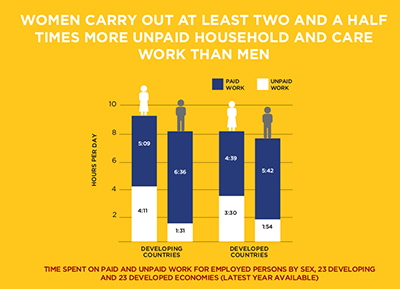
These “hidden” forms of unpaid work also have worrying implications for gender equality, as they are disproportionately performed by women. Despite having near-equal representation in the workforce in many Western countries, women perform the majority of unpaid labor, a phenomenon referred to as the “double burden.” For example, an average English female 15-year-old is expected, throughout her life, to spend more than two years longer performing unpaid caring work compared to the average male 15-year-old. This statistic is no exception. The Human Development Report, studying 63 countries, found that 31% of women’s time is spent doing unpaid work, as compared to 10% for men. A U.N. report finds that, in developed countries, women spend 3:30 hours a day on unpaid work and 4:39 hours on paid work. In comparison, men spend only 1:54 hours on unpaid work, and 5:42 on paid work. Finding a way to make currently unpaid work pay, such as a carer’s allowance, could also be part of the solution to this inequality problem.

Is unpaid work ethical? Yes, no, and maybe. Unpaid work covers a wide bandwidth on the ethical spectrum. At one extreme, there are clear cases of unpaid work which are morally unproblematic, such as altruistically volunteering for a charity or cooking yourself a meal. And, at the other extreme, there are cases where unpaid work is clearly unethical exploitation: cases of work that ought to be paid but where employers take advantage of their workers’ weak bargaining positions to deny them the financial compensation to which they are morally entitled. And many cases of unpaid work fall somewhere between these two extremes of the moral spectrum. In thinking about these cases, we have no alternative but to look in close detail at the specifics: at the power dynamics between the employers and the employees, the range and acceptability of the options that were available to workers, and the implications for equality.

Women, Representation, Revolution

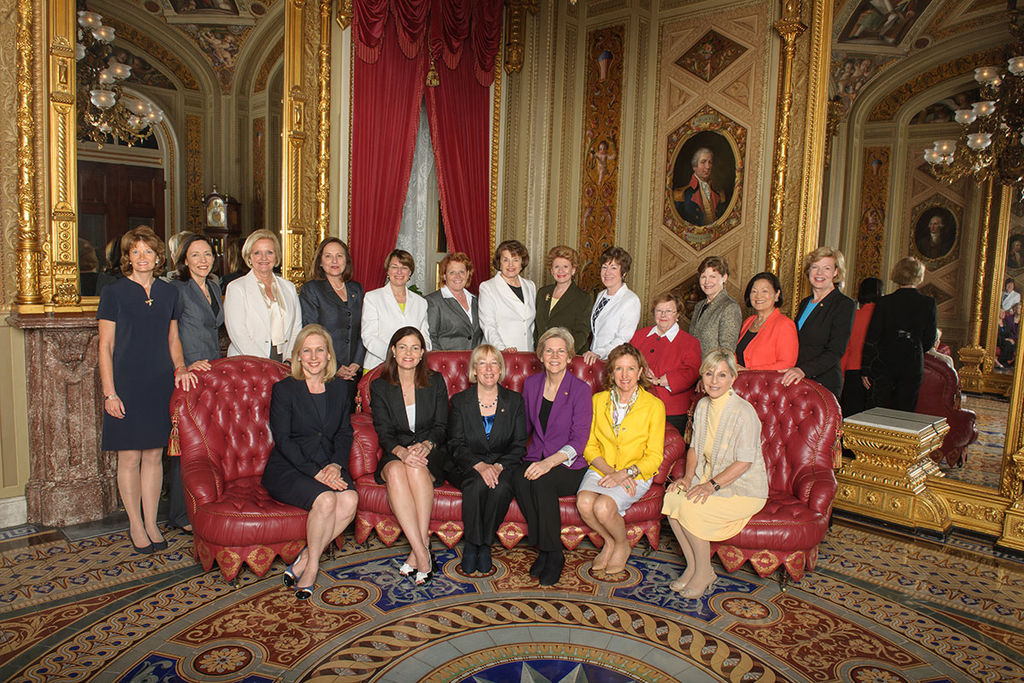
photograph of all the women save Senator Mary Landrieu on the US Senate in 2013

This article has a set of discussion questions tailored for classroom use. Click here to download them. To see a full list of articles with discussion questions and other resources, visit our “Educational Resources” page.


As the midterm election rapidly approaches, one thing is obvious—the number of women running for office is truly historic.  There are 256 women running for Congress, 234 for seats in the House and 22 for seats in the Senate.  The majority of the women running are Democrats. There are 197 Democratic female candidates and 59 Republican female candidates. The previous record for Democratic female nominees to the House was established in 2016, when 120 women were nominated, a record that is shattered by this year’s numbers. Historically, women have never comprised more than one-fourth of the House or the Senate. This year, that might change.

With the possibility of more female governance on the horizon, it seems like a good time to reflect on what this might mean for the country in both the short and the long term. One of the more immediate results of having more women in power might have been one of the main motivators for women to run for office in record numbers this year in the first place: a change in tone with respect to how women’s issues are discussed. To many, it seems as if there are no real consequences when it is revealed that important public officials discuss and treat women in demeaning, objectifying ways. If more women are in position to write and edit the script when it comes to how public officials talk about and treat women, we might be looking at a new normal.  

If there were more women in power, it would make a tremendous difference when it comes to the habituation of children. Female children would be put in a position to see a new range of possibilities for themselves. If these female candidates are successful, becoming a politician might seem like a natural career choice for a young woman dreaming about her future. Male children being raised in a society with more female representation will never be led to believe that political power is held predominantly by men in the first place. A choice to become a politician will seem equally possible for young men, and they’ll be ready to come to the decision-making table and roll up their sleeves with both men and women.

If there were more women in power, decisions about women’s issues could be made with the benefit of the crucial female voice. Of course, not all women share the same opinions, but discussion generated by healthy disagreement among women with different backgrounds and experiences with women’s issues is crucial to constructing sound policy and legislation in these areas.

Of course, it’s not as if the dominant reason for electing women is so that they can have a say when it comes to issues that affect women. That women should be involved in discussion about women’s issues is a pretty minimum requirement for just, fair governance. A female perspective is crucial when it comes to all social policy.  

It might be time for a revolution when it comes to our philosophy of power. There are different approaches to power, each of which might be appropriate in different domains and which may work together to regulate one another. We know that women provide the majority of both paid and non-paid care work. In our current political climate, that work is significantly undervalued. What if we came to recognize the value of care—and saw it for the tremendous source of power that it ought, rightly, to be? This kind of power is not a power over, but a power to, specifically, a power to help. A care relationship arises out of need. For example, a child may have needs for food, clean drinking water, and shelter, among other things. Parents, in their capacity as caregivers, have the power to help to satisfy those needs.

What if the popular understanding of the relationship between representative and constituent changed? Currently, we tend to have a pretty paternalistic conception of the way that political representation works. People vote along party lines and then largely check-out, trusting the elected official to make decisions in ways that are consistent with their values. Politicians, on this model, are given wide berth to engage in dubious political machinations and place themselves in the pockets of lobbyists. But care relationships don’t work this way. What would change if we came to view the relationship between the representative and the constituent as a relationship of care, where the power wielded by politicians was the power to help? Care depends on need, and addressing needs requires paying attention. So a politician fails to satisfy their obligation of care when, for example, they fail to respond to constituents who overwhelmingly express a need for change in firearm legislation. The representative would retain some autonomy and authority over the precise way in which this need gets pursued, but they can’t just ignore it altogether. If a child expressed an urgent and legitimate need for medical care, we’d view a parent as negligent if they didn’t attempt to satisfy that need to the extent that they were able. Should we respond any differently when it is our fellow citizens drowning themselves in debt to pay for essential medical needs while our representatives look on, unresponsive?

People have different personalities and interests and express power in various ways, irrespective of gender. We’ll avoid generalizing. But if, as the numbers bear out, women often voluntarily engage in care work regularly in an earnest desire to help, this new way of conceiving of power results in the conclusion that many women would be quite well-suited to take on the political mantle. In many of the locations in which women are running this year, they have little chance of being successful. But some races look promising. It’s a start.

Where Should Your Money Go?

Photo of five boxes of girl scout cookies

We’ve all experienced pitches for donations that tugged on our heartstrings.  During certain times of the year, when you walk into a supermarket, you can’t help encountering smiling, toothless young girl scouts pleading with you to buy cookies.  On other occasions, you may run into firefighters who encourage you to put money into a boot to support the local fire department. On yet other occasions, you may be asked by a cashier at the department store if you’d like to donate to the Make-a-Wish foundation or the Special Olympics. I’m sure that all of us have, at one time or another, capitulated to these requests.  Are we right to do so?

To be sure, a lot of good comes from charitable giving.  The Make-a-Wish foundation makes lots of suffering children happy every year.  The Girl Scouts provide valuable, formative experiences for young women. The good that firefighters do is quite obvious. If we are assessing the consequences of our donations to these causes, there is no doubt that our giving brings about something positive.

What’s more, donating to these causes makes us feel good because we observe firsthand the good that is done for our communities.  These are people who, in many cases, we know. At the very least, these causes are closely related to people and institutions that we care about.  Caring is an important component of moral motivation. What’s more, when we actually see the good that is being done with the money we’ve given, we might be more likely to give to good causes again in the future.

One question we can ask, however, is whether our money should be going to promote a modest amount of good when the same amount of money could, instead, be spent preventing a significant amount of harm.  Consider, for example, that delicious box of thin mints that you bought from an adorable girl scout. Recently the price of girl scout cookies went up from around $4.00 to around $5.00.  On its website, the Girl Scouts proudly advertises that, “100 percent of the money stays local! That means you’re not only supporting girls’ success, but the success of your community too—sweet!”  Individual troupes have the option to donate the money earned by individual camps back to the troupe or to donate it to another worthy cause. The values that The Girl Scouts are trying to instill in young members are laudable.  Scouts are being taught the importance of good decision-making, goal setting, money management, people skills, and business ethics. If The Girl Scouts as an organization is effective in its endeavors, young girls develop crucial virtues and, ideally they spread those virtues to other members of society as they develop into citizens, professionals, and parents.  But is it a good thing that the money you donate is staying local?

If we are reflective about our charitable giving practices, one important question we must ask ourselves is whether it is better to spend money doing good or preventing harm.  We aren’t preventing harm when we choose to buy a box of Girl Scout cookies, though we are doing good. On the other hand, another way that we could spend that same discretionary five dollars is to donate to, for example, a cause like the Against Malaria Foundation.  Malaria is a preventable and treatable disease, but in impoverished nations, it is a deadly and destructive one.  Ninety percent of malaria cases take place in sub-Saharan Africa. Even when people afflicted with malaria don’t die from the disease, it can have significant effects on the body, including severe cognitive impairment.  A $2.50 donation to the Against Malaria Foundation provides a insecticidal bed net that can help prevent two at-risk Africans from contracting Malaria for up to a year. This means that the $5.00 we spent on buying a box of thin mints could prevent four people from being infected with malaria for a year.

One proposal we might consider is the following: as a general rule, we should focus our charitable giving on reducing and eliminating harms first.  Harms should be, as far as is possible, ranked in terms of severity. Once we have dealt with the most significant harms, we can then move on to the harms that are less significant. Only when we have dealt with all of these harms can we finally move on to charitable causes that seek to provide benefits rather than to reduce harms.  This kind of strategy is predicated on the idea that, in our charitable giving, we should strive to do the most good we can do, which means that we should seek to donate our discretionary funds as effectively as possible. This is a strategy endorsed by a growing group that calls themselves effective altruists.  Effective altruism is a movement that maintains that charitable giving should be motivated not merely by fellow-feeling (though empathy is, of course, not discouraged), but instead by the results of careful inquiry and evidence collection on the subject of where the money could really do the most good.

This is a rational, evidence-based approach.  On the other hand, some argue that important features of moral behavior and the development of virtuous character are missing when the issue is approached in this way.  One lesson we can take from care ethics, for example, is that morality is a matter of developing relationships of care with others. This involves putting ourselves in a position to understand the people involved and be receptive to their needs.  This is a practice that involves more than brute calculations. It involves really getting to know others. It may follow from this view that we are in a better position to care for the local Girl Scout than the malaria ridden person oversees. The care ethicist wouldn’t argue that we shouldn’t help those who are struggling in distant countries, however, they would argue that morality can’t simply be reduced to math.    

Good people can all agree that charitable donation is important. We all need to ask ourselves which set of moral considerations should guide our decision making.  Is a decision fully moral if it relies on rationality alone? Do we need to be emotionally invested in the causes to which we commit our resources?

The Moral Messages of Violence in Media

This article has a set of discussion questions tailored for classroom use. Click here to download them. To see a full list of articles with discussion questions and other resources, visit our “Educational Resources” page.


Season two of the The Handmaid’s Tale returns with darker themes and more overt torture and sexual violence directed at the majority female cast. The dystopian drama depicts the practical consequences of misogynistic theocracy that takes power in the face of environmental collapse and widespread infertility, set in an eerily similar near-future America.

The violence in The Handmaid’s Tale is often compared to another hulking series, Game of Thrones. Both use liberal amounts of violence against women to keep their plot moving, but to different effect:

The Handmaid’s Tale isn’t glamorizing atrocities against women, exactly, or sanitizing them in the way that Game of Thrones or other prestige dramas might sanitize rape. The brutality is the point—the show wants us to experience the logical extension of institutionalized misogyny and theocratic governance.”

Indeed:

In shows like True Detective and Game of Thrones, the focus on female debasement is often criticized precisely because female suffering is positioned as entertainment. What happens on The Handmaid’s Tale is different, as violence against women plays out as a kind of morality tale.”

Visceral scenes in books, TV, and movies are a way of conveying the lived experiences and realities that audiences might struggle to relate to. In speculative fiction like The Handmaid’s Tale, showing in detail what would result from misogynist value systems and authoritarian, theocratic regimes can bring home how horrible the lives of the oppressed would be.

Art helps us to relate to experiences and realities that are different from our own, and can have a positive moral impact for this reason. People that read more novels have been shown to have greater emotional intelligence. However, when the perspectives and experiences are particularly graphic and violent, or run the risk of normalizing or sanitizing the persecution or rate of violence against an oppressed group, this raises questions about the ethics of continuing to portray the experiences of violence in detail.

Should we need to experience the pain of others to have their suffering be morally salient to us?

Legislators who become more feminist when they have daughters occupy an interesting dialectical space. While it is a positive step of course, it is good to adopt policies that recognize the fundamental equality of people the fact that they had to care for a daughter in order to tap into the moral reality is more than a bit distressing.

A further complication is the notion that there may just be an epistemically unbridgeable gap between communities that rely on one another for support regarding their experiences. It may just not always be possible to fully grasp another person’s everyday reality. It would be a great misfortune to discover immovable obstacles might bar someone from fully sympathizing with another person and experiencing the appropriate moral emotions regarding their plight.

Moral emotions such as sympathy, indignation, care, and regret play different roles of significance depending on the ethical theory you favor. Consequentialist views such as utilitarianism focus not so much on the emotional or motivational landscape that leads to action, but rather the result of our behaviors. If you make people have a better life out of indifference or kindness, it amounts to the same thing from an ethical perspective for utilitarians. Other views on morality heavily favor the emotions; care ethics and feminist views focus on our relationships to one another and tending to our roles appropriately. A behavior done out of sympathy would have a different moral assessment than the same behavior done out of indifference.

Given these considerations, we could reflect on art that attempts to bring pain and suffering into view in different ways. If the value in question is one of developing the appropriate moral response to suffering, we may ask: is this really necessary? (Isn’t this a case where we should really be able to get to the moral emotions on our own, as in the case of the legislators realizing women are people only when they’ve faced a daughter of their own?) Or, are there countervailing concerns, such as those raised in the discourse around the sexual violence in Game of Thrones? (Is this violence normalizing an already troubling reality?)

There are rich and nuanced questions regarding the consumption of art that includes graphic and detailed violence against marginalized groups. It puts pressure on how we conceive of our moral burdens in relating to one another, and how we experience the messages media sends us.