What Public Bathrooms Can Teach Us About Justice


 SHARE
SHARE
One of the criticisms that is often thrown at philosophy, and by extension philosophers, is that it spends too long on abstract issues that, at the end of the day, have little impact on the “real world.’” For example, in a Nerdist podcast, Neil deGrasse Tyson suggested philosophy is a useless pursuit that distracts from the questions with which we should concern ourselves today. He thinks, unsurprisingly, that science is where the intellectual action is. Similar perspectives on the “queen of the sciences” as Kant called it (although to be fair, he was talking just about metaphysics) have been expressed by Stephen Hawking, Richard Feynman, and, perhaps surprisingly, Thomas Hobbes. Indeed, it is not uncommon for those who study philosophy to regularly be faced with the question “why?”
And, if I’m being honest here, I get it. As someone who has made a career doing philosophy, I sometimes look at the work to which philosophy lays its claim and think what the point of that is. If I’m being really honest, I struggle to grasp the point of metaphysics at times. While I enjoyed thinking about the problem of universals when I studied metaphysics at undergrad, it never struck me as something that would be helpful in life or had too much value beyond mere mental mastication.
It should come as no surprise then that my first philosophical love, and the one with which I am still enamored, is ethics. Normative and metaethical questions – how we should behave and why, how we know what right is, how it differs from wrong – are to me the best of philosophical traditions. It is also this area that I think has the easiest job of bringing those skeptical of philosophy’s value on board. It can be hard to demonstrate the value of the substantivalism (space exists independent of the objects within it) versus relationalism (space only exists as a relation between objects) debate to the average Joe on the street. But, if you ask them whether abortion should be criminalized, whether torture is permissible, whether they should help others at a cost to themselves, or simply whether they think they lead a good life, then, my intuition and experience tell me, it is far more interesting for them. They can more easily see the value of such study and contemplation.
It is this aspect of philosophy, to be action-guiding not just on the grandest scales but also the personal and practical ones, that I find most engaging. It is also in those aspects that I spend most of my time thinking and writing about; hence why I’m a bioethicist and why I like, or at least am unable to stop, thinking about philosophy as I go about my life. And, as a true standard bearer for grounded and applicable philosophy, I think it works its way down to the humblest and, for lack of a better word, messiest areas of life.
It is with all this in mind, the idea that philosophy should go where the people are and be embedded in the very real aspects of how we live our lives, that I want to talk about something which, although I have no evidence, I am willing to hazard a guess, doesn’t get talked much about in academic or public philosophy: public bathrooms.
Now, I know what you’re thinking: we talk about bathrooms all the time, specifically when discussing who and who does not get to use which bathrooms. And you’re right, that aspect of the discussion is well trodden, although not done well, in the public arena. But I want to turn our gaze not to the bathroom’s use but to its existence and its maintenance.
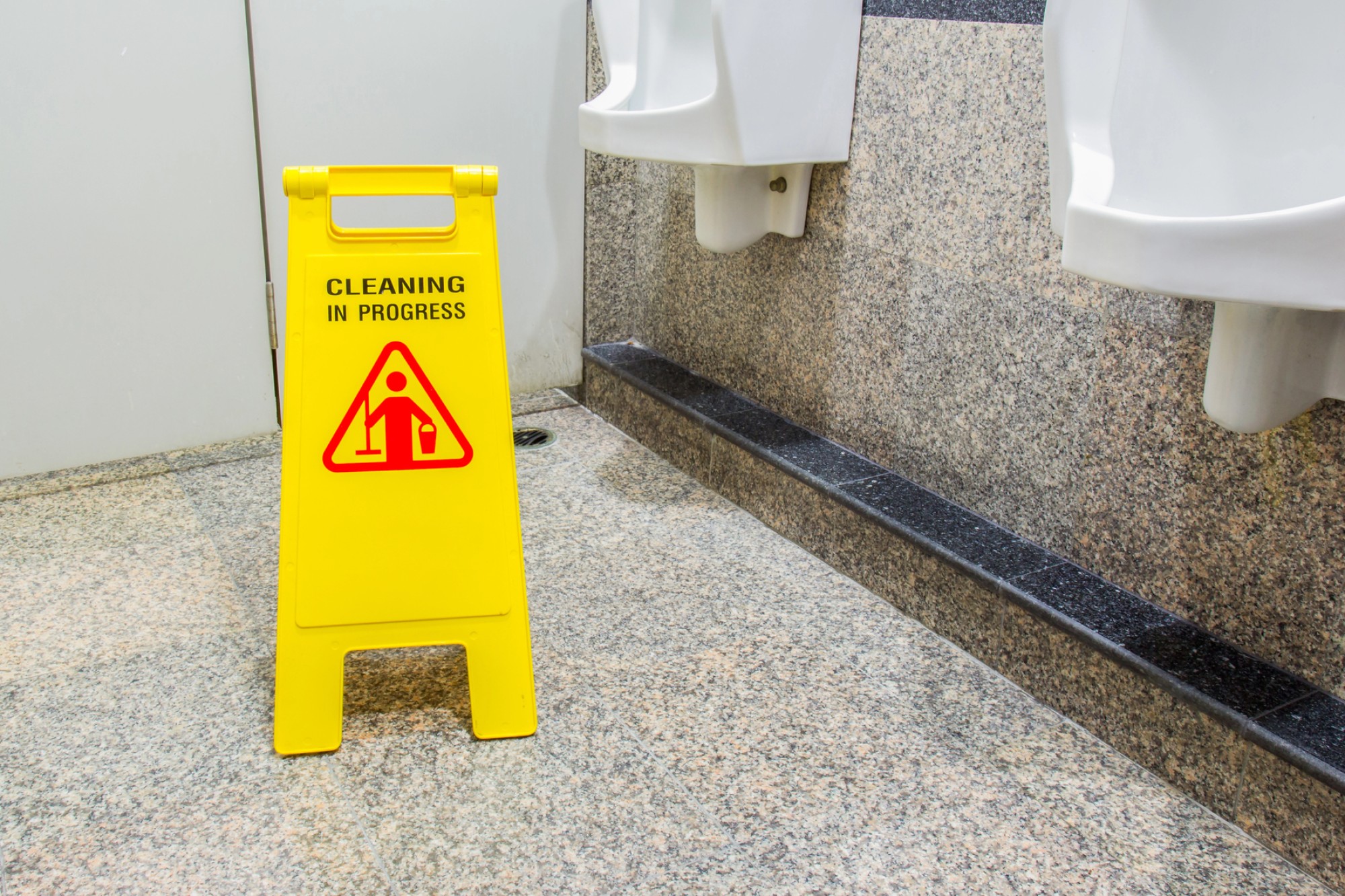
The reason for this is rather simple. I travel a lot. Thus, I tend to use public bathrooms. About a week ago, I was in Bristol Temple Meads station and needed to use the facilities. While in there, as with any busy train station, many people were coming and going. There was also a member of the station facilities team working hard and cleaning the bathroom. And as I was washing my hands, it struck me that this individual was getting a raw deal. They had the not-so-enviable job of cleaning up the messes of other people, and I’m assuming, if you’ve ever been in a public bathroom and know what state they can sometimes become, they were not getting paid enough to do so.
What’s more, there is an echo of the tragedy of the commons about the situation. Public toilets are a public good. However, their use deteriorates them. Thus, without continual maintenance, cleaning, and resupplying, that public good will eventually become depleted. This ruins that good for all.
This then started me thinking about a more just system. After all, the work of cleaning the bathroom needs to be done. If not, then the only option would be to leave the public toilet to fester or shut it, neither of which is viable in a busy train station. So, if we assume that it is not fair for those who have not made the mess in the bathroom to be expected to clear it up, even when they are financially compensated to do so, how might this be done better? It was then, as is so often, that John Harris’s work came to mind, and specifically, his 1975 essay The Survival Lottery.
In that work, Harris proposes that if organ transplantation becomes a perfect science where organs will save lives if transplanted, then we should collectively, as a society, implement a lottery which randomly selects healthy people from the populace and kills them so that we may then harvest their organs. This would then enable us to save the lives of two or more people, as well as improve the lives of many others. In other words, it is a simple numbers game: we sacrifice one person at random to save the lives of more than one person; thus reducing the net loss of life. Harris argues that, while the possibility of being selected would itself be a harm, this would be outweighed not just by the benefit gained from easy access to organs, but by the likelihood of actually being selected being so small as to be next to non-existent. Sure, we would live with the stress of possibly dying at some point; but that’s a stress that we already have in our daily lives.
Now, I suspect Harris was not serious in his suggestion. My intuition is that he suggested this as a means of highlighting an uncomfortably vague line between killing someone and letting them die. However, the premise itself – that a lottery can be a useful, perhaps even just, method of reassigning responsibility, and that a broader communal resource pool provides great benefit – strikes me as having something to it. For Harris, that communal resource was organs and the good they provide when available to those that need them for transplant. For me, I’ve been wondering, continue to wonder, and will likely continue to do so going forward, whether public toilets are comparable. Should there be a lottery for their upkeep?
The process would be rather simple. Each use of a public bathroom enters you in a lottery; if you’re selected at that moment, it is your turn to clean the bathroom. The chance of being selected would increase in relation to the condition of the toilet at the point of use. The dirtier the toilet, the greater the likelihood that someone would be selected. Ultimately, however, the chance of being selected, given how many people use public toilets each day, would be small. Much like with Harris’ organ suggestion, the risk to the individual remains low.
Of course, there are obvious objections. First, there is the practical problem. Many would rather miss their train than be informed that they’ve been selected to spend however long it would take to scrub a station lavatory sufficiently. Even if one were to accept the fairness of the arrangement in principle, and they need not, many would refuse. Any public authority attempting to implement such a lottery would almost instantly discover that civil disobedience becomes common.
There is also a deeper philosophical concern. Although lotteries distribute burdens impartially, they do not necessarily distribute them justly. Imagine two people. One uses public toilets several times a day because they work as a delivery driver and are constantly on the move. Another works from home and only occasionally ventures into public spaces. It seems strange that both might face an identical burden of being selected simply because they happened to enter a toilet at a particular moment. Fairness is not always the same thing as randomness.
Yet before we dismiss the idea entirely, it is worth considering why it feels so outrageous. The answer, I suspect, is that the proposal makes visible something that normally remains hidden. Public toilets do not remain clean by magic. Platforms do not remain swept, bins do not empty themselves, and hospital wards do not somehow reset overnight into a sanitary condition. Societies depend upon enormous amounts of maintenance work. Much of that work is physically demanding, poorly rewarded, socially invisible, or, most likely, all three and many more.
Political philosophers have increasingly directed attention towards what is sometimes called the ethics of maintenance. While we find acts of creation, innovation, and leadership captivating, far less attention is paid to the labor required simply to keep things functioning. We celebrate the architect who designs the building rather than the cleaner who keeps it usable. We applaud the politician who establishes a public service rather than the people who make sure it continues to operate day after day.
Across several works, such as Who Cares?, John Tronto argues that care is not simply a private virtue but a central political activity. Societies function because people engage in the often-unnoticed work of caring for others and maintaining shared institutions. And while Tronto is primarily interested in caregiving relationships, the insight generalizes quite neatly to public infrastructure. Clean toilets, as well as safe streets, public parks, libraries, and transport systems all rely on forms of maintenance labor that are easy to overlook precisely because they are successful. When things work, we normally don’t notice the work being done.
Like Harris’ survival lottery, the toilet lottery functions not as a serious proposal, although I would be interested to see if it might. Rather, its function is to force us to notice an otherwise unnoticed reality. It asks us to imagine that the burden of maintenance might directly fall on us rather than on a largely invisible workforce. The horror you may experience at this prospect, I think, reveals less about the absurdity of the proposal and more about our assumptions regarding who ought to perform such labor.
Ordinarily, we solve this problem by assigning maintenance responsibilities to particular people and compensating them for their work. This may be preferable to a lottery. Most of us possess neither the skills nor the inclination required to maintain public facilities effectively. A randomly selected member of the public is unlikely to outperform a trained facilities worker. Nevertheless, the idea has, hopefully, got you thinking. It has exposed just how dependent we are on forms of labor that disappear from view the moment they are done well.
This, I think, brings us back to the beginning.
One of the common criticisms of philosophy is that it concerns itself with questions too abstract to matter in ordinary life. Fair enough. Yet philosophy, when it’s at its best, does not remove us from everyday experience but grounds us in it.
A public bathroom at a railway station is about as everyday as one can imagine. It is certainly not where most people expect to stumble upon a philosophical problem. Yet standing in Bristol Temple Meads, watching somebody quietly clean up after hundreds of strangers, that’s what happened. I found myself thinking about justice, responsibility, labor, public goods, and the often-invisible work on which social life depends; none of which are abstract in the slightest.
So, next time you use a public bathroom, perhaps it is worth pausing for a moment to acknowledge that the facility exists at all, that its continued usefulness depends upon somebody else’s contributions, and that many forms of work sustain the benefits we enjoy every day and rarely notice because they are done well. If nothing else, the toilet lottery may serve as a reminder that philosophical questions are not confined to seminar rooms, journal articles, or thought experiments involving runaway trolleys. Sometimes they are lurking in the most mundane corners of everyday life.