
When the Land Rejects Its King: Texas, Sacred Sovereignty, and the Mythology of Political Collapse


 SHARE
In the legends of King Arthur, there is a king who cannot heal, and a land that cannot flourish. The two conditions are not unrelated. Indeed, they are at the heart of one of the most enduring ideas in European mythology. When sovereignty becomes wounded, the consequences extend far beyond the ruler himself.
The Fisher King, a mysterious figure in the Arthurian Grail romances, suffers from an injury that leaves him incapable of exercising his former powers. As the legend developed, his condition became closely associated with the desolation of his kingdom. The land grows barren, its vitality disappears, and restoration depends upon something more than military strength. Someone must recognize what has gone wrong and bring about the healing of a broken order. The king still possesses his title. His castle remains standing. Yet something essential to kingship has disappeared.
I could not help thinking about this story while watching the extraordinary political events in Texas on November 3, 2026. For decades, Republican control of Texas seemed almost a permanent feature of the American political landscape. Governors came and went, political controversies erupted, and demographic predictions repeatedly suggested that Texas might eventually become competitive. Yet the basic arrangement survived. Texas was Republican, and for many observers that was simply how things were.
Then, rather suddenly, it wasn’t.
Democrats won the governorship, lieutenant governorship, and other statewide offices, while also capturing a U.S. Senate seat. Gina Hinojosa’s victory over Greg Abbott was particularly remarkable. Texas had not elected a Democratic governor since Ann Richards in 1990.
There are, of course, conventional explanations for the result. Economic dissatisfaction, political exhaustion, disputes over public policy, and changing voting coalitions all deserve attention. Elections are complicated things, and no single explanation accounts for every voter.
But the speed with which a seemingly permanent political order can lose its authority raises another question, one that is considerably older than the Republican Party, Texas, or the United States itself.
Why do societies repeatedly imagine the collapse of rulers whose authority once appeared unquestionable? And why does that collapse so often resemble a crisis not merely of government, but of the entire order that government supposedly sustains?
The Fisher King is particularly interesting because his problem cannot simply be resolved by replacing one army with another. In Chrétien de Troyes’ unfinished Perceval, or the Story of the Grail, the young knight encounters a wounded king and witnesses a mysterious procession involving a bleeding lance and the Grail. Perceval remains silent because he has been taught that a courteous knight should avoid asking too many questions. Only later does he discover that he should have asked whom the Grail served. Had he asked, he is told, the wounded king might have been healed and his people spared further suffering. What initially appears to be an innocent act of restraint thus becomes a missed opportunity to restore an entire kingdom.
The relationship between the king’s wound and the devastated landscape becomes more elaborate in subsequent Grail traditions. What matters is the underlying idea that the health of the political community and the condition of its ruler are mysteriously connected.
This is not quite how modern constitutional government is supposed to operate. A governor is neither a divine king nor the mystical embodiment of a state. Nevertheless, the myth draws attention to a distinction that modern politics sometimes obscures. A ruler may continue to exercise power long after the public has begun to question the legitimacy of his authority.
The Fisher King’s castle remains, but its existence cannot cure the wound. Similarly, an established political party may retain its institutions, supporters, and considerable resources while losing the confidence necessary to maintain its governing position.
The comparison does not require believing that Texas was literally a wasteland under Republican government. Nor does an electoral defeat establish that a defeated administration was morally illegitimate. The more interesting point is that political stability can conceal a gradual deterioration in the relationship between those who govern and those who consent to be governed. What appears permanent may merely be waiting for the moment when its underlying weakness becomes visible.
The Greeks understood this problem rather well. In the Theogony of Hesiod, divine sovereignty is hardly a peaceful institution. It passes from one generation to another through a succession of violent confrontations. Uranus is overthrown by Cronus, who in turn faces the possibility of being displaced by his own children. Cronus attempts to prevent this by swallowing them, a rather extreme approach to succession planning, although one suspects that a few modern politicians might appreciate the sentiment.
His precautions ultimately fail. Zeus survives, frees his siblings, and leads the younger gods against the Titans in the great conflict known as the Titanomachy. The victory of Zeus establishes a new divine order. His authority is not simply a continuation of Cronus’s government under different management. The structure of sovereignty itself has changed.
What makes this story especially interesting is that Cronus was not an outsider trying to seize power. He was the established sovereign. His position had its own history and apparent legitimacy. Yet none of these things made his authority permanent. The Greek imagination therefore presents sovereignty as something remarkably unstable. Even the gods can lose their thrones.
There is also an uncomfortable complication. Zeus himself is hardly a modern constitutional democrat. After establishing his authority, he takes precautions to prevent another generation from overthrowing him. Hesiod describes his swallowing of Metis, whose future son was prophesied to threaten his rule. The new sovereign is immediately confronted with the same problem that destroyed his predecessor. This matters because the Titanomachy is not merely a story about a good generation replacing a bad one. It is a story about the recurring insecurity of political authority. Every successful ruler must somehow confront the possibility that the order he creates will eventually be displaced.
The Texans who voted for political change were not reenacting an ancient mythological Greek war. Nevertheless, the election exposed a remarkably similar assumption: a governing order may become so familiar that people mistake its longevity for necessity. Hesiod reminds us that even Olympus had a change of management.
A third variation appears in Richard Wagner’s monumental Der Ring des Nibelungen, particularly its conclusion, Götterdämmerung, or Twilight of the Gods. Wagner drew upon Germanic and Norse mythological traditions, including ideas associated with Ragnarök, but his operatic universe is also a nineteenth-century reinterpretation of those materials. Its treatment of sovereignty is especially revealing.
At the center stands Wotan, ruler of the gods, whose authority rests upon laws, agreements, and obligations symbolically inscribed upon his spear. As the San Francisco Opera’s discussion of Wotan explains, the very contracts that sustain his authority also constrain him. His pursuit of power repeatedly brings him into conflict with the rules upon which his sovereignty supposedly depends. Wotan wants the benefits of law without always accepting its limitations.
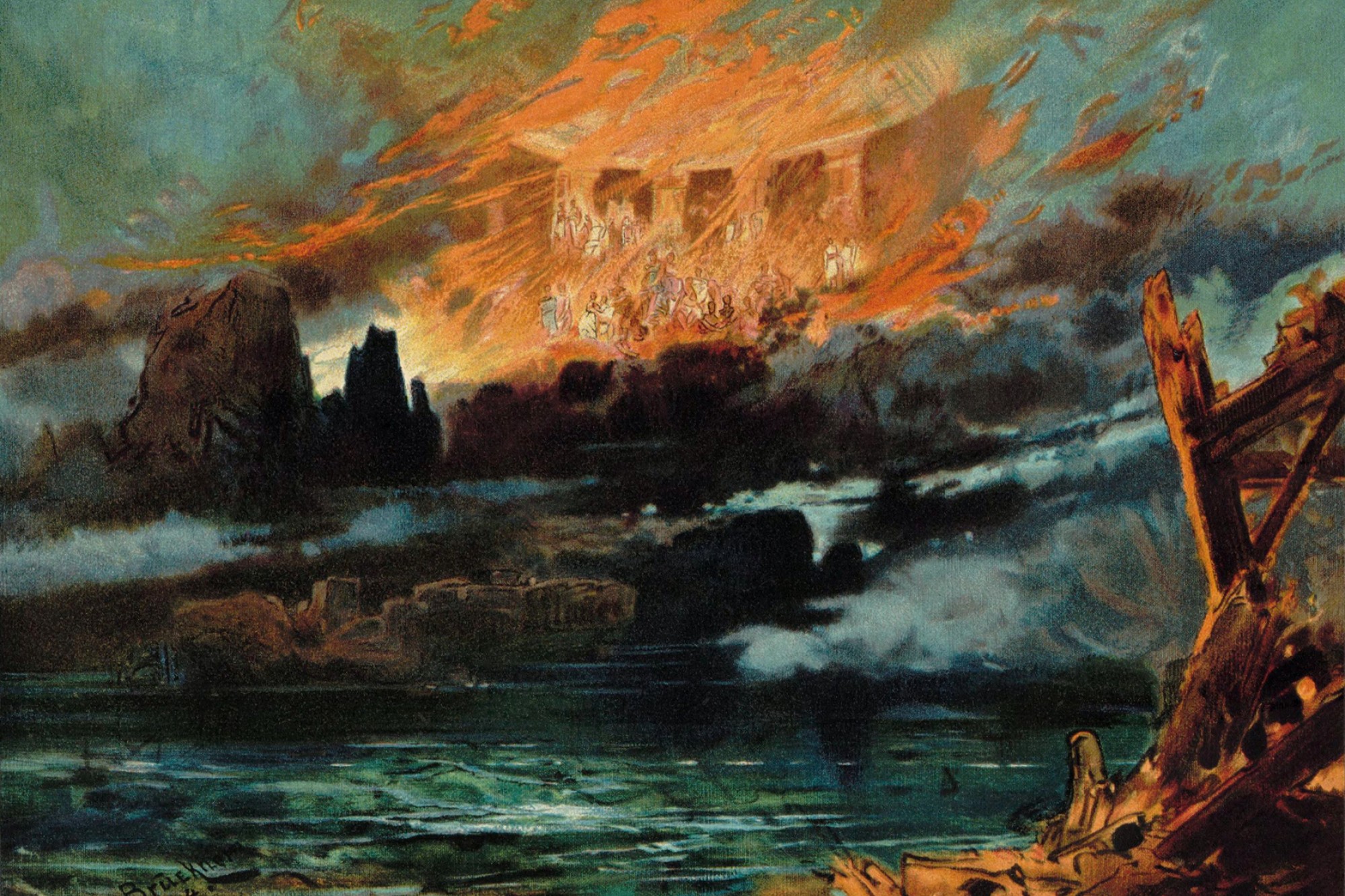
That contradiction gradually destroys his position. His schemes produce consequences he can neither control nor escape. In Siegfried, the hero shatters Wotan’s spear, symbolically breaking the old sovereign authority. By the conclusion of Götterdämmerung, Valhalla itself is consumed by flames. The gods do not lose their authority merely because someone stronger happens to appear. Their world collapses under the weight of contradictions already present within it.
Wagner’s interpretation offers a somewhat different perspective from the Fisher King and Zeus. The wounded king requires healing. Cronus is replaced by a younger generation. Wotan presides over an order whose own foundations have become untenable.
In each case, however, sovereignty confronts a limit that power alone cannot overcome. These stories are not identical, nor should they be treated as evidence of a single universal myth preserved unchanged across European history. Nevertheless, they share an important concern with the vulnerability of sovereignty.
The comparative mythologist Georges Dumézil devoted much of his scholarship to examining recurring structures of authority in Indo-European traditions. His distinction between sacred or juridical sovereignty, martial power, and productive prosperity offers one way to understand why the legitimacy of a ruler cannot be reduced to the ability to command obedience.
I explored a related problem in my recent essay on The Lion King. Scar successfully seizes Pride Rock, but taking possession of the throne does not establish his right to govern. The condition of the Pride Lands reflects the failure of his rule to sustain the community. The parallel with the Arthurian wasteland is difficult to overlook. What makes a ruler legitimate if mere possession of power is insufficient?
I have explored this larger relationship between mythology and political authority in my book, Gods, Judges, and Presidents: Trifunctional Archetypes in American Law and Government. One of the questions underlying that work is how ancient ideas about sovereignty continue to shape institutions that no longer recognize kingship as a legitimate form of political authority.
The Texas election offers an unusually vivid illustration. Yet there is one fundamental difference between the ancient stories and contemporary democracy. In mythology, the collapse of sovereignty frequently requires catastrophe. Kings are wounded, gods wage war, and entire cosmic orders are destroyed before renewal becomes possible. Democracy offers a rather more civilized mechanism.
A political order can be repudiated without the destruction of the political community itself. Elections permit the withdrawal of governing authority while preserving the institutions through which that authority is exercised. The defeated ruler simply has to leave office. And the victorious party is not thereby transformed into a new Olympus. Its mandate remains conditional, subject to the same possibility of withdrawal that confronted its predecessor.
This is perhaps the most important lesson of the comparison. The electorate is not the equivalent of Zeus, the Fisher King, or Wotan. It is closer to the authority that determines whether any of them ought to continue ruling. Texas may change parties again. Indeed, democratic accountability depends upon that possibility remaining open. The wounded king, the fallen Titan, and the twilight of the gods all remind us that sovereignty cannot be understood simply through the possession of power. Political authority depends upon something beyond its immediate ability to enforce obedience.
We have spent centuries telling stories about kings who failed to recognize this distinction. The remarkable achievement of democracy is that we no longer need to burn down Valhalla to remind them.