
← Return to search results
Back to Prindle Institute

We Can Handle The Truth

Steven Spielberg’s Disclosure Day is, among other things, a story about the right to know (Spoiler Alert: I discuss some of the plot points of this film). As the film unfolds, we follow several characters who are on a mission to tell the planet about the existence of aliens, whose existence has been covered up by a company called Wardex.

The film portrays two main ideological fronts: “team disclosure” and “team cover up.” Team Disclosure is primarily composed of Daniel Kellner, Margaret Fairchild, and Hugo Wakefield, who are racing against an army of agents trying to thwart them, so that they can broadcast a trove of files that Kellner has stolen to the world. Team Cover Up is led by Noah Scanlon, the head of Wardex, and his employees, trying to stop the disclosure.

In the middle of these ideological fronts stands Kellner’s girlfriend, Jane Blakenship. When Kellner finally reveals to Blakenship what he is trying to do, she is horrified by the possibility that telling the world would be completely destabilizing. Her concern is similar to Scanlon’s concern, though we have some reason to think that Scanlon is also motivated by greed and power, whereas Blakenship’s motives are more selfless. Blakenship ultimately joins Team Disclosure.

Setting aside any misguided motives, the film poses an interesting and important question about epistemology and knowledge: What is the right to knowledge or information grounded in, in the first place? Is there some universal human right to know certain facts about the universe (such as whether or not there are aliens)? Does this human right to know about the universe take precedence over the risk that certain disclosures may have to the stability of society (and if so, when)? If someone has access to facts that fall within the sphere of things we all have a right to know and is in a position to disclose these facts, do they have an obligation to do so?

The right to knowledge is crucially connected to other important rights. If one is committed to a right to freedom of choice, thought, or the right to life, it is not difficult to understand why the right to knowledge becomes important. Consider, for instance, how free choice requires knowledge about the world. When I make a decision without knowledge, receiving additional knowledge may change the decision I make, and thus allow me to make a “freer” choice.

For instance, if I decide to go swimming in the lake, and then I learn that there has recently been a chemical spill in the lake, I will change my decision for the better. This example illustrates the positive impact that having information does for us in our decision making. I am surely more free when I have this information and my interest in protecting my life is much better preserved as well.

However, we should not assume that more information is always better when it comes to protecting our interests. For instance, imagine that someone is at the doctor’s office and needs to decide about a treatment. They learn that they have two options: either have surgery or take medication. Because they are not a medical expert, there is a limit to the amount of information they can comprehend. Every time a healthcare provider informs their patient of options, they need to decide how much detail to give. If they give too little information, they run the risk of violating the moral criteria required for informed consent. However, if they give too much information, they may inhibit the patient’s ability to make the best choice. Giving non-experts information at an expert level of granularity may simply be confusing. So, while the right to knowledge is important, it does not necessarily translate into a duty to share all information in all contexts.

In addition to the bundle of rights that a right to knowledge may be connected to, knowledge about the world is crucial for accountability. When it comes to the right to know, one of the more pressing epistemic arenas is anywhere that power relations exist, e.g., coercive governmental power or corporate power. When power asymmetries exist and one person or group can use their power to influence the lives of others, the right to knowledge serves as a way to protect those who are subjected to power. This is precisely what is at stake in Disclosure Day. Wardex’s suppression of the alien files is not merely a corporate secret, it is an exercise of power over an entire planet’s right to know about something that concerns them.

A significant number of modern political societies have recognized this very point and have enshrined the legal right to information in some form or another. In the United States, we have the Freedom of Information Act. In India, there is The Right to Information Act. In 2002, Mexico passed a particularly unique and groundbreaking version of the right to information; this law requires information to be shared when it concerns important human rights violations, even if sharing such information is a threat to national security. While many countries throughout the world recognize the right to information, none have a provision quite like this.

While having a legal recognition is important for securing a right to know, implementation of these laws is often subject to controversy. In the U.S., there has been a long and protracted debate about the Epstein Files and whether or not the U.S. government has fulfilled its obligation to release information in a sufficiently transparent way. Critics argue that the government’s redactions serve only to protect an economic elite class of serial abusers while at the same time causing further harm to the survivors of the horrible ordeal.

We can return again to the core question that Disclosure Day forces us to confront: to what extent does the public have a right to know facts, when sometimes those facts may lead to chaos? Was Kellner right? Should we learn the truth about aliens, even if the disclosure carries a great deal of risk? I believe the answer is yes, and I am on Team Disclosure for three reasons.

First, society is often in a state of chaos. I am not so naïve to think we will always survive the chaos, but I also do not see any reason to think that one piece of information will be the downfall of us all. One criticism I have of the film is the depiction of the disclosure itself, where the world grinds to a halt and watches in silence as the data trove is broadcasted. Humans are so accustomed to sensational news that I wonder if we wouldn’t treat this like every other piece of news; there will be debate, denial of its legitimacy, hot takes from YouTubers, advertising campaigns trying to figure out how to reach their new intergalactic audience, and the whole gamut of responses we see in everyday sensationalism.

Second, facts about our galactic neighbors strike me as information that really does concern everyone. There is a real distinction between private information and public information and while there is a fuzzy middle, it is hard to argue that knowledge of intelligent off-world life falls in that vague space. The question of intelligent life outside of earth relates to our deepest and oldest questions about the origins of our own existence and the nature of our being.

Third, knowledge of alien life is clearly political and has serious implications for how humanity governs itself. I am, in my heart, an optimist about what we might find out there. It is entirely possible that an intelligent species capable of crossing the cosmos has transcended the violent impulses that have plagued our own history, or may never have developed weapons at all. But the very fact that another life form has managed to reach us tells us something important: they possess technology that exceeds our own, and where technological superiority exists, the capacity for superior weaponry exists. We also know nothing of their politics, their history, or how they have handled conflict among themselves or with others.

Of course, these are not reasons for us to be hostile out of the gate, but they are reasons to take the question of first contact seriously and we will need to know: are they friend or foe? I know enough about human history to know how beings that believe they are superior treat those they perceive as inferior, and that pattern of behavior is not one we can assume is unique to us. Either way, the question of how to respond to these visitors surely concerns every person on this planet. I for one would not want to be left out of the decision-making procedure that my own government may make in response. To know what the government knows about non-human intelligent life seems crucial for any people that want to retain reasonable public influence over the powers that govern us.


Alien Disclosure – Is Ignorance Bliss?

image of ufo hovering over desert road

This week – in scenes straight out of an episode of The X-Files – a House Oversight subcommittee has begun hearing testimony regarding an alleged alien cover-up by the U.S. Government. According to retired Major David Grusch, the U.S. has been retrieving and reverse engineering unidentified flying objects (UFOs) since the 1930s. Among the claims made by Grusch, the most audacious – and, perhaps, most unsettling – is that this government activity has included the recovery of non-human biologics.

Put simply: Grusch claims that aliens have visited Earth, and that the U.S. government is well aware of this.

It’s obvious that UFOs exist: I see one every time I spot something in the sky that I’m incapable of identifying. What is controversial, however, is the claim that some of these UFOs are of alien origin. As famed astronomer Carl Sagan noted, however: “extraordinary claims require extraordinary evidence.” And while Grusch has provided a great deal of testimony relating to the alleged cover-up, this has been exclusively in the form of second-hand reports from other government officials. Grusch himself has not seen these alien spacecraft or biologics first-hand, nor has he yet provided concrete evidence of their existence to the subcommittee.

But suppose that Grusch is right. The possibility of the government covering up evidence of alien visitations raises all kinds of ethical questions – especially when it comes to a government’s duty to disclose information to its citizens. Would it be right for the U.S. to keep such a revelation from its people?

Governments keep secrets all the time. Ostensibly, this is done for the benefit of those they govern. We can only assume that something similar would be true in this case. Incontrovertible evidence of the existence of alien life would be an unprecedented turning point in human history. It would shatter the worldviews of many, and have far-reaching implications for many of our religious and philosophical beliefs. It’s conceivable that, despite our best cognitive intentions, this revelation would be accompanied by widespread fear and anxiety.  As the protagonists of Men in Black so eloquently put it:

James Edwards: “Why the big secret? People are smart. They can handle it.”

Agent Kay: “A person is smart. People are dumb, panicky, dangerous animals and you know it.”

The reason for government non-disclosure, then, might simply be to avoid such panic: that is, to maximize the welfare of the citizenry. But how do we measure welfare? Put another way, how do we establish what makes a life go well? One obvious answer is “happiness.” Indeed, this is what the Hedonists believe – that how well a life is going can be measured purely in terms of pleasure and pain. What this means is that if the disclosure of alien life would, on balance, make people’s lives less happy, then the government is maximizing welfare (i.e., doing the right thing) by refraining from sharing that information.

But is pleasure really all that matters? Robert Nozick poses a famous thought experiment to challenge this idea. Imagine that there is a machine that can give you any experience you want. You can program it with whatever will bring you pleasure, and avoid anything that brings you pain. What’s more, upon entering the machine, you will lose any memory of having done so – meaning that your experiences will not be ruined by the knowledge that they are illusory.

The question: would you choose to hook up to this machine for the remainder of your life?

When I pose this thought experiment to my students, they often raise one of several concerns. Many worry about the friends and family they would leave behind. But suppose that these people also have the option to enter their own experience machines – something which they happily do. Others worry that a life filled with constant pleasure wouldn’t be as good – that is, that without the bitter, the sweet wouldn’t be as sweet. But we can take care of that too. If it helps your appreciation of the pleasure, some small amounts of pain can be programmed into your experience too. Ultimately, all that matters is that your life in the experience machine would be one that gives you a greater balance of pleasure-over-pain than your ordinary life.

Yet, despite this, many would be reluctant to enter the experience machine. The most often cited reason for this is that there is more to our welfare than happiness. Sometimes, what’s best for us isn’t what brings us the most pleasure. That’s why we go to bed early, visit the dentist, and read dry philosophical treatises.

And the very same reasoning applies to knowledge. Suppose that you’ve just bought a brand new outfit and ask a trusted friend how you look. Suppose, further, that the outfit is atrocious and makes you look absolutely ridiculous. Which would be better for you: To be told a flattering lie that makes you feel good about yourself? Or to receive the harsh truth – a truth that might allow you to make better decisions going forward? While the former might bring about greater pleasure, there are good reasons why many of us might prefer the latter.

There are many cases where it might be good for us to be given certain information, even when that information brings us sadness or anxiety or fear. Consider, for example, a cancer diagnosis or evidence of the infidelity of a spouse. The question for us is whether or not evidence of alien life is one such example. It’s undeniable that while some would be thrilled by government disclosure of the existence of alien life, many others would suffer from a raft of negative emotions. Given the considerations above, however, it’s no longer immediately obvious that these negative responses justify non-disclosure. It may very well be the case that our lives will go better knowing that we are not alone in the universe, even if that prospect doesn’t make us happier. Maybe, when it comes to evidence of aliens, ignorance isn’t bliss.

Moral Limits on State Secrets

photograph of "Top Secret" manila envelope

The topic of UFOs recently made headlines, as a purported whistleblower claims the United States government is secretly in possession of alien spacecraft. This proclamation comes in the midst of increased national attention to the prospect of UFOs in recent years. Of course, the general American public is far from having any definitive evidence of the existence of such things as UFOs or intelligent life from other galaxies, but if such evidence exists, we might wonder if the government has a moral obligation to disclose it.

It seems there are at least two distinct questions to unpack here: Under what conditions (if any) can the government permissibly keep a secret from citizens? Under what conditions (if any) can the government permissibly lie to citizens? Let’s start with the former. Of course, there is a strong precedent of the government refusing to disclose certain kinds of information to the public. For instance, most agree that certain information pertaining to military operations and national security should be held in secret due to the risks involved with leaking such intel. But the ethics surrounding state secrecy get murkier once we start talking about matters pertaining to citizens’ privacy or risks that would potentially change their day-to-day behavior. There also are clearly issues where the American public is justified in demanding full transparency from government officials, including the procedures behind elections, the allocation of tax payer money, etc.

The relevant question thus becomes into which of these categories does evidence of UFOs or extraterrestrial life most plausibly fit. It must be determined if releasing this evidence to the general public poses sufficiently harmful threats, so as to justify state secrecy. One potential concern is that releasing significant evidence of UFOs or extraterrestrial life would constitute such a paradigm shifting event, it is extremely difficult to predict how the public would react. We have strong historical reason to be skeptical that the population will respond in a fully peaceful or rational manner. If we consider all of the social upheaval and violence that came along with the paradigm shifting events of the Scientific Revolution, the Enlightenment, and the Protestant Reformation, we can safely conclude that rapid influxes of knowledge that fundamentally transform society are not always well-received. Of course, such a rationale does not provide conclusive reason for the state to keep secrets, but societal peace and stability are certainly factors when it comes to making complex ethical judgments at the governmental level.

Other reasons why the state might have an interest in keeping UFOs or evidence of extraterrestrial life a secret pertains to national security and military strategy. If, as some have claimed, the government possesses partial or even fully intact alien technology, the state is likely scrambling to understand the engineering behind such objects. This knowledge would be helpful when it comes to building superior military technology, making it clear why governmental authorities would not want to share this advantage with other nations. Similarly, the government surely does not want knowledge of how to build more effective weapons falling into the wrong hands. While there is a clear national advantage to possessing the best, most sophisticated technology, there is also a clear national disadvantage if that technology is adopted by one’s political enemy. Thus, for reasons of both public safety and military strategy, the state might possess compelling reasons to conceal evidence of life and technology from other galaxies.

So we’ve established there may be sufficiently strong reasons to justify government secrecy in the case of UFOs and extraterrestrial life, but we have yet to discuss the permissibility of state-endorsed lies. Lying is thought to be more difficult to morally justify than merely withholding the truth. Furthermore, lying also greatly diminishes institutional trust, causing lasting damage beyond the initial moral damage involved in the telling of the lie. Thus, it is probably safe to conclude that if ever it is permissible for the government to lie to citizens, such instances are somewhat scarce. They might include severe threats to the public that would cause mass panic, violence, or social unrest, especially if it is likely these threats can be resolved in a way that avoids these negative outcomes. The thought here is that lying is justified because it is necessary to promote the greater good.

However, even if we grant the state’s good intentions, some might remain dubious that the government is ever morally permitted to spin lies to its own citizens. The moral and pragmatic costs of lying are simply too high to be justified, particularly at the state-level. A philosophically interesting test case for this can be found in the domain of healthcare ethics. In a recently published paper, the author argues there are four conditions which must be met in order for public health officials to lie: (1) the risk of harm to the public is substantial, (2) the upside of telling the lie is very high, (3) lying mitigates this risk of harm to the public, (4) and lying is by far the most effective way to mitigate the risk of harm. Insofar as these four conditions are plausible in the public health case, they can perhaps serve as a more general template for judging the permissibility of lying in other domains as well.

Much of the difficulty in judging the moral status of state secrets and lies derives from our collective uncertainty of the actual risks posed to civilization by UFOs or extraterrestrial life. Assuming the existence of such entities, even the people among us who know the most, still know vanishingly little about the extent of intelligent life beyond our planet. Without more information, we can only speculate as to the nature of the risks. Ultimately the government’s decision to either conceal or share evidence with the public needs to be sensitive to a range of public goods, including that of institutional trust, public safety, and political stability, all of which might be threatened by revelations of life vastly more advanced than humanity.

UFOs and Hume on Miracles

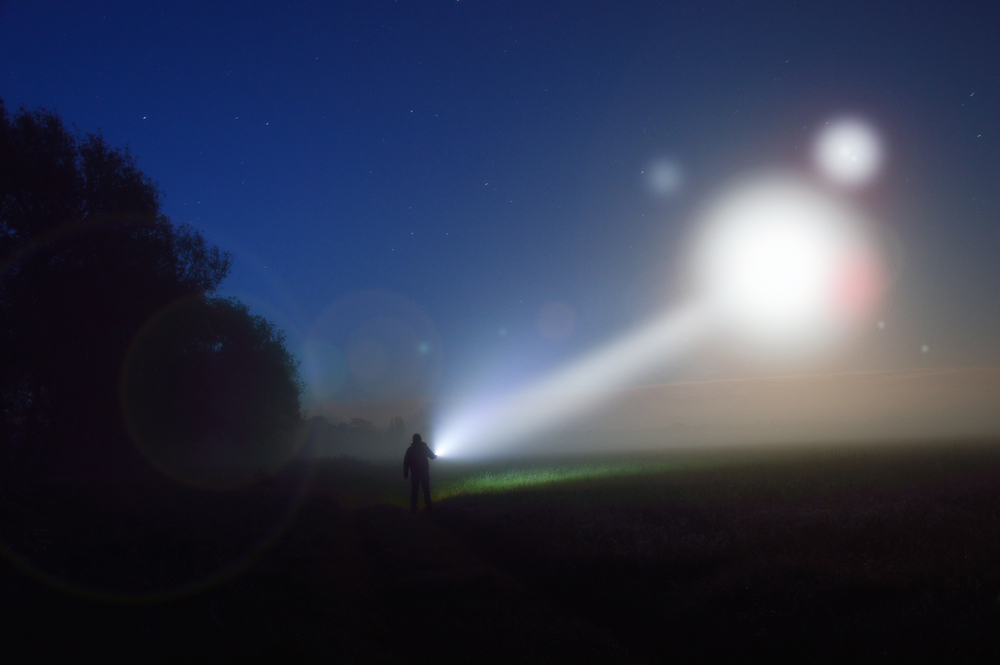
photograph of silhouetted figure shining flashlight at light source in the night sky

UFOs appear to be having a cultural moment. A Pentagon report laying out what U.S. intelligence agencies know about UFOs — or, to use the government’s preferred acronym, UAPs (unidentified aerial phenomena) — is expected at the beginning of June. A recent “60 Minutes” segment included interviews with two former Navy pilots who described their encounters with a UFO. The New Yorker ran a long piece about UFOs in its May 10th issue. And last week former Nevada senator Harry Reid penned a long reflection in The New York Times about his interest in the phenomenon.

It is relatively common to see UFOs, such as those tracked by Navy fighters’ infrared weapons cameras, described as “defying the laws of physics”; for example, flying at many times the speed of sound and then coming to an abrupt halt, without any visible means of propulsion. Being woefully ignorant about those laws, it is difficult for me to tell whether this is journalistic hyperbole or a claim to be taken literally. But if we do take it literally, then we can call on the great Scottish philosopher David Hume to help us decide what to believe.

Hume famously defined a “miracle” as a violation of a law of nature. For Hume, a law of nature obtains only when we have an extensive, and exceptionless, experience of a certain kind of phenomenon: for example, our extensive experience of human beings dying “establishes” the law that all human beings die. (As this example suggests, violations of laws of nature are not impossible or inconceivable; they are simply counterinstances to our extensive, exceptionless experience.) If UFOs really defy the laws of physics, then they perform miracles in the Humean sense.

Hume argued that no testimony — i.e., a person’s statement that something is true — can establish the existence of miracles. His argument can be summarized as follows:

1. The evidence against the existence of a miracle is as strong as it possibly could be.

A law of nature is established on the basis of experience, which is the only kind of evidence we can have for a causal proposition. And our experience is both extensive and exceptionless, so it furnishes evidence that is as strong as experiential evidence could be.

2. The evidence for the existence of a miracle from testimony, while perhaps very strong, is weaker than the evidence against the existence of a miracle.

Hume avers that it is always more probable that testimony is false — that the person giving the testimony “either deceive[s] or [has been] deceived” — than that a miracle has occurred. Put another way: to constitute stronger evidence than that which we have against the existence of a miracle, testimonial evidence for a miracle must be such that its falsehood would itself be a miracle — in fact, would itself be a greater miracle than that which the testimony is evidence for.  But for any given piece of testimony, there is always a non-miraculous possibility of its falsehood.

3. We ought to proportion our belief according to our evidence, and evidence for contradictory conclusions cancels out.

Hume here appeals to “evidentialism,” the commonsense idea that we ought to proportion our belief in a proposition to the evidence we have for it. In addition, he says that evidence for a proposition and evidence for its negation “destroy” each other.

4. Therefore, whenever our evidence for a miracle is based entirely on testimony, we ought to believe that it did not occur.

Since the evidence against the existence of a miracle is always stronger than testimonial evidence for it, when testimonial evidence is all the evidence we have for a miracle, we ought to believe that the miracle did not exist or did not occur.

We can now see how the argument can be applied to UFOs. If UFOs really perform miracles, then any testimonial evidence for the existence of UFOs is always weaker than the evidence against their existence. Therefore, we should reject the existence of UFOs if the only evidence we have for them is based on testimony.

It might be objected that we have non-testimonial evidence for UFOs, such as the infrared camera videos. However, these videos are by themselves difficult for most people to interpret or understand, as are most of the alleged photographs of UFOs. The layman must instead rely on the testimony of experts to interpret the videos or photographs for him or her. Thus, even when photographs or videos are held up as evidence of UFOs, it is really the testimony of experts, who provide authoritative interpretations of these materials, that is doing the evidentiary work. And this leads us back to Hume’s problem.

Of course, Hume’s argument is not without its many detractors; objections are legion. One objection revolves around what Hume says about the “Indian prince, who refused to believe the first relations concerning the effects of frost …” The Indian prince had an extensive, exceptionless experience of water in a liquid state. Frost is a counterinstance of the “law” that water is always liquid. Does it follow, then, that the Indian prince could not justifiably believe in frost on the basis of any testimony, no matter how strong? Hume’s response is that solid water is an experience that is not contrary to the prince’s experience, although it is also not conformable to it. The more general problem is that Hume needs to allow for progress in the sciences, including the revision of our understanding of the natural laws. Like many of Hume’s arguments, his argument about miracles set the agenda for much of the succeeding discussion, but left many questions unanswered.

Still, Hume’s argument against miracles is undeniably compelling. As applied to UFOs, the argument shows us the limits of testimony, however well-intentioned or authoritative.