

← Return to search results
Back to Prindle Institute

Wage Theft and the Social Construction of Crime

On June 25th, house members once again introduced the Wage Theft Prevention and Wage Recovery Act. As the bill’s sponsors point out, “wage theft” — when an employer fails to give an employee a benefit or payment they are legally entitled to — is the largest source of property crime in the US. The bill seeks to increase employer accountability, facilitate recovery of owed money, and increase penalties for employers engaging in wage theft.

However, despite the incredible scale of wage theft and the impact it has on workers, historically, wage theft has been treated as a bureaucratic matter, rather than a criminal one. (And employee underpayment is assuredly sometimes a matter of bureaucratic error.)  Under current law when wage theft is established, the employee is entitled to back pay and sometimes so-called liquidated damages in an amount equal to the back pay. Although, as of June 2025, the US Department of Labor no longer pursues liquidated damages. To be clear, the proposed law still does not criminalize wage theft at the federal level, although it does increase possible damages. Some states have, however, taken steps to criminalize wage theft.

What determines when something is treated as a crime and how serious the consequences should be? One approach is analytic. We begin by considering the social goals at play. Surely one aim is deterrence – in criminalizing intentional wage theft, we expect employers will take further precautions to ensure fewer instances occur. In considering policy, we might also look at other kinds of theft to see how wage theft fits those models. Wage theft certainly deprives workers of property, a key hallmark of theft. Although, conversely, it does not take existing property from employees, but deprives them of owed property. So, from a technical perspective, one could argue it is best understood as breach of contract.

Rarely though is the law decided on such dry analytic grounds — power matters too. Enter the social construction of crime. “Social constructs” have been somewhat maligned over the past few years, entangled in the culture war. But the underlying idea is simple and useful. Social constructs are things whose existence and character are a product of societal agreement. If all humans were to suddenly disappear, mountains would still exist, as would artifacts such as cars. However, the value of money would not. Money then, or at least the value of money, is a social construct.

A social constructivist approach to crime contends that what things we identify as crimes (and what punishments they deserve) are not the result of pure ethical analysis, but the product of a social context and often reflect who has power and influence. In a previous article, I discussed the case of punishment for pollution in the US. Plausibly, the lesser status of “wage theft” reflects the lesser political influence of employees compared to their employers.

But wage theft also demonstrates how labor organizers and activists leveraged the socially constructed nature of crime. While the idea of employers stealing from their employees is hardly novel, the term “wage theft”  is quite new, dating to the early 2000s. It strategically packaged together a number of employment infractions, from unpaid overtime to employee misclassification, and labeled them as theft. By design, it stresses that employers are taking money from their employees, rather than simply violating policy. In short, it created a category of crime.

This fact alone is neither good nor bad. Being a social construct is a descriptive claim about what kind of thing something is. From a philosophical perspective, the crucial question is what are the reasons behind a designation. For example, there may be excellent reasons to consider murder a crime. We may be less impressed with the US Supreme Court’s very narrow reading of corruption. A social constructivist approach helps us attend to the full suite of reasons behind whether something is criminalized and how seriously it is taken.

A social constructivist approach also reminds us that criminality is contested ground and the categories we have arrived at are not inevitable. For example, homosexuality used to be criminalized in the US. Wage theft is a straightforward case. It is not buried deep in our culture and it is easy to understand how the treatment of wage theft is a product of changing social conditions. We can imagine far deeper revisions of the relationship between wage labor and criminality. Many Marxists, for example, would stress that all labor under capitalism is similar to theft because the owner-class takes all additional profits resulting from their employees’ labor and appropriates it for themselves. This is a much more radical claim and pushes harder against our entrenched sense of the appropriate organization of the economy.

In fact, this is a key value for more “radical” philosophy even if we ultimately disagree. We all go through life picking up beliefs here and there, often quite casually. By interrogating our beliefs and confronting alternatives even to core convictions, we can improve the reasoning behind our ethical commitments.

Fortunately, Congress does not have to wrestle with the socially constructed nature of crime nor radical alternatives to wage labor to vote on the proposed wage theft law. The law uses existing non-criminal enforcement processes and simply makes them more robust. It remains to be seen if, unlike 2022, the bill will make it out of committee.
The Remarkable Odyssey of a Solid Gold Toilet

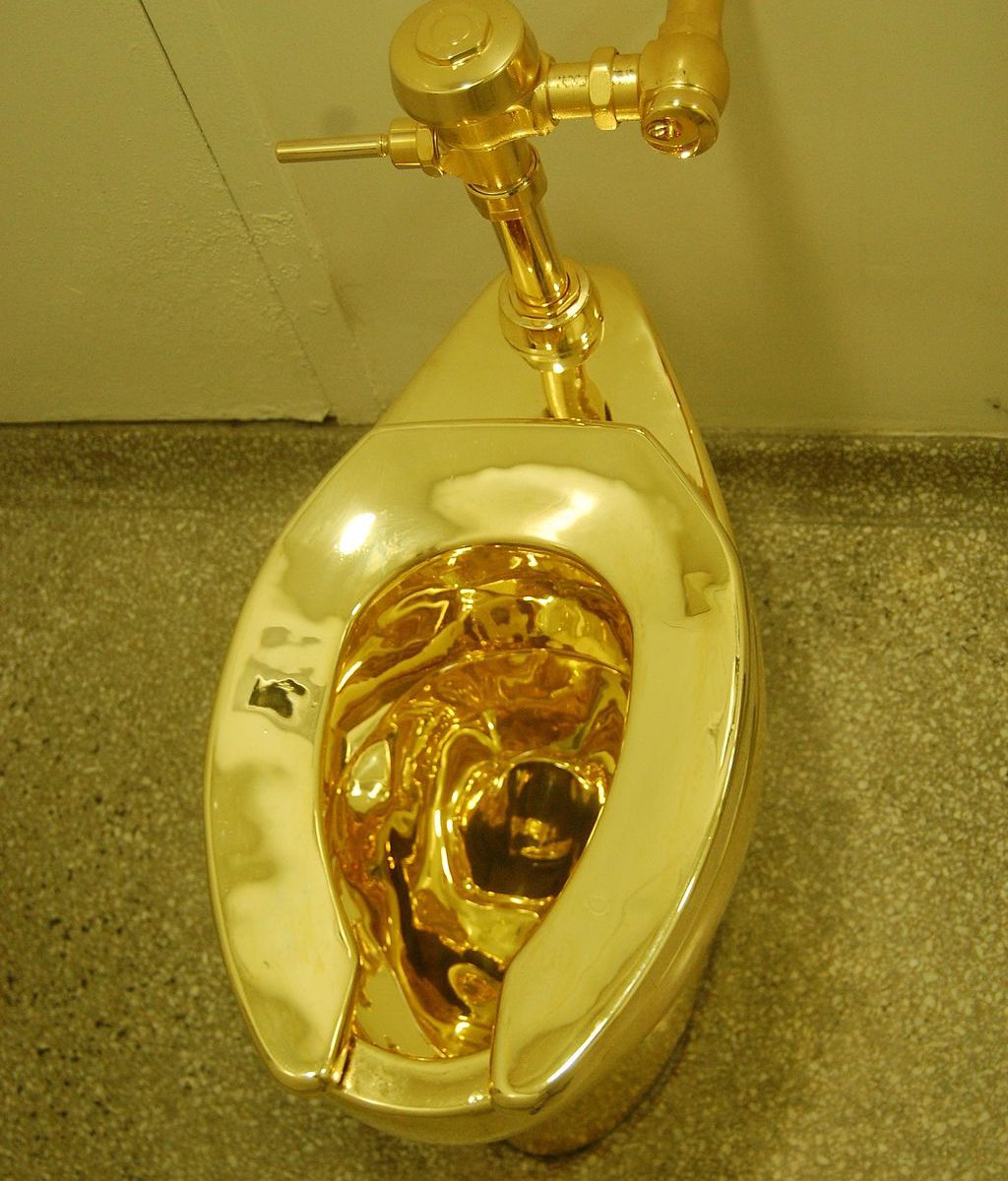
photograph of solid gold toilet America

In the early morning hours of Saturday, September 14th, a golden toilet named America was stolen from the birthplace of Winston Churchill. Artist Maurizio Cattelan crafted the piece of art in 2016 for an exhibition at the Solomon R. Guggenheim Museum in New York City. The toilet is fully functional and was designed to resemble the other toilets in the museum. Patrons had the opportunity to use the costly commode, crafted entirely of 18-carat gold, for the purposes for which such items are typically intended. The work was installed on Thursday of last week, again, in a fully functional fashion, in Blenheim Palace in Oxfordshire, England. A 66-year-old man is in custody in connection with the incident.

America is no stranger to front-page headlines. In keeping with presidential tradition, in 2018, President Trump requested to borrow a work of art from the Guggenheim Museum for display in the White House. In particular, he asked for Van Gogh’s Landscape with Snow. That request was denied. He was offered America instead.

To point out that there are layers upon layers of irony in play in this story would be, perhaps, to state the obvious. One level of irony comes from the fact that a golden toilet that represented income inequality was forcibly torn from its palatial home. The toilet was installed in Blenheim Palace in the same way its less expensive counterparts would be. As a result, stealing it required ripping it out. This was done quickly and caused significant water and structural damage to the room.

The motivations for the caper have yet to be revealed, and it might be amusing to speculate that the perpetrator knew just how ironic his actions would be and that he did what he did for that reason. Such speculation is probably misguided—the work was probably stolen because of the worth of the gold. If this is the case, the whole thing is actually even more poetic and provides a critical insight: it is a luxury to be in the position to view a million dollars worth of gold as nothing more than high art or social commentary. The message that Cattelan was trying to convey when he created America has to do with income inequality in America, and with the inescapable features of existence that we share in common regardless of our differences in wealth, status, and power. The theft of America organically goes meta on that message. The person who stole the piece presumably didn’t think that the best use of a million dollars worth of gold was to ironically adorn the water closet of a British palace somewhere.

It might be tempting to believe that the golden toilet saga represents art at its very best. Here, the value isn’t in the beauty of the piece or in the skill of the artist. Instead, it’s in the fact that it provides a potent motivation for reflection on income inequality both locally and globally. The community of art viewers, including presidents, museum docents, and art thieves, has contributed to the art and to the content of the message—it is an evolving work that reflects back at us who we are and what we value. The question is thus posed in a unique and interesting way. Art is a compelling form of speech. We might conclude, as a result of all of this, that as a human community we ought to take a page out of a toilet thief’s playbook and deconstruct the systems of wealth, privilege, and power that make golden toilets possible.

On the other hand, while we in the west are making toilets out of gold to finally generate long overdue conversations about income inequality, children in impoverished countries are dying of preventable diseases. Communities suffer from lack of access to food, shelter, clean drinking water, and basic medical care. It may be the case that America poses questions about income equality in a way that gets people to sit up and listen, but what does it say about our priorities that this is what it takes to get us to pay attention? Why aren’t we motivated more strongly by empathy for suffering beings?

A further observation has to do with the kind of value that we place on art and the ways in which that value gets expressed. The creation of art has instrumental value and may even have intrinsic value. It may be the case that the process of engaging in creative activity has value all on its own, regardless of whether the work created is good by any objective standard, or whether the creation serves a social function for the community at large. Human beings can be the harbingers of devastating destruction, and it is good to remember sometimes that we can be powerful creative forces as well. It also seems just and fair for artists to be compensated for their work. That said, the art world itself contributes to its own system of social hierarchy. Not all creation is created equal, and maybe it shouldn’t be. One great irony of the golden toilet heist is that six million dollars of the seven million dollar valuation of the art is the work’s value as art. Only one million dollars of the valuation is located with the gold of which the piece is comprised. Our valuation of art contributes to class-based distinctions. The possession of highly-valued fine art is a status symbol. Last year, a sculpture called “Rabbit,” created in 1986 by artist Jeff Koons sold for 91.1 million, setting a record for the most expensive work sold by a living artist. The sculpture resembles a rabbit-shaped silver Mylar balloon. In the meantime, hundreds of thousands of people in sub-Saharan Africa died of Malaria, while multi-million dollar rabbits sat on the tabletops of the elite.

Colonialism and the Western Museum

Inseparable from the modern museum is an examination of how the forces of globalization affect it. As audiences of these museums seek increasingly globalized experiences, so too have the collections of museums diversified with collections from around the world. Impressive as they may be, though, such collections bring with them a number of ethical issues. And in the time of ISIS and antiquity black markets, foremost among them is just how such antiquities arrived in the museum’s hallowed halls in the first place.

Continue reading “Colonialism and the Western Museum”