
← Return to search results
Back to Prindle Institute

Truth, Power, and the BBC: An Arendtian Warning

The BBC is often regarded as one of the most respected media institutions in the world. Since its founding in 1922, the public-service broadcaster has pursued its now-famous mission to inform, educate, and entertain audiences not only in the United Kingdom but across the globe. Yet, despite the best efforts of those who work for and lead the organization, the BBC has never been entirely free from controversy. As social and political tensions within the UK have intensified in recent years, the corporation appears to have found itself under scrutiny more frequently than usual. Be that Gary Liniker, former host of Match of the Day, sharing a social media post about Zionism which included the imagery of a rat (for which he later apologized), to the ever steady stream of sexual misconduct accusations made against multiple presenters, most recently the former MasterChef host Gregg Wallace. Most recently, it has drawn the attention of none other than Donald J. Trump. And, unexpectedly, the former president may have something resembling a point.

To recap: in January 2021, a crowd of Trump supporters gathered in Washington, D.C., after the then-president addressed them on the National Mall. The demonstration moved toward the U.S. Capitol and ultimately breached the building. By the end of the day, five people had died, including one shot by Capitol Police; hundreds were injured, including roughly 140 police officers; and dozens had been arrested. By early 2025, more than 1,500 individuals had been charged in connection with the attack. This is all well known and documented, but it is that documentation that has caused the BBC its recent headache.

On November 2nd, 2024, the investigative documentary series Panorama aired a special, hour-long episode titled Trump: A Second Chance?. The program included excerpts from Trump’s speech on January 6. This, in itself, is not unusual: a documentary cannot reasonably broadcast a lengthy speech in full, and selective quotation is an inevitable part of editorial practice. However, the program’s editing choices drew sharp criticism from Trump, who argued that Panorama had stitched together lines from the speech in a way that altered their meaning. The broadcast sequence appeared to show him telling supporters, “We’re going to walk down to the Capitol and I’ll be there with you. And we fight. We fight like hell.” This single line came from two different parts of his speech, over an hour apart. First, he said “We’re going to walk down to the Capitol, and we’re going to cheer on our brave senators and congressmen and women, and we’re probably not going to be cheering so much for some of them.” This was then followed a whole hour later with “We fight like hell. And if you don’t fight like hell, you’re not going to have a country anymore.” Now, even if you think his original comments were provocative, it’s hard to argue that Panorama’s editing conveys a much stronger, more explicit, call to violent action.

This is the crux of the issue that Trump has latched on to. That his words were taken out of meaning. And it is something for which the BBC has apologized. Nevertheless, a simple apology hasn’t placated the president, with him claiming he is going to sue the BBC for anywhere between $1 billion to $5 billion.

So, where then, is the ethics in all this? Well, there’s the obvious point about journalistic integrity and professional ethics – was this an intent to deceive or simply an ignorance of the possibility to do so. There are also questions about the freedom of the press. After all, many commentators and (so called) journalists bend or break the truth to tell better stories and get better ratings.

What I want to focus on, however, is the response to Trump’s criticism – not the issue itself, but the timidity it seems to have awakened. There is a growing sense that institutions, including the BBC, are adopting an increasingly defensive, self-censoring posture whenever confronted with the threat of Trump’s disapproval. This is not entirely new. We have seen US broadcasters remove entertainers and hosts from shows for criticizing the president. Jimmy Kimmel, for example, was taken off the air in September 2025 in what seemed to be an obvious attempt to placate the president. That decision was then reversed in less than a week. The BBC, meanwhile, appears to be internalizing the logic of appeasement, altering its editorial decisions before any protest is made. This is perhaps clearest in its handling of this year’s Reith Lectures.

The Reith Lectures, an annual series founded to promote the BBC’s educational mission, provide leading thinkers with a platform to explore the most pressing questions of the moment. This year’s lectures are being delivered by Dutch historian Rutger Bregman, author of Humankind: A Hopeful History and Utopia for Realists. His lecture series, called “Moral Revolution,” “explore[s] a growing trend for unseriousness among elites, and ask[s] how we can follow history’s example and assemble small, committed groups to spark positive change.”

In the first lecture, Bregman directs criticism at both left and right, calling the modern right corrupt and the modern left unwilling to act with moral courage. Unsurprisingly, Trump features prominently. Yet the BBC — apparently eager to avoid yet another confrontation — removed from the audio broadcast a line in which Bregman described Trump as “the most openly corrupt president in American history.” Bregman has since accused the BBC of cowardice and noted the irony of censoring a lecture series literally dedicated to moral courage.

It is here that philosophy reveals its value. For the ethical problem at stake is not merely about one edit, one lawsuit threat, or one lecture clipped for safety. It is about truth, power, and the need for healthy public discourse.

In The Origins of Totalitarianism, Hannah Arendt warned that the greatest threats to freedom arise not only from overt censorship, but from the gradual corrosion of a shared reality. In such conditions, individuals and institutions come to anticipate the expectations of the powerful and adjust their speech accordingly. This self-imposed conformity, with people silencing themselves before anyone needs to silence them, was, for Arendt, one of the most dangerous features of a collapsing public realm. It presents itself as caution or professionalism, yet it quietly erodes the very conditions under which truthful speech and political judgment can survive. In other words, it is not so much a defensive retreat but a preemptive surrender.

This is why the Panorama edit and the Reith Lectures matter. The former was a mistake that was later corrected. The latter was an act of anticipatory caution. Together, they trace a worrying progression from error, to apology, to fear, to self-censorship.

For Arendt, truth-telling is a political act, one that is never neutral or risk-free. A functioning public sphere depends on institutions willing to articulate facts even when those facts are contested, inconvenient, or unwelcome. Once a broadcaster, and especially one of the size and reputation of the BBC, begins to tailor its editorial decisions to avoid antagonizing the powerful, it ceases to be a guardian of public truth and becomes instead a manager of public feeling.

If the BBC wishes to maintain its reputation and live up to its purpose, it must confront the deeper ethical stakes at play. Preserving trust does not mean avoiding offense; it means demonstrating the courage to uphold factual truth in the face of intimidation or political pressure. Bregman is right that without that courage, the public sphere shrinks, and in that space, something else, something darker, steps.
Expert Suspicion: Arendt and the “Public Space”

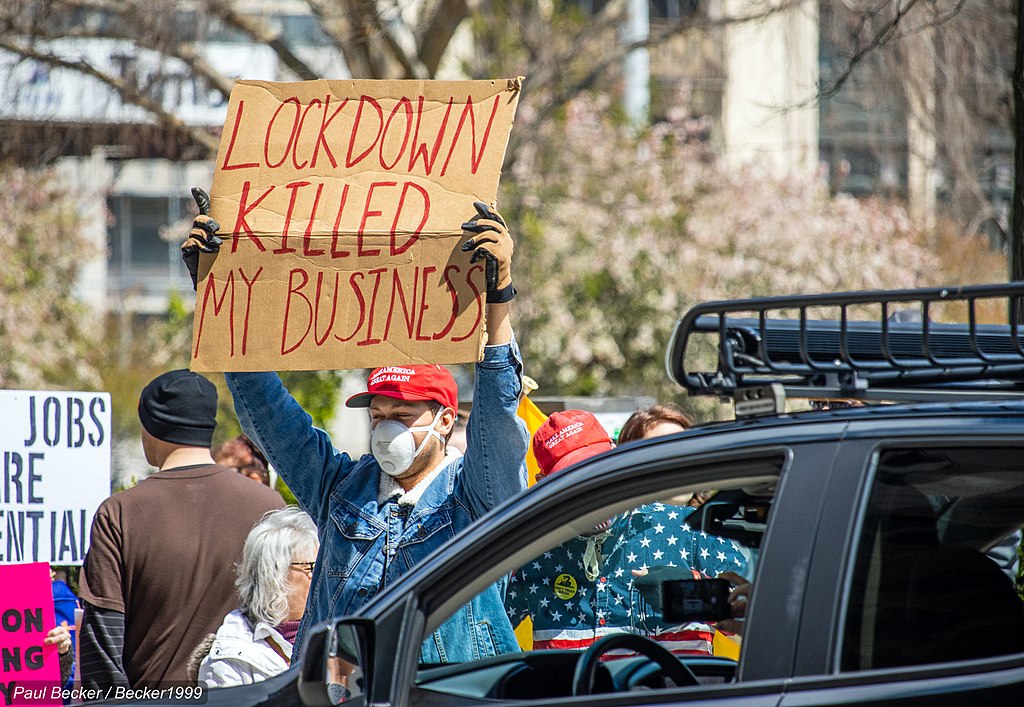
photograph of Open Ohio protesters

In the opening days of May, health care workers reported nearly 100,000 new cases of COVID-19 in the United States; in that same time, several thousand patients died of the disease. Nevertheless, as of May 4th, at least nine states have begun to loosen restrictions on movement in public spaces placed in response to the coronavirus outbreak, reopening beaches, restaurants, gyms, and other “nonessential” businesses.

As shouted by protestors from Arizona to Wisconsin to the White House, one explanation for rolling back the pandemic response, despite the spread of the pandemic itself showing no signs of slowing, is that “the cure cannot be worse than the disease.” Since March, more than 30 million Americans have filed for unemployment and these numbers indicate only a fraction of the economic fallout from the enforced quarantines. Thus far, almost no industry — from entertainment, to higher education, to oil production, and more — has escaped unaffected and, particularly with the globe teetering on the edge of a recession, it is far from clear what sort of long-term consequences of the shutdown lie ahead.

Certainly, with their tendency towards ultra-militarized displays of aggression and their often-explicitly racist messaging,  there is much that is inexcusable about many lockdown protests, but when CNN’s Don Lemon says that people unhappy with the lockdowns just “want a haircut” or “want to go play golf,” he seems to be unfairly painting all complaints about the shutdowns as if they are as ignorant as those clearly silly concerns. A “nonessential” locally-owned art gallery or specialty construction company forced to close to prevent the spread of the disease might, nevertheless, feel terribly “essential” to the people whose livelihoods depend on those businesses being open.

Of course, medical experts agree that easing “social distancing” restrictions at this point is premature and could very well lead to an even more serious spread of the virus. The moral calculation of “millions going bankrupt” against “tens of thousands dying” is not a problem I – or, indeed, anyone – could hope to easily solve. Both of these outcomes are clearly unacceptable and most policymakers around the world seem to be trying to chart a course between Scylla and Charybdis that keeps both threats as low as possible, simultaneously. But conversations about the pandemic seem to typically prioritize only one of these two political concerns (“saving citizens’ livelihoods” vs. “saving citizens’ lives”) at a time.

Much has been said recently (including by me) about “expertise in the time of COVID-19.” Certainly, spreading pseudo- and anti-scientific information is dangerous (particularly during a pandemic) and we should think carefully about how we think about the coronavirus. Trusting experts in matters of public health and safety is a crucial part of living in a large, well-functioning society like ours — pretending otherwise, even for looming existential concerns, is simply irresponsible. But, particularly for people whose exposure to the pandemic has been primarily economic — such as those citizens in less-populated states where the spread of the virus has thankfully been less severe — it can be understandably off-putting to have your most salient personal political concerns belittled (or even morally condemned) for the sake of other political concerns, no matter how objectively important both sets of concerns may be. To denigrate your perspective for the sake of “listening to the experts” (when the perspective of those experts is simply orthogonal to your concerns) might well only serve to provoke a backfire effect that leads primarily to greater levels of frustration at the experts being touted and suspicion of the information they share.

This, I take it, was one thing that the philosopher Hannah Arendt was concerned to avoid by her treatment of politics not simply as a process of governmental operations, but as “the place and activity of shared communication based on the distinct perspectives of equal human beings.” Rather than treat politics or political decision-making as an activity properly performed by specially-trained experts, Arendt argued that wherever people gather together “in the manner of speech and action,” they create a community with power to accomplish their political purposes. In her book, The Human Condition, Arendt explains how the development and preservation of public spaces wherein we can politically engage with each other is both a fundamental element of the human experience and a necessary precondition for civic freedom. Importantly, by “public space” Arendt does not just mean physical locations, but rather the realm of discourse wherein perspectives and concerns can be expressed, challenged, debated, and legitimated. When governments seek to restrict and restrain these sociological structures, they begin to take what she calls a “totalitarian” form, thereby precipitating all manner of further oppressions and human rights abuses (on this, see her The Origins of Totalitarianism).

Just to be clear: I do not mean to suggest that Arendt would necessarily be opposed to a mandated lockdown to prevent the spread of COVID-19 (and I certainly do not mean that Dr. Fauci or other healthcare workers are totalitarian oppressors!). Of course, Arendt held no principled animus against experts as such; she simply recognized that their expertise would have to be shared within the public space wherein others would be able to respond. Artificially constraining the operation of that public space — even for demonstrably moral purposes — is a necessarily troublesome notion. And from the perspective of people concerned about the dire economic consequences of the lockdown, forcing a conversational shift to a discussion of mortality rates and other healthcare issues might come off as just such a constraining move.

So, I think that Arendt’s realistic analysis of how our perspectives shape our participation in political structures can help to explain some of the curious disagreements about the response to the coronavirus pandemic, as well as the all-too-common tension in conversations about what we should do next. The clash of perspectives over what is “clearly the right thing to do” cannot simply be resolved with reference to a particular statistic (economic or scientific), but requires the sort of free speech and effortful conversation that Arendt considered fundamental to the human condition.

(I also want to note: I sorely wish that Arendt could respond to President Trump’s widely rejected assertion that “When somebody’s the president of the United States, the authority is total,” but that’s a different conversation!)

Christchurch: White Supremacism, Politics and Moral Evil

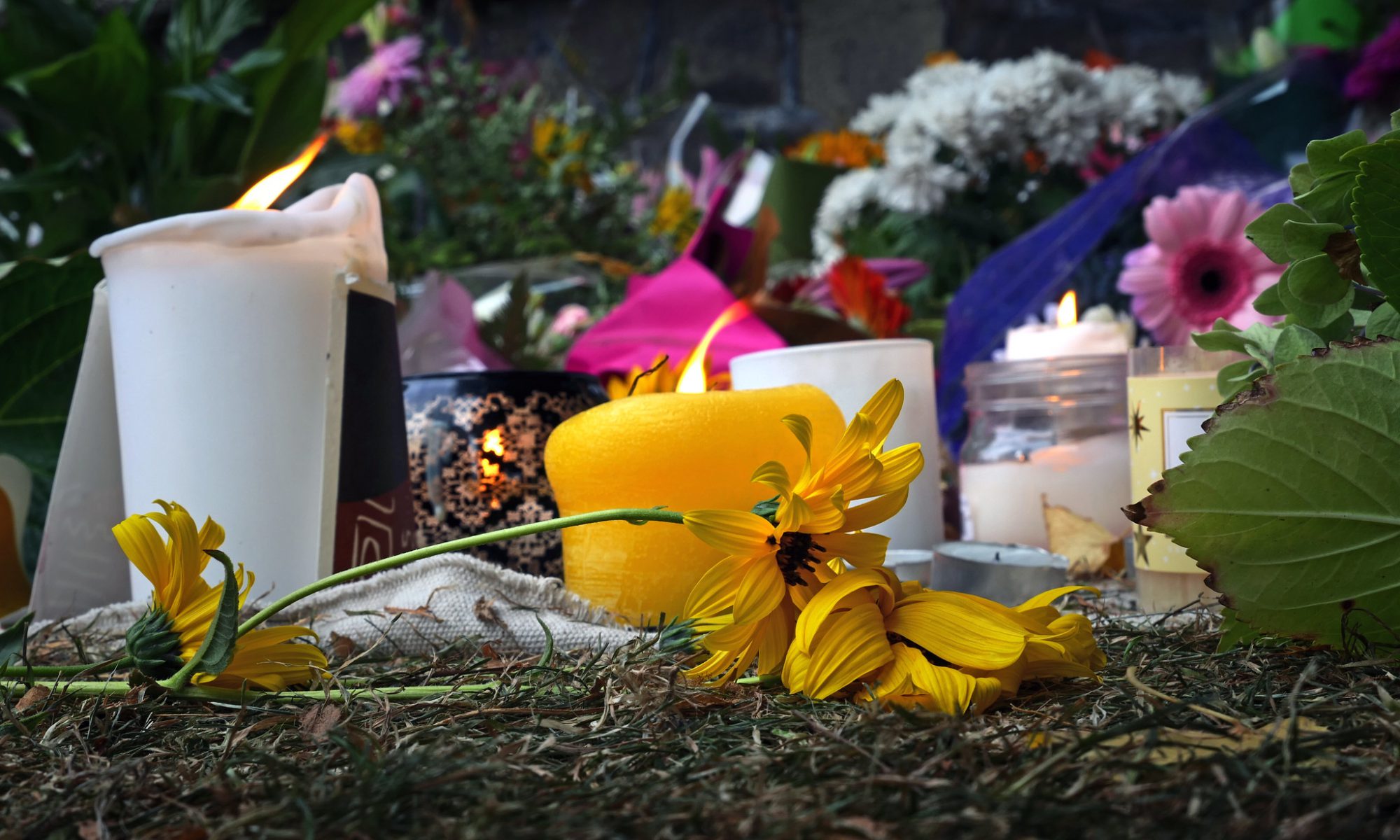
Photograph of candles and flowers arranged to mourn victims of the shootings

Almost three weeks ago, on Friday March 15, 2019, the world looked on in horror as news broke of a terrorist attack perpetrated by a white supremacist against a community of Muslims during Friday prayers at two Mosques in Christchurch, New Zealand. The gunman, a 28-year-old Australian man, killed 50 people with a cache of weapons including semi-automatic rifles emblazoned with white nationalist symbols. He streamed film footage live on social media before and during the massacre. (Jacinda Ardern, New Zealand’s Prime Minister, has promised not to speak the terrorist’s name in public so as to deprive him of the fame he desires. Many news outlets in New Zealand and Australia have followed by continuing not to use his name, and in that spirit, this article will also decline to use his name.)

This individual was not known to authorities or to security agencies in Australia or New Zealand, but subsequent searches show that he supported Australian far right groups (now banned on social media) and was an active member of several online white supremacist forums. Prior to the massacre he published a 74-page “manifesto” online titled “the great replacement” in which he enthusiastically discusses various neo-fascist modus operandi including creating an atmosphere of fear in Muslim communities. He describes himself as a “regular white man from a regular family” who “decided to take a stand to ensure a future for my people.” He said he wanted his attack on the mosques to send a message that “nowhere in the world is safe.”

The accused gunman mentioned Donald Trump in his manifesto, praising the US president as “a symbol of renewed white identity and common purpose.” Acting White House chief of staff Mick Mulvaney brushed off the association: “I don’t think it’s fair to cast this person as a supporter of Donald Trump” Mulvaney said, adding “This was a disturbed individual, an evil person.”

The notion of evil is evoked in particularly extreme and egregious circumstances. Doubtless Mulvaney is right about the gunman being disturbed, and perhaps about his being evil. Evil is a moral category that bears some examination; but statements of the ilk of Mulvaney’s, which emphasize the individual nature of the action are challenged by another view. Since this horrific event there has been much soul-searching and a great deal of public debate in the gunman’s home country of Australia about possible causes or exacerbating factors for such an event; or at least about its possible relationship to wider public sentiments about issues like race and immigration. Many have criticized the level of public discourse in Australia where some views espoused by mainstream media and mainstream politics seem to prefigure and presage many of the views expressed by the gunman in his manifesto.

It is being widely acknowledged that there has been a rise in anti-Muslim sentiment in mainstream political discourse; that incendiary platforms of anti-immigration and racist rhetoric have increasingly been employed not just by fringe right-wing political outfits (in Australia the One Nation party is a particularly egregious example) but also by the major political parties to drum up support and to create political advantage.

Examples are not difficult to find. In the days following the massacre Frazer Anning, a senator from One Nation (Australia’s furthest right, whitest, most nationalist minor party), was castigated for suggesting the mosque attack highlighted a “growing fear over an increasing Muslim presence” in Australian and New Zealand communities. These remarks are obviously abhorrent, and Anning will be formally censured in Parliament for them. But while Australian Prime Minister Scott Morrison was denouncing Anning, he was also explaining, or rather denying, remarks he himself is reported to have made in a strategy meeting as opposition Immigration spokesman, in which he reportedly urged his colleagues to capitalize on the electorate’s growing concerns about “Muslim immigration”, “Muslims in Australia” and the “inability” of Muslim migrants to integrate.

And all this is familiar to the Australian public who have just witnessed, in the weeks before the massacre, the government drumming up hysteria about refugees (most of whom are Muslim) by suggesting that they may be rapists and paedophiles, and that bringing them to Australia for medical treatment would deprive Australians of hospital beds. There is no doubt (even if Donald Trump denies it) that white supremacy is on the rise, that it is being fed by social media, and that the movement is feeling emboldened by the current political climate. Given this tinderbox of conditions, many believe that it was only a matter of time before it again erupted in violence.  

So how do we square claims about the social and political conditions that feed such hatred with claims about the individual evil of the nature and actions of the one gunman who committed this massacre?

The question must be about responsibility. Acknowledging the conditions, which foment a general anxiety about race and immigration, and which embolden the already radicalized, are important parts of what we must as a (local and global) community come to terms with. Yet if we want to say that this was an act of evil perpetrated by an evil person, then we want it to be understood that that also means he is fully morally culpable, not that he is simply an instrument or product of the zeitgeist. We therefore must be aware of those who want to use that view to deflect responsibility away from themselves or their vested interests, including politicians whose policies and public pronouncements too closely resemble the evildoer’s message of hate.  

So how do we think about the notion of moral evil – and assess the moral usefulness of that concept here? There is a long history in philosophy of discussions of the nature of evil. Historically, evil has been a theological concept, and much philosophical discussion has tended to focus on ‘natural’ rather than ‘moral’ evil (natural evil is said to include bad events or bad things that happen over which agents have no control). Reasons for shunning the concept of evil in modern moral discourse are its sense of the supernatural, and because it can be thought to, by evoking a sense of mystery, express a lack of understanding and of reason. In the secular systems of philosophy, evil as a moral concept has often been eschewed in favor of moral categories of ‘wrong’ and ‘bad.’

When people say, following such an event, that ‘it was an act of evil’, what do they mean? Even if the category of evil is evoked over and above badness or wrongness, there may be different understandings of its distinction from these categories. Is evil different in kind, that is, is it qualitatively different, from an act that is just morally wrong, or may be described as bad? If that is the case, then there must be some element an evil act possesses that an act that is simply morally wrong does not. Yet it has not been easy for philosophers to pinpoint what that element is. It has been suggested, for example, by Hillel Steiner in his article “Calibrating Evil” that the quality present in an evil act that is not present in an act of ‘ordinary wrong’ is that of the pleasure derived by the perpetrator from the act. On the other hand, it could be argued that evil is quantitatively different from acts of ordinary badness, and that as a moral category it serves to amplify our understanding of the moral terribleness of an action.   

Regardless of your metaphysical commitments on these questions, a reason for turning to the concept of evil in moral philosophy is that the moral categories of ‘wrong’ and ‘bad’ are at times not enough to capture the moral significance of horrors which seem to go beyond the limits of those concepts. Hannah Arendt famously wrote about the concept of evil, in the context of her report on the trial of Adolf Eichmann, one of the chief architects, and bureaucrats, of the Jewish Holocaust. (As it happens, both her theory and her source material seem to be relevant here.) Arendt employed the idiom ‘evil beyond vice’ to name a kind of radical evil, one she saw as coming to fruition in the horrors of the Nazi death camps and the ‘final solution’. She analyzes evil of that nature as being a form of wrongdoing that cannot be captured by other moral concepts; that involves making human beings superfluous and that is not done for humanly understandable motives like self-interest.

Though a great deal of philosophical ethics is normative – gives us the tools to discern in a variety of situations, right from wrong and good from bad – following an event like the Christchurch massacre it seems that the role of ethics becomes partly a descriptive one – so that we use moral concepts to come to terms with, and face honestly up to, the terribleness of such events.

The paradigm for evil since the Second World War is the horror of the Nazi regime and the Jewish holocaust. It is very disturbing that there is a link, and not an incidental one, between that paradigm of evil and the motivations of the evil of the Christchurch shooter. White nationalism is white supremacy and white supremacy is neo-Nazism. There are ample pictures on the internet of the groups with which the Christchurch shooter identified, and countless groups like them, showing people displaying swastikas and doing the Nazi salute. Even the United States president Donald Trump ostensibly claimed that there were ‘fine people’ marching with torches in a white supremacist rally in Charlottesville in 2018.

Calling this an act of evil may, or may by some using that designation, be meant to distance it or cut it off from factors which the speaker has a reason to be defensive about. Yet there is no reason to accept the implication that an evil act is an act that occurs in isolation from social and political forces. Matters of causality are difficult, and almost always opaque. Not every individual engaged in nationalist chat rooms or racist conspiracy theories will commit an atrocity, but the discussions in those spaces will foment and galvanize the hatred. And every politician’s casually nationalist or off-handed racist statement or policy adds to the normalization of the same sorts of messages that white supremacists promote. All of this matters because it will help create the atmosphere for such unspeakable acts of evil to take place.