
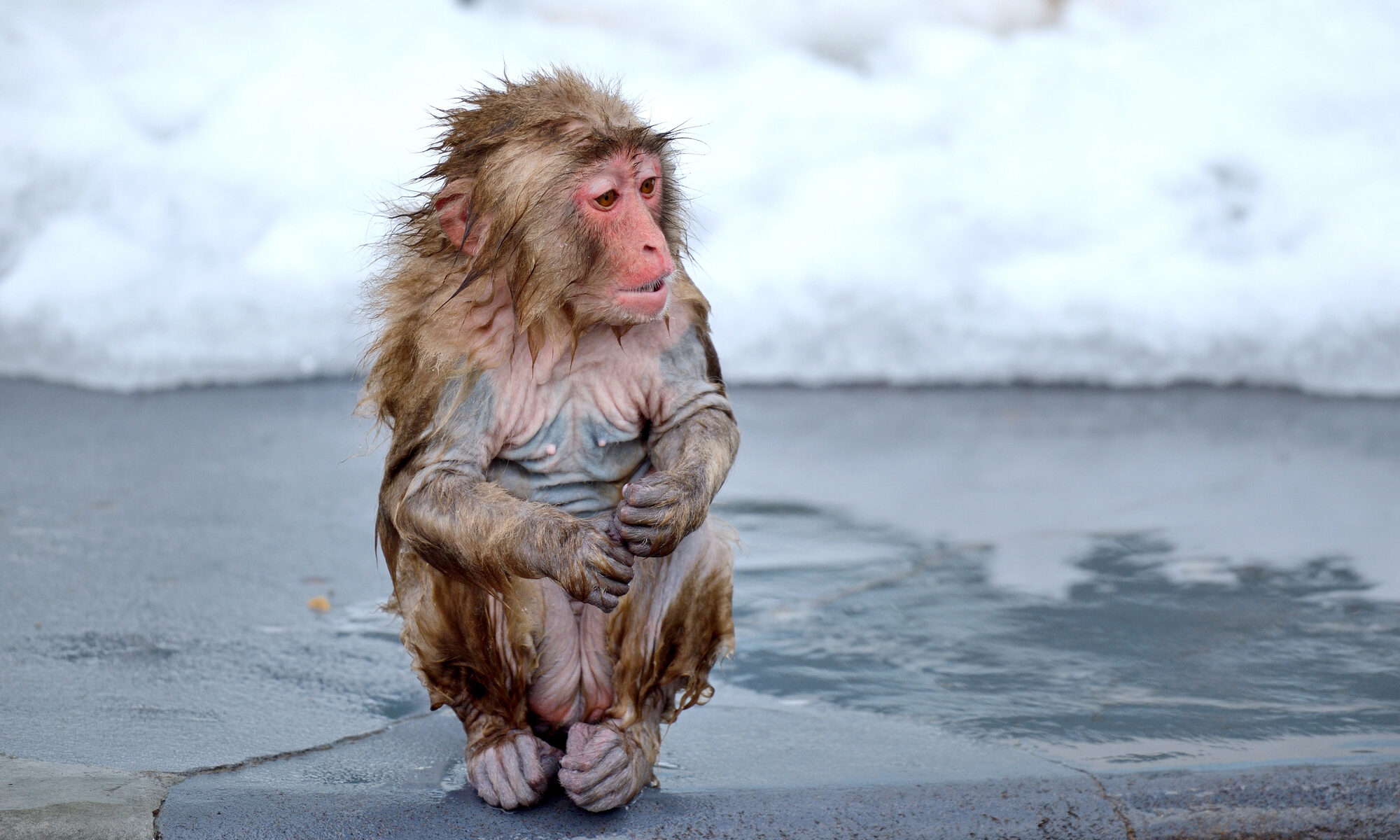
Punch, a baby macaque monkey at Ichikawa City Zoo in Japan, has tugged on millions of heartstrings in his short seven months of life. He has become a worldwide sensation due to his inseparable relationship with an unlikely companion: an orange stuffed orangutan. Zookeepers gave the stuffed orangutan to Punch after his macaque mother rejected him shortly after birth. The zoo has seen nearly 5,000 visitors a day in late February owing to the phenomenon; posts and videos of Punch have attracted millions of views and likes.
How does little Punch connect with two ancient philosophers and a millennia-old philosophical question? It turns out our spontaneous reactions to watching videos and viewing images of Punch may just be a modern-day viral equivalent of a 2,000-year-old philosophical thought experiment.
Mengzi (c. 372-289 BCE) was an ancient Confucian philosopher who is famous for advancing the view that human nature is good. In making this claim, Mengzi was responding to a vibrant debate in ancient Confucian philosophy on the question of whether human nature was fundamentally good, bad, or neither. Contemporary philosophers are still asking the same questions.
Mengzi wasn’t a rosy-eyed, naïve optimist about human beings — he didn’t think all of us are fully virtuous or good people. Rather, he thought all human beings had the potential to become good. He thought this predisposition toward goodness helped to explain why we could achieve a flourishing human life, exhibited through practice of certain key virtues. He compares our innate moral dispositions toward goodness as “sprouts” which can be nurtured to full virtues. According to an ancient collection of sayings, Mengzi says:
As for what they are inherently, [human beings] can become good. This is what I mean by calling their natures good. As for their becoming not good, this is not the fault of their potential. Humans all have the feeling of compassion. Humans all have the feeling of disdain. Humans all have the feeling of respect. Humans all have the feeling of approval and disapproval… Benevolence, righteousness, propriety, and wisdom are not welded to us externally. We inherently have them. It is simply that we do not reflect upon them [to develop them into full virtues]. (Mengzi 2A6.5-7; Bryan Van Norden trans.)
To support this claim, Mengzi deploys a thought experiment to show that human beings naturally have the “sprout” of benevolence within them. He considers what is called the “child and the well” case. In it, Mengzi asks us to imagine a small child toddling toward a well, about to fall in. Mengzi thinks that nearly all of us would show spontaneous and unthinking care for this child, stepping in to save it from falling into the depths of the well. Mengzi says that we would do this even if we thought there would be no reward money, we knew nothing of the child’s parents, and whether or not we would be annoyed by the child’s cries.
This is where Punch comes in. The widespread Internet engagement with Punch may suggest that (at the very least) millions upon millions of people have the “sprout” or starting-point of benevolence within them, providing us a contemporary viral version of Mengzi’s “child and the well” case. When we see little Punch missing a mother and needing love and care, the thinking goes, we feel a spontaneous surge of benevolence, hoping to help this little child-like animal. Morton Kringelbach, Professor of Neuroscience at the University of Oxford, commenting on the underlying moral neurocircuitry at work as we watch Punch, says that witnessing Punch’s plight “reminds us of what it is really to be human.” He says that these experiences are the gateway to empathy and compassion.
Xunzi (313-238 BCE), another important ancient Confucian philosopher, disagrees. He criticizes Mengzi, saying that following our human natures is a sure path to destruction. Human nature, he argues, is bad. He says:
People’s nature is bad. Their goodness is a matter of deliberate effort. Now people’s nature is such that they are born with [a fondness for profit, feelings of hate and dislike, desires of the eyes and ears…] [If] people follow along with their inborn dispositions and obey their nature, they are sure to come to struggle and contention, turn to disrupting social divisions and order, and end up becoming violent. So, it is necessary to await the transforming influence of teachers and models and the guidance of ritual and yi (righteousness), and only then will they come to yielding and deference, turn to proper form and order, and end up becoming controlled. (Xunzi 23.1-17; Eric Hutton trans.)
Xunzi points to war, cruelty, greed, and desires for pleasure as the roots of human evil. He thinks our natures can’t be trusted and questions whether we all really have the sprouts of virtue Mengzi describes.
But Xunzi faces challenges in arguing for this view. He still wants to think we can develop and grow into better people with the transforming influence of moral exemplars he calls sages. But, if we’re all that bad, how can we ever become good? Interestingly, Xunzi eventually argues that we may be something of a mixed bag — our natures exhibiting some positive, prosocial motivations common to all social animals and exhibiting destructive, selfish human motivations that pit us against one another.
The overwhelmingly loving and caring reaction to Punch’s all-too-relatable loneliness and exclusion (and primal need for love and connection), we might think, could be seen to tip the scales in favor of Mengzi in this ancient (and modern) debate about humanity’s starting points. It doesn’t evidence fully formed virtues in viewers, to be sure, but perhaps it does show something like sprouts of benevolence, caring, and compassion in millions upon millions of viewers around the world.