← Return to search results
Back to Prindle Institute

When Is It Wrong to Be a Fan?

In times like these, it’s good to be a fan. Our favorite fantastical worlds can provide an escape from the many crises that surround us. But they can also provide answers. Tales of hope, heroism, and – most importantly – kindness, can give us the inspiration we need to respond to the overt acts of cruelty we read about in the news each day. But even so, might there be times when it’s wrong to be a fan?

In a recent series of Middle School Ethics Olympiads, I had the privilege of hearing students’ opinions on whether we can still enjoy artworks created by morally problematic artists. For the most part, this question was met with a resounding “yes.” And that sort of makes sense. Whatever determines the aesthetic value of an artwork, it seems minimally dictated by the moral status of its creator. Put another way, a beautiful painting will still be beautiful, even if created by someone who has engaged in repugnant behavior. And it’s hard to see how it might be morally wrong of us to still appreciate this aesthetic value.

Perhaps a trickier question, then, is whether or not it’s morally permissible for us to patronize such artists. Many artworks cost money to enjoy. We have to pay to read a book or to watch a movie (assuming, of course, we’re doing so legally). Engaging with art in this way takes things a step further: we move beyond mere aesthetic appreciation of the artwork and instead provide financial support for the artist. Is it wrong for us to provide this support for an artist who has engaged in morally questionable behavior? And what about cases where our money will be used by the artist to do even more harm?

This consideration bears some similarity to the moral obligation to engage in “divestment” – that is,  to withdraw our investments from corporations and other organizations actively engaged in causing harm. This is the kind of reasoning behind New York City’s ongoing attempts to divest their pension fund from the coal, oil, and gas industry – since remaining invested in those industries arguably contributes to the worsening climate crisis. A similar argument for divestment might be made in cases where our money is invested in perpetuating other environmental harms, or – say – supporting an unjust war. At the end of the day, these arguments are built on one general principle: money makes the world go round, and where we invest our money matters.

Might something similar be true in the realm of art? Consider J. K. Rowling – author of the best-selling book series of all time. Beloved by fans, Rowling has – in more recent years – gained infamy for her position on transgender rights: specifically, her expression of allegedly transphobic views and her opposition of Scotland’s Gender Recognition Reform Bill. Assuming that her views are morally problematic, can fans still enjoy her creations? Does it remain morally permissible for someone to sit down and watch a Harry Potter movie marathon, or reread their favorite novel in the series? According to those middle school students I spoke to, the answer, again, is “yes.” Whatever makes Rowling’s works aesthetically valuable, that value remains in spite of her controversial views. The books are no less well-crafted, nor the movies any less enthralling.

What’s more controversial is whether or not we can morally justify providing Rowling with financial support. This is made all the more complicated by her establishment of the JK Rowling Women’s Fund (JKRWF) in 2024. The JKRWF is a private fund, financed exclusively by Rowling’s personal wealth of approximately $1.2 billion – the majority of which owes its existence to the astronomical success of the Harry Potter franchise. The purpose of the fund is singular: to (as the official website describes it) offer “legal funding support to individuals and organizations fighting to retain women’s sex-based rights in the workplace, in public life, and in protected female spaces.” Ultimately, the JKRWF is positioned to engage in anti-trans activism – and has already been responsible for an $89,000 donation to the organization whose legal challenge resulted in the UK Supreme Court ruling that the legal definition of a woman is determined by biological sex.

A decision to fund Rowling, then, is a decision to fund the JKRWF. With the purchase of every Harry Potter novel, or movie ticket, or licensed LEGO set, a contribution is made to Rowling’s wealth – a contribution that may be used to engage in anti-trans advocacy. To be clear, a fan might still read the books they already own, and rewatch the DVDs they purchased long ago – but any new contribution to Rowling’s wealth will be difficult to justify. Put simply: if someone disagrees with the mission of the JKRWF – that is, if they believe in trans rights – then it’s hard to see how they can consistently maintain their moral position while continuing to patronize Rowling’s work.

The Exploitation of Goodwill: Valuing the “Helping” Professions

Nursing is no longer federally classified as a professional degree. When news broke in November, the American Nurses Association condemned the action, arguing the move drains funding for pre-service nurses, “undermining efforts to grow and sustain the nursing workforce.” In response, The Department of Education argued that this is “not a value judgment” but, rather, “distinguish[es] among programs that qualify for higher loan limits.” Still, the declassification itself seems to reflect a valuation and, in turn, risks social devaluation of nursing and similar professions.

This demotion comes alongside an overwhelming underwhelm of support for other social services, including budget slashes for public schooling and behavioral healthcare. The laborers behind these so-called “helping,” “care,” or “service” professions fill interpersonal roles in direct aid to others’ well-being. The category includes nurses and emergency responders, school counselors and teachers, and psychologists and social workers.

In addition to their licensure requirements, care professions are also characterized, in the United States, by a low amount of support. This creates a disillusioning disparity: high standards for hire with low standards for working conditions. What might this gap — and its persistence — say about our perceptions of the helping professions?

First, let’s consider the prerequisites for working as a service professional.

Social workers, for instance, require a master’s and, just like registered nurses, must pass a licensure exam after completing supervised clinical experience. Similarly, the road initial teaching licensure requires a bachelor’s in the teacher’s content area and an educator prep program (EPP): a yearlong apprenticeship, a teaching performance assessment (edTPA), and subject exams. New York teachers must earn a master’s degree within their first five years.

In other words, you can’t just walk into a school or hospital and be eligible for hire.

At least, that’s in most cases. One exception is found in Florida’s response to its teacher shortage: a United States veteran with four years of military service may obtain a teaching certificate without a bachelor’s degree or EPP. This specialization deviation has been met with alarm, implying an intuition that teachers should engage in specialized training. Granted, a degree isn’t the only opportunity for learning, but removing its requirement speaks, at least generally, to lowered standards for content expertise. At the end of the day, you probably can’t teach AP Statistics effectively without understanding statistics yourself.

The necessity of training is further evidenced by the challenges baked into helping professionals’ jobs.

For instance, nurses facilitate care for patients and their loved ones. First responders, by definition, arrive at emergencies before anyone else. This means horrific, perhaps end-of-life, encounters are a possibility for any given shift. 1 in 3 first responders develop PTSD (compared to the general public’s 1 in 5 chance). Teachers, counselors, and social workers accommodate individual student learning needs while delivering developmentally appropriate curriculum. They are often the only non-parent adults with daily eyes on a child, emphasizing the gravity of their duties as mandated reporters of abuse and neglect.

But we’ve heard about these challenges. They’re expected, inherent in the jobs themselves.

Instead, what deserves more airtime is the extent to which helping professionals are trained to expect structural failure: challenges emerging from inadequate support in, or as a result of, the professional environment. Unlike the challenges of caring for sick patients or teaching chattery kids, structural workplace obstacles could, theoretically, be eliminated. Consider, for instance, The First-Year Teaching Rollercoaster, a graph popularly shown to pre-service educators:
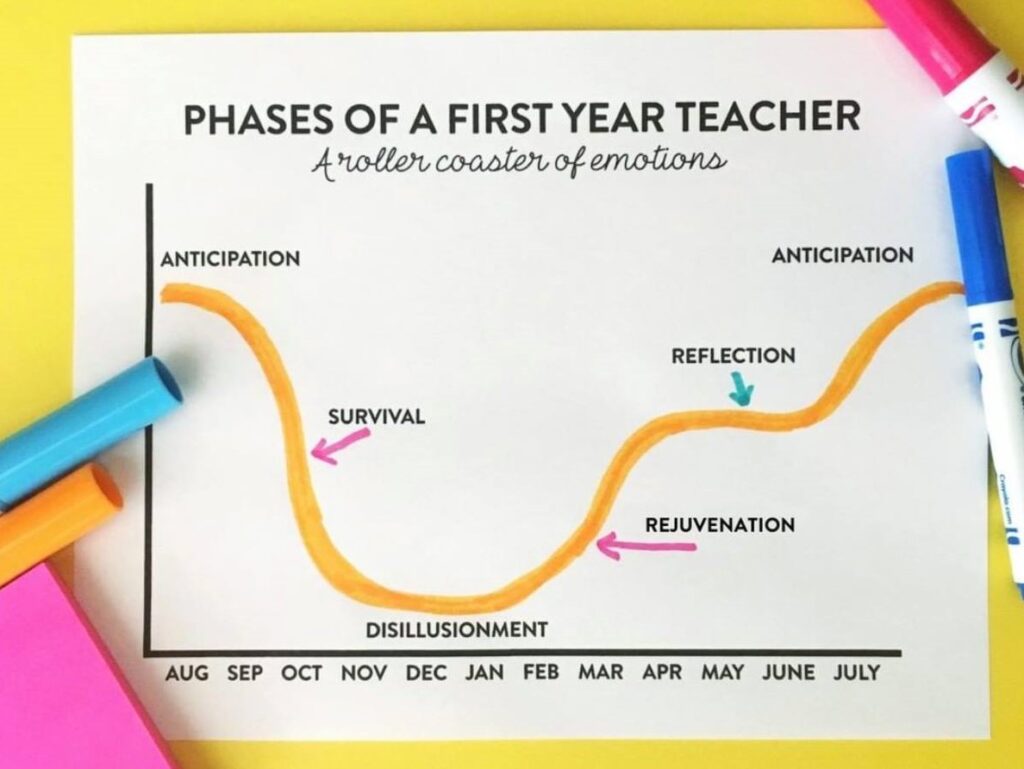
There’s something bizarre about telling someone to anticipate seasonal disillusionment. It’s off-putting to be able to do so with patterned years of data — and weirder if the listener is a professional-in-training in your field. In effect, this expectation-setting not only numbs newbies to workplace malfunction but also legitimizes routine floundering within it.

In analogy, suppose you are told your room will soon overheat. Given the warning, you are unsurprised to find moisture beading in your hairline or humidity fogging your view. But this warning, no matter how emphatically shared, will never cool the space or dry your sweat. All it does mean is that you’re likely to feel less justified in questioning the temperature.

But COVID-19 cracked these steaming fissures open. Structural failures — like increased workload, staff shortages, and elevated stress — and the subsequent burnout became unignorable.

Both before and eighteen months after the pandemic, The University of Pennsylvania collected well-being data on 70,000 licensed registered nurses in New York and Illinois. Results reveal that “64.9% of medical-surgical nurses reported insufficient staffing,” a number spiking to 75% mid-pandemic. Lack of confidence in hospital management moved from 69% to 78%. Most jarringly, higher patient-to-nurse ratios were found correlated with increases in likelihood of death.

These structural inadequacies promote further frustration by dominoing into devaluing workers’ professional specializations. For instance, in 2020, 39% of school counselors considered “being assigned inappropriate duties” a day-to-day challenge, as reported by The American School Counselors Association. Monitoring students in the morning and afternoon bus lines, as well as during class change and lunch duty, are essential tasks for a functioning school. However, these assignments total hours per week, all of which require emotional labor, none of which are expended on meeting students’ counseling needs.

This is not merely distracting or demoralizing. It is exploitative.

Trying to stretch a counselor, teacher, or a nurse thin wears down the very essence of the job itself. Conducting science class in a lab packed with nearly forty twelve-year-olds (a reality down the hallway from my classroom) is not the same as doing so in one half or third of its size. These conditions promote depersonalization, even if only by degrees. To be in a helping profession is, necessarily, to narrow one’s scope, to be interpersonal and slow and methodical and observant. You cannot mass-produce relationship.

This is why teachers, nurses, and first responders protest, quit, and eventually strike. They’re not enacting defiance merely in hopes of personal improvements. Rather, they’re speaking up because they can’t do their jobs.

It’s true strikes are disruptive. Those intended to be aided by these jobs are left underserved, leading some to suggest walkouts are unprofessional, selfish, or unethical.

However, it seems unlikely that a veteran paramedic who works twelve- or twenty-four-hour-long shifts and, literally, saves strangers’ lives merely “didn’t feel like working” after the pandemic. Perhaps, instead, a deep belief in the profession was her only tether to it until, eventually, the environment became inhospitable. When people who define themselves by the intrinsic value of their work threaten to walk away, there’s good reason to believe them to be canaries in a coal mine, sounding the alarm for help.

In October, over 31,000 Kaiser Permanente nurses, pharmacists, midwives, and rehab therapists went on five-day strike to protest insufficient staffing and salary’s lack of pace with inflation. In the same month, Cape Cod hospice nurses enacted a three-day strike in response to stalemated contract negotiations over “uncompetitive wages, recruitment challenges, and chronic turnover.” Disruption often becomes the only way to create change. In 1978, firefighters in Normal, Illinois walked off the job for fifty-six days in the longest firefighting strike in American history. One participant argues it set a new standard: “If we had not done that, and if we hadn’t been successful, there is no one in Normal that would have the benefits they have, the salary they have, the working conditions they have.”

Calling out a lack of support, in many cases, might enable these professions, and those who work in them, to persist in the long run.

However, collective bargaining is impermissible, at least nominally, for many helping professionals, who tend to be public employees and essential workers. Totaling roughly 730,000 in the recent government shutdown, these “excepted” federal workers must work regardless of appropriated funds and hope for back pay. Essential workers’ efforts are judged too integral to halt, which leaves them little ability to protest without objection or prompting substantial disorder.

For example, teacher strikes are unlawful in 37 states, by 2023 estimates. Nonetheless, Arizona, Kentucky, Oklahoma, and West Virginia all saw illegal walkouts in the heat of the 2018 Red for Ed wave. This series of strikes called out insufficient wages, benefits, and respect, emerging victorious in several dimensions. Though many of these efforts reaped victories, an estimated 1 in 8 teaching positions are unfilled or filled by inadequately certified teachers.

It’s hard to see what bars these systems from crumbling. Heart, maybe? Burnt-out nurses who celebrate patients’ birthdays while working, understaffed, on their own? A kindergarten teacher who, unpaid, unlocks his classrooms on a Saturday to fill empty shelves with books he bought?

When people take a job on the professed basis of duty, a decreased quality of its other attributes — salary, environment, autonomy — might be more willingly bared. There are nurses who “wanted to follow [their] mother’s steps and contribute, in some way, to improving people’s health and lives,” and there are educators who say,“Teaching students is wonderful. It is all the OTHER that is exhausting.” Until structural reinforcements come along, the helping systems will continue to rely on those in it nearly entirely out of love for who they serve.

Patterned lack of support for service professionals communicates, in many ways, that they are less deserving of quality working conditions because they chose their careers out of goodwill.

But is a person less deserving of respect merely because they are willing to persist without it?

Truth, Power, and the BBC: An Arendtian Warning

The BBC is often regarded as one of the most respected media institutions in the world. Since its founding in 1922, the public-service broadcaster has pursued its now-famous mission to inform, educate, and entertain audiences not only in the United Kingdom but across the globe. Yet, despite the best efforts of those who work for and lead the organization, the BBC has never been entirely free from controversy. As social and political tensions within the UK have intensified in recent years, the corporation appears to have found itself under scrutiny more frequently than usual. Be that Gary Liniker, former host of Match of the Day, sharing a social media post about Zionism which included the imagery of a rat (for which he later apologized), to the ever steady stream of sexual misconduct accusations made against multiple presenters, most recently the former MasterChef host Gregg Wallace. Most recently, it has drawn the attention of none other than Donald J. Trump. And, unexpectedly, the former president may have something resembling a point.

To recap: in January 2021, a crowd of Trump supporters gathered in Washington, D.C., after the then-president addressed them on the National Mall. The demonstration moved toward the U.S. Capitol and ultimately breached the building. By the end of the day, five people had died, including one shot by Capitol Police; hundreds were injured, including roughly 140 police officers; and dozens had been arrested. By early 2025, more than 1,500 individuals had been charged in connection with the attack. This is all well known and documented, but it is that documentation that has caused the BBC its recent headache.

On November 2nd, 2024, the investigative documentary series Panorama aired a special, hour-long episode titled Trump: A Second Chance?. The program included excerpts from Trump’s speech on January 6. This, in itself, is not unusual: a documentary cannot reasonably broadcast a lengthy speech in full, and selective quotation is an inevitable part of editorial practice. However, the program’s editing choices drew sharp criticism from Trump, who argued that Panorama had stitched together lines from the speech in a way that altered their meaning. The broadcast sequence appeared to show him telling supporters, “We’re going to walk down to the Capitol and I’ll be there with you. And we fight. We fight like hell.” This single line came from two different parts of his speech, over an hour apart. First, he said “We’re going to walk down to the Capitol, and we’re going to cheer on our brave senators and congressmen and women, and we’re probably not going to be cheering so much for some of them.” This was then followed a whole hour later with “We fight like hell. And if you don’t fight like hell, you’re not going to have a country anymore.” Now, even if you think his original comments were provocative, it’s hard to argue that Panorama’s editing conveys a much stronger, more explicit, call to violent action.

This is the crux of the issue that Trump has latched on to. That his words were taken out of meaning. And it is something for which the BBC has apologized. Nevertheless, a simple apology hasn’t placated the president, with him claiming he is going to sue the BBC for anywhere between $1 billion to $5 billion.

So, where then, is the ethics in all this? Well, there’s the obvious point about journalistic integrity and professional ethics – was this an intent to deceive or simply an ignorance of the possibility to do so. There are also questions about the freedom of the press. After all, many commentators and (so called) journalists bend or break the truth to tell better stories and get better ratings.

What I want to focus on, however, is the response to Trump’s criticism – not the issue itself, but the timidity it seems to have awakened. There is a growing sense that institutions, including the BBC, are adopting an increasingly defensive, self-censoring posture whenever confronted with the threat of Trump’s disapproval. This is not entirely new. We have seen US broadcasters remove entertainers and hosts from shows for criticizing the president. Jimmy Kimmel, for example, was taken off the air in September 2025 in what seemed to be an obvious attempt to placate the president. That decision was then reversed in less than a week. The BBC, meanwhile, appears to be internalizing the logic of appeasement, altering its editorial decisions before any protest is made. This is perhaps clearest in its handling of this year’s Reith Lectures.

The Reith Lectures, an annual series founded to promote the BBC’s educational mission, provide leading thinkers with a platform to explore the most pressing questions of the moment. This year’s lectures are being delivered by Dutch historian Rutger Bregman, author of Humankind: A Hopeful History and Utopia for Realists. His lecture series, called “Moral Revolution,” “explore[s] a growing trend for unseriousness among elites, and ask[s] how we can follow history’s example and assemble small, committed groups to spark positive change.”

In the first lecture, Bregman directs criticism at both left and right, calling the modern right corrupt and the modern left unwilling to act with moral courage. Unsurprisingly, Trump features prominently. Yet the BBC — apparently eager to avoid yet another confrontation — removed from the audio broadcast a line in which Bregman described Trump as “the most openly corrupt president in American history.” Bregman has since accused the BBC of cowardice and noted the irony of censoring a lecture series literally dedicated to moral courage.

It is here that philosophy reveals its value. For the ethical problem at stake is not merely about one edit, one lawsuit threat, or one lecture clipped for safety. It is about truth, power, and the need for healthy public discourse.

In The Origins of Totalitarianism, Hannah Arendt warned that the greatest threats to freedom arise not only from overt censorship, but from the gradual corrosion of a shared reality. In such conditions, individuals and institutions come to anticipate the expectations of the powerful and adjust their speech accordingly. This self-imposed conformity, with people silencing themselves before anyone needs to silence them, was, for Arendt, one of the most dangerous features of a collapsing public realm. It presents itself as caution or professionalism, yet it quietly erodes the very conditions under which truthful speech and political judgment can survive. In other words, it is not so much a defensive retreat but a preemptive surrender.

This is why the Panorama edit and the Reith Lectures matter. The former was a mistake that was later corrected. The latter was an act of anticipatory caution. Together, they trace a worrying progression from error, to apology, to fear, to self-censorship.

For Arendt, truth-telling is a political act, one that is never neutral or risk-free. A functioning public sphere depends on institutions willing to articulate facts even when those facts are contested, inconvenient, or unwelcome. Once a broadcaster, and especially one of the size and reputation of the BBC, begins to tailor its editorial decisions to avoid antagonizing the powerful, it ceases to be a guardian of public truth and becomes instead a manager of public feeling.

If the BBC wishes to maintain its reputation and live up to its purpose, it must confront the deeper ethical stakes at play. Preserving trust does not mean avoiding offense; it means demonstrating the courage to uphold factual truth in the face of intimidation or political pressure. Bregman is right that without that courage, the public sphere shrinks, and in that space, something else, something darker, steps.