

Who Is My Neighbor?
Book Module Navigation
Summary
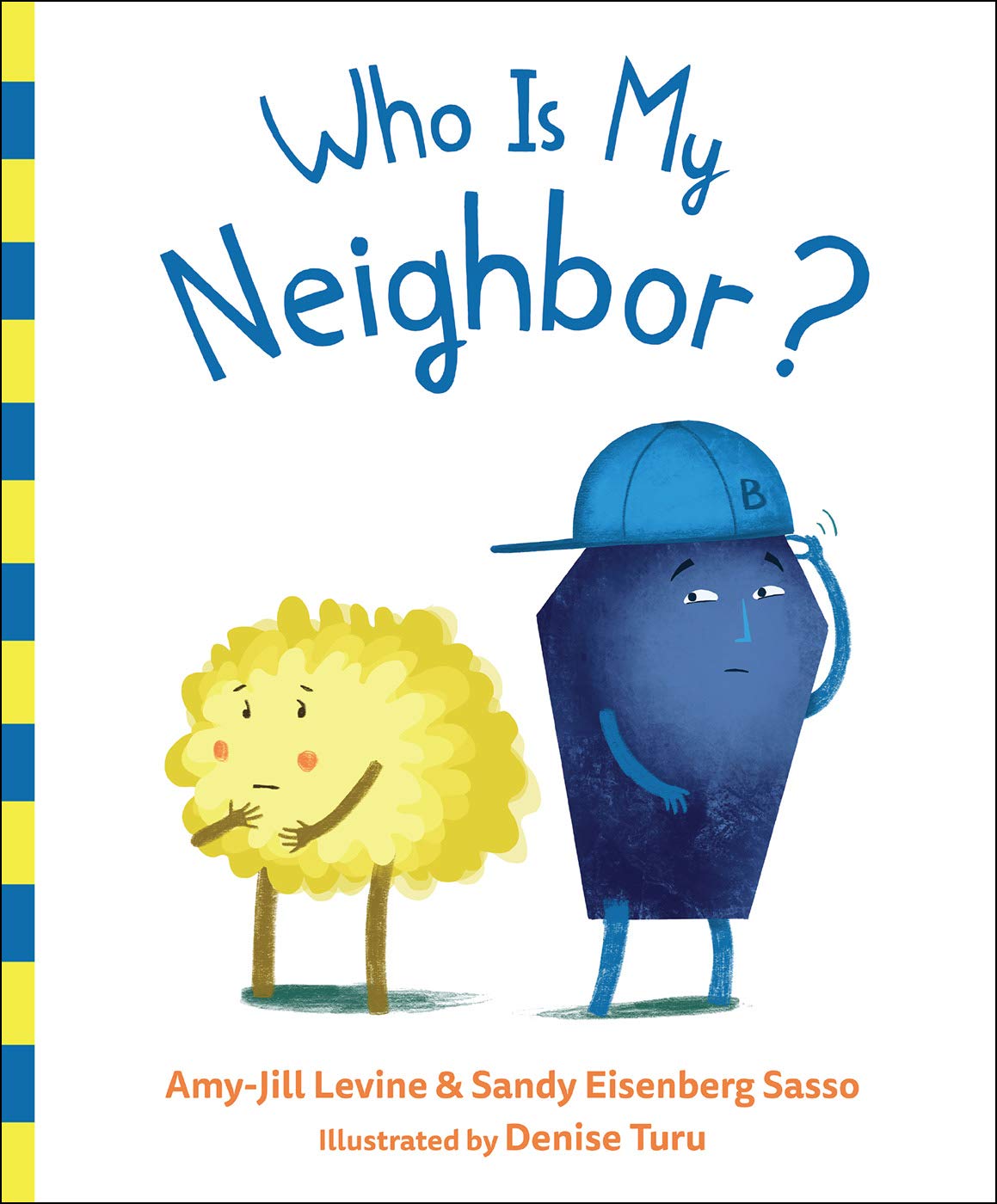
Who Is My Neighbor? tells the story of two communities, the Blues and the Yellows, who have always kept apart, certain that the other group is somehow lesser. Each has been taught that “they are not our neighbors,” though no one quite remembers why. When Midnight Blue falls off his bike, his fellow Blues, Navy and Powder Blue, are too afraid to stop and help. It is Lemon, a Yellow, who overcomes her own hesitation and comes to his aid. Through this small act, Midnight Blue and Lemon discover that the differences they had been taught to fear say little about who someone actually is. A retelling of the parable of the Good Samaritan, the story raises questions about belonging, fear of difference, and what it really means to be a good neighbor.
Guidelines for Discussion
Who Is My Neighbor? offers a clear and approachable way into questions that children encounter early and often: Who counts as someone we should care about? Why do we sometimes feel suspicious of people we don’t know? And does being a good neighbor require us to act, even when it’s uncomfortable?
One central theme is in-group loyalty and division. The Blues and Yellows have never questioned their separation, and the story is careful to note that no one remembers why it started. This invites children to think about inherited beliefs: Do we sometimes treat people as different or untrustworthy simply because that is what we’ve always been told? Facilitators can help children notice that Midnight Blue, Navy, and Powder Blue are all the same color, yet they behave very differently from one another, just as Lemon’s kindness sets her apart from any assumption about what Yellows are like. This opens space to ask whether a group can really tell us much about a person at all.
Another theme is fear and moral courage. Navy and Powder Blue pass by their injured friend because they are afraid; the story makes clear that Lemon is afraid too, but chooses to help anyway. This mirrors a thread found across many TCP titles: that courage is not the absence of fear but the choice to act in spite of it. Children might be invited to consider why fear sometimes stops people from doing the right thing, and what it takes to act differently.
The book also raises the question of who counts as a neighbor. The title itself poses this directly, and the story resists giving children a simple checklist. Is a neighbor someone who lives nearby, someone who looks like us, or simply someone who needs help and is in front of us? Children can be encouraged to draw on their own experiences of kindness from someone unexpected, or moments when assumptions about a person turned out to be wrong.
Finally, the story touches on change and the reshaping of community. By the end, the bond between Lemon and Midnight Blue begins to shift how the two communities see each other. This invites reflection on how change happens: does it take one relationship, or many, to change a group’s mind? Can two people’s friendship really unsettle something everyone assumed was fixed?
Facilitators should resist steering children toward a single tidy conclusion, such as “everyone is the same” or “differences don’t matter.” The story is more interesting, and more honest, when held open: differences are real and noticeable in the book, but the question is what we do in response to them.
Discussion Questions
Belonging and Division
- Why do you think the Blues and the Yellows stopped being neighbors in the first place?
- Can a group of people really tell you what one person from that group is like?
- Have you ever assumed something about a person before you got to know them?
Fear and Courage
- Why were Navy and Powder Blue afraid to help Midnight Blue?
- Was Lemon brave even though she was scared too?
- What helps someone act kindly even when they feel nervous?
Who Is a Neighbor
- What do you think makes someone a neighbor?
- Does a neighbor have to live near you?
- Could a stranger become a neighbor? How?
Change and Community
- How did Lemon and Midnight Blue’s friendship change the way Blues and Yellows saw each other?
- Do you think one friendship can change a whole community’s mind?
- What would you do if your friends disagreed with a friendship you cared about?
Suggested Activity: Who Are My Neighbors?
After the discussion, give each child a large sheet of paper and invite them to draw themselves at the center, surrounded by the people, animals, or places they consider their neighbors. Encourage them to think beyond the people who live closest to them: classmates, a crossing guard, a librarian, even someone they’ve only spoken to once.
As they draw, circulate and ask gentle prompting questions: “What makes this person a neighbor to you?” or “Is there someone you’d like to get to know better who isn’t on your page yet?”
Once finished, invite students to share their drawings in pairs or small groups. Bring the group back together to connect the activity to the story: What did Lemon and Midnight Blue have to do before they could become neighbors? Does that match what we drew today? This activity helps children translate the book’s abstract question, who is my neighbor, into something personal and concrete.
About the Prindle Institute
The Prindle Institute for Ethics equips people to deepen their understanding of different moral perspectives and to think critically about the inescapable ethical issues of our time. Through ethics education resources and interactive experiences, we bring communities together to fully engage with the ethical dimensions of their lives.
About Teaching Children Philosophy
Teaching Children Philosophy began with the philosopher, Dr. Tom Wartenberg, whose pioneering work showed how picture books can open the door to big ethical and philosophical questions. Today, The Prindle Institute serves as the digital home for the library, expanding and maintaining this growing collection of guides so educators everywhere can bring lively, thoughtful dialogue into their classrooms.
Further Resources
Some of the books on this site may contain characterizations or illustrations that are culturally insensitive or inaccurate. We encourage educators to visit the Association for Library Service to Children’s resource guide for talking to children about issues of race and culture in literature. They also have a guide for navigating tough conversations. PBS Kids’ set of resources for talking to young children about race and racism might also be useful for educators.
Philosophy often deals with big questions like the existence of a higher power or death. Find tips for leading a philosophical discussion on our resources page.
