

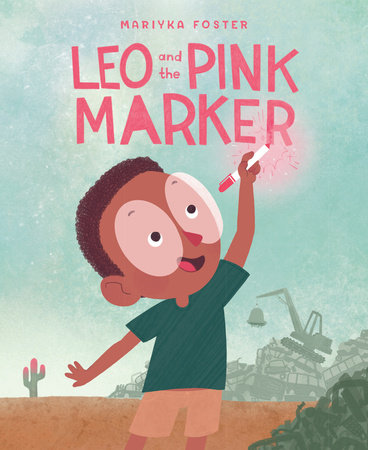
Leo and the Pink Marker
Book Module Navigation
Summary
Leo and the Pink Marker is a bright and playful debut from author-illustrator Mariyka Foster. Leo loves his pink marker, and when a gray, dusty day at the family scrapyard leaves him restless, he decides that a little color would improve things considerably. While Mom and Mama are occupied with work, Leo sets about transforming the scrapyard: the old cars, the magnet crane, the mailbox, and eventually the family cat all get a splash of pink. When his moms finally discover what Leo has done, the ending surprises both Leo and the reader. The story invites children to think about creativity and self-expression, the boundaries of rules, and how the people who love us respond when we push against those limits.
Guidelines for Discussion
Leo and the Pink Marker works well as a starting point for philosophical discussion because it holds its central questions open. Leo’s behavior is neither clearly condemned nor simply celebrated, and the moms’ surprising reaction refuses to settle the question of whether what Leo did was wrong. That ambiguity is the story’s greatest philosophical asset.
One natural entry point is creativity and self-expression. Leo is not simply being mischievous; he is making something. He has a genuine aesthetic vision, and the illustrations show that his pink additions do, in a way, transform the scrapyard into something livelier. Teachers can invite students to think about what it means to create, and whether creativity gives us special permissions. Does making something beautiful change whether it was okay to do? Is there a difference between expressing yourself and doing whatever you want? These questions connect to deeper ideas about art, intention, and value.
A second theme is rules and permission. Leo acts while his moms are not looking, which raises the question of whether the wrongness of an action is connected to whether someone is watching. Children often have strong intuitions here, and those intuitions are worth examining. If no one had ever found out, would that change whether Leo did something wrong? What are rules actually for, and who gets to make them? Facilitators can guide students to notice that rules often protect something, and to ask what the rules Leo broke might have been protecting.
This connects naturally to a third theme: consequences and accountability. When Leo’s moms appear, readers expect a scolding, and Leo clearly expects one too. The moms’ response invites reflection on what it means to be held accountable for something, and whether love and accountability are in tension or can coexist. Students can be encouraged to think about times they did something they were not sure was allowed, and how it felt to face the consequences or the absence of them.
Finally, the story quietly raises questions about belonging and acceptance. The scrapyard belongs to Leo’s family, and Leo, in his own way, is putting his mark on it, making it his own. The response he receives from his moms affirms something about who he is, not just what he did. Teachers can help students reflect on what it means to feel accepted, and whether there is a difference between being loved unconditionally and being told that everything you do is fine.
The philosophical richness of Leo and the Pink Marker lies in the fact that none of these questions resolve neatly. Facilitators should resist the urge to land on a tidy moral, and instead encourage students to sit with the complexity and offer their own reasoning.
Discussion Questions
Creativity and Self-Expression
- Why do you think Leo wanted to color the scrapyard pink?
- Does making something look better change whether it was okay to do?
- Is there a difference between making art and just doing whatever you want?
Rules and Permission
- Did Leo do something wrong? Why or why not?
- Would it matter if his moms had never found out?
- What do rules protect, and who gets to decide what the rules are?
Consequences and Accountability
- Why do you think Leo expected to be in trouble?
- What does it mean to be held responsible for something you did?
- Is it possible to love someone and still tell them they did something wrong?
Belonging and Acceptance
- Why do you think Leo chose the scrapyard to color?
- What does it mean to put your mark on something?
- Can someone accept you fully even if they don’t always approve of what you do?
Suggested Activity: Color Your World
After the discussion, invite students to think about a space in their own lives that feels dull or overlooked, the way the scrapyard did to Leo. Provide each student with a sheet of paper and ask them to draw that space as it is now. Then, on a second sheet, ask them to reimagine it: What would they change? What colors would they use? What would they add, and why?
Once students have completed both drawings, bring the group together to share. Encourage each student to explain not just what they changed, but why. As they share, ask gentle follow-up questions: What made you choose those colors? Would you need permission to make those changes in real life? What do you think the people who use that space would say?
After sharing, use the drawings to return to the story’s central questions. Did Leo have the right to transform the scrapyard? Do we have the right to change the spaces around us? What does it mean to make a place your own? This activity helps students move between the personal and the philosophical, using their own creative choices as a way into the larger questions the book raises.
About the Prindle Institute
The Prindle Institute for Ethics equips people to deepen their understanding of different moral perspectives and to think critically about the inescapable ethical issues of our time. Through ethics education resources and interactive experiences, we bring communities together to fully engage with the ethical dimensions of their lives.
About Teaching Children Philosophy
Teaching Children Philosophy began with the philosopher, Dr. Tom Wartenberg, whose pioneering work showed how picture books can open the door to big ethical and philosophical questions. Today, The Prindle Institute serves as the digital home for the library, expanding and maintaining this growing collection of guides so educators everywhere can bring lively, thoughtful dialogue into their classrooms.
Further Resources
Some of the books on this site may contain characterizations or illustrations that are culturally insensitive or inaccurate. We encourage educators to visit the Association for Library Service to Children’s resource guide for talking to children about issues of race and culture in literature. They also have a guide for navigating tough conversations. PBS Kids’ set of resources for talking to young children about race and racism might also be useful for educators.
Philosophy often deals with big questions like the existence of a higher power or death. Find tips for leading a philosophical discussion on our resources page.
