


Fireworks
Book Module Navigation
Summary
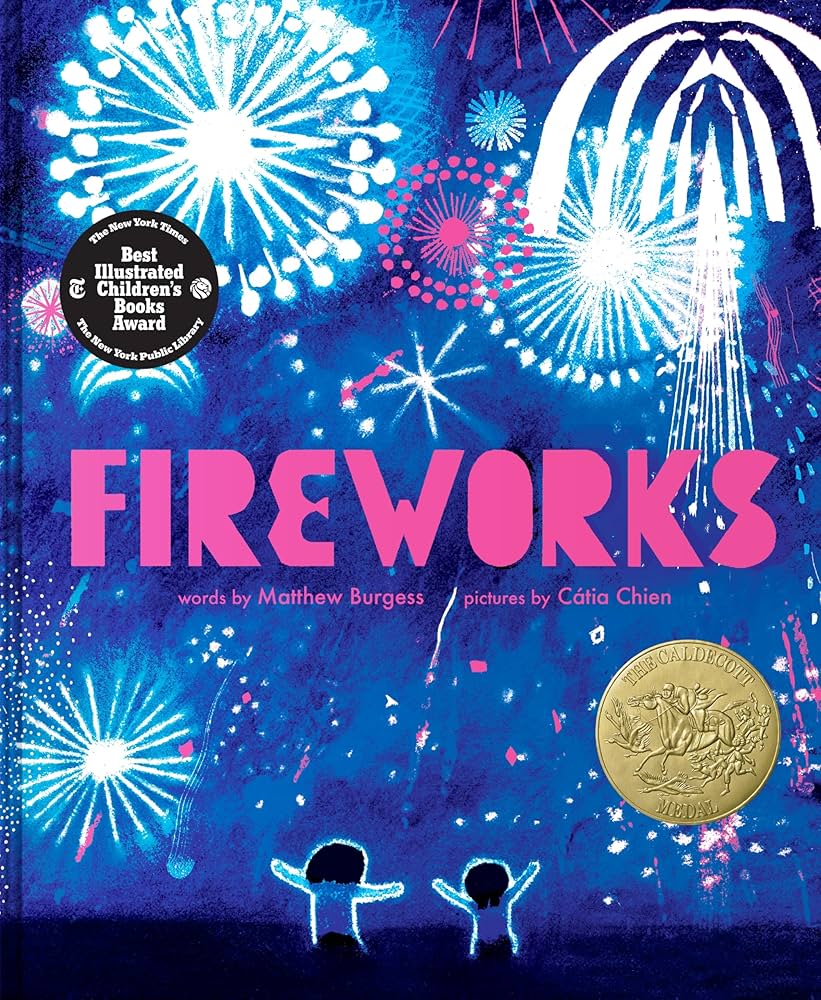
Fireworks is a luminous picture book that follows two siblings through a steamy Fourth of July in the city. From their morning breakfast with Grandmother through splashing in fire hydrant spray, dancing to a saxophonist in the park, and eating watermelon, the children savor the sensory pleasures of a summer day. As evening arrives, they climb to a rooftop to watch the fireworks light up the sky. Burgess’s poetic, onomatopoeia-rich text and Chien’s vibrant mixed-media illustrations create an immersive experience of anticipation, wonder, and the joy of being fully present. The story invites children to reflect on what it means to pay attention to the world around us, how shared experiences create bonds, and why moments of beauty and wonder matter.
Guidelines for Discussion
Fireworks may seem like a simple story about a summer day, but its gentle pacing and rich sensory detail open the door to several philosophical conversations that children can explore with depth and sincerity.
One central theme is wonder and attention. The two siblings do not rush through their day—they notice the heat on their skin, the sounds of the city, the taste of watermelon, the feel of water from a fire hydrant. This attentiveness invites children to consider what it means to really pay attention to the world. Why do some moments feel more vivid than others? Does paying close attention to ordinary things make them more meaningful? Facilitators can encourage children to think about whether wonder is something that happens to us or something we choose, and whether slowing down changes how we experience the world.
Another theme is anticipation and patience. The entire arc of the book builds toward the fireworks display, but the children find joy along the way. This creates a natural entry point for discussing whether waiting for something can be part of the pleasure, or whether it is simply an obstacle. Children can reflect on times they have eagerly anticipated something and consider whether the waiting itself shaped the experience. Philosophically, this connects to questions about what makes an experience valuable—is it only the destination, or does the journey matter too?
The story also highlights shared experience and community. The siblings move through a neighborhood full of people—on stoops, in parks, on sidewalks—all sharing the same summer evening. The fireworks themselves are a communal event, experienced together by an entire neighborhood looking skyward. Facilitators can ask children why watching fireworks with others feels different from watching them alone, and what it means to share a moment with strangers. This opens up reflection on how community is built not only through conversation but through shared presence and shared wonder.
Finally, Fireworks touches on the relationship between language, art, and experience. Burgess’s text is full of onomatopoeia—”POP,” “Tizzle-ting,” “KABOOM”—and Chien’s illustrations burst with color and movement. Children can explore whether words and pictures can truly capture what an experience feels like, or whether some things are beyond language. This is a playful but genuine philosophical question: How do we share experiences with others? Can a book make you feel something you have never actually experienced? These questions help children think about the nature of expression, communication, and imagination.
Taken together, these themes show that Fireworks is not just a celebration of a holiday—it is an invitation to reflect on how we experience the world, why beauty and togetherness matter, and how stories and art help us hold onto fleeting moments.
Discussion Questions
Wonder and Attention
- Why do the children seem to notice so many small things during their day?
- Does paying attention to something closely make it more special? Why or why not?
- Can ordinary things—like water, music, or a warm day—be wonderful?
Anticipation and Patience
- The children wait all day for the fireworks. Does waiting for something make it better when it finally happens?
- Is the fun of a special event only in the event itself, or is looking forward to it part of the fun?
- Have you ever waited for something that turned out to be different from what you expected?
Shared Experience and Community
- Why might watching fireworks with other people feel different from watching them alone?
- What does it mean to share an experience with someone, even if you do not talk about it?
- How do events like fireworks bring a community together?
Language, Art, and Experience
- Can words like “POP” and “KABOOM” really capture what fireworks sound like?
- Can a picture or a story make you feel something you have never experienced yourself?
- Why do people try to describe beautiful moments, even when it is hard to find the right words?
Suggested Activity: Sensory Snapshot
After the discussion, invite students to create their own “Sensory Snapshot”—a drawing and writing piece that captures a single moment they find beautiful, exciting, or meaningful. Begin by reminding students how Fireworks lingers on small details: the feel of summer on skin, the sound of a saxophone, the taste of watermelon. Ask them to think of a moment in their own lives that stands out—not because something dramatic happened, but because they remember how it felt. It could be a holiday evening, a walk in the rain, a family meal, or a moment playing outside.
Provide paper divided into two sections. On one side, ask students to draw the moment, filling the page with colors, shapes, and details that capture the feeling of being there. On the other side, ask them to write a few words or short sentences describing what they saw, heard, smelled, tasted, or felt—encouraging them to experiment with sound words and vivid descriptions, just as Burgess does in the text.
Once students have finished, invite them to share their Sensory Snapshots in pairs, small groups, or with the whole class. As they share, facilitators can ask: What made you choose this moment? What details help someone else feel like they are there with you? Conclude with a reflective conversation connecting the activity back to the book: Why do some moments stay with us? How does paying attention—and finding ways to express what we notice—help us appreciate the world around us? This activity reinforces the themes of wonder, attention, and the power of language and art to capture experience.
About the Prindle Institute
The Prindle Institute for Ethics equips people to deepen their understanding of different moral perspectives and to think critically about the inescapable ethical issues of our time. Through ethics education resources and interactive experiences, we bring communities together to fully engage with the ethical dimensions of their lives.
About Teaching Children Philosophy
Teaching Children Philosophy began with the philosopher, Dr. Tom Wartenberg, whose pioneering work showed how picture books can open the door to big ethical and philosophical questions. Today, The Prindle Institute serves as the digital home for the library, expanding and maintaining this growing collection of guides so educators everywhere can bring lively, thoughtful dialogue into their classrooms.
Further Resources
Some of the books on this site may contain characterizations or illustrations that are culturally insensitive or inaccurate. We encourage educators to visit the Association for Library Service to Children’s resource guide for talking to children about issues of race and culture in literature. They also have a guide for navigating tough conversations. PBS Kids’ set of resources for talking to young children about race and racism might also be useful for educators.
Philosophy often deals with big questions like the existence of a higher power or death. Find tips for leading a philosophical discussion on our resources page.
