

Blue Monster
Book Module Navigation
Summary
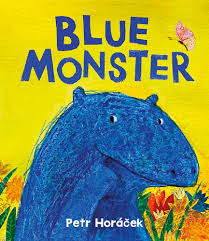
Blue Monster wants to play, but Rabbit is sleeping and refuses to be disturbed. Frustrated, Blue Monster does the unthinkable: he swallows Rabbit whole. When the other animals ask where Rabbit has gone, Blue Monster denies it, and then swallows them too, one by one, to silence their questions. Left entirely alone, he feels sad, guilty, and very lonely. Then, mid-yawn, all the animals tumble back out. The friends are not pleased. But Blue Monster says he is sorry, and—to the reader’s possible surprise—the animals forgive him, and they all play together at last. Horácek’s bold, scribbled illustrations and escalating absurdist comedy make this a raucous read-aloud, but beneath the silliness lie genuine questions about impulse and self-control, honesty and cover-up, and what forgiveness actually requires.
Guidelines for Discussion
Blue Monster is a funny book, and its humor is part of what makes it philosophically useful. Children laugh at Blue Monster’s increasingly desperate attempts to conceal what he has done, and that laughter opens a door to reflection: Why is it funny when someone keeps making things worse? What does it feel like to be in Blue Monster’s position? These questions move naturally from the story into territory children already inhabit in their own lives.
A central thread is impulse and self-control. Blue Monster does not set out to harm his friends: he simply wants to play, and when Rabbit refuses, something in him takes over. Children can explore what it means to act without thinking and whether doing something wrong on impulse is different from doing it on purpose. This is a distinction children encounter frequently, and the story gives them a character who is clearly not malicious but who still causes real harm. Facilitators can encourage children to think about times when they have acted before they thought, and what that felt like afterward.
The cover-up is at least as philosophically interesting as the original act. Blue Monster’s response to having done something wrong is to compound it: he swallows each witness in turn, trying to make the problem disappear. Children will recognize this impulse even without having enacted it so dramatically. This opens conversation about honesty and the temptation to hide our mistakes: Why is it so hard to admit when we have done something wrong? Does trying to cover up a mistake make it worse? What does it cost us to be honest, and what might it cost us not to be?
The ending raises the most open questions. Blue Monster says he is sorry, and the animals forgive him, but the story moves quickly past this moment. Facilitators can invite children to slow down and examine it. What does it mean to be truly sorry? Is saying the words enough, or does an apology require something more? And on the other side: are the animals obligated to forgive Blue Monster? Forgiveness is not the same as pretending nothing happened, and children may have strong and differing intuitions about whether the friends’ response feels right. The story does not require a settled answer here, and the richest discussions will probably resist one.
Finally, there is the question of what makes someone a good friend. Blue Monster genuinely wants companionship: his actions, however misguided, come from a desire to connect. Children can reflect on whether wanting to be someone’s friend is enough, or whether friendship requires something more: respecting what others need, even when it is inconvenient for us. This connects the story’s silliest moments to one of childhood’s most pressing questions.
Discussion Questions
Impulse and Self-Control
- Why do you think Blue Monster swallowed Rabbit instead of just waiting for him to wake up?
- Is doing something wrong by accident different from doing it on purpose? Does it matter?
- Have you ever done something before you had time to think about it? What happened?
Honesty and Cover-Up
- Why did Blue Monster keep swallowing more animals instead of admitting what he had done?
- Does trying to hide a mistake make things better or worse?
- Is it ever easy to admit you have done something wrong? What makes it hard?
Apology and Forgiveness
- What does it mean to be truly sorry–is saying “I’m sorry” enough?
- Do the animals have to forgive Blue Monster? Why or why not?
- Is forgiving someone the same as saying that what they did was okay?
Friendship and Respect
- Blue Monster wanted to play more than anything. Does that make what he did more understandable?
- What do you owe a friend who does not want to do what you want to do?
- What does it mean to be a good friend when you disagree?
Suggested Activity: The Sorry Letter
After the discussion, invite students to imagine they are Blue Monster, and ask them to write, dictate, or draw a letter to one of the animals he swallowed. The letter should do more than say “I’m sorry.” Prompt students to think about what a real apology includes: What did Blue Monster do? Why was it wrong? How do you think the animal felt? What would Blue Monster do differently next time?
Once students have finished, invite them to share their letters in pairs or small groups, then open a brief whole-class conversation: Were all the apologies the same, or did different students include different things? What did the best apologies have in common? Then ask the harder question: if you were the animal receiving this letter, would you forgive Blue Monster? Why or why not?
For an extension, invite a second round of writing from the animal’s perspective: a short response to Blue Monster’s letter. This reversal asks students to practice perspective-taking and to think carefully about what forgiveness actually involves: what it requires, what it feels like, and whether it always has to happen right away. The activity works well as a paired exercise, with students exchanging their Blue Monster letters and writing responses to each other.
About the Prindle Institute
The Prindle Institute for Ethics equips people to deepen their understanding of different moral perspectives and to think critically about the inescapable ethical issues of our time. Through ethics education resources and interactive experiences, we bring communities together to fully engage with the ethical dimensions of their lives.
About Teaching Children Philosophy
Teaching Children Philosophy began with the philosopher, Dr. Tom Wartenberg, whose pioneering work showed how picture books can open the door to big ethical and philosophical questions. Today, The Prindle Institute serves as the digital home for the library, expanding and maintaining this growing collection of guides so educators everywhere can bring lively, thoughtful dialogue into their classrooms.
Further Resources
Some of the books on this site may contain characterizations or illustrations that are culturally insensitive or inaccurate. We encourage educators to visit the Association for Library Service to Children’s resource guide for talking to children about issues of race and culture in literature. They also have a guide for navigating tough conversations. PBS Kids’ set of resources for talking to young children about race and racism might also be useful for educators.
Philosophy often deals with big questions like the existence of a higher power or death. Find tips for leading a philosophical discussion on our resources page.
