



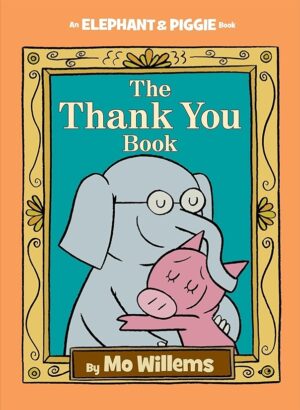
The Thank You Book
Book Module Navigation
Summary
In The Thank You Book, the final story in Mo Willems’s beloved Elephant and Piggie series, Piggie decides to thank everyone who has ever helped her. She thanks her best friend Gerald, the reader, and a colorful cast of familiar characters. Gerald worries that Piggie will forget someone important—and in the end, she almost does. The story blends humor and heart, reminding readers that gratitude is something we give freely, not something we owe. Willems’s playful dialogue and simple drawings create an opening for children to think about kindness, attention, and the many ways we are connected to others.
Guidelines for Discussion
The Thank You Book offers an ideal way to explore the concept of gratitude with children. Piggie’s mission to thank everyone invites reflection on what it means to say “thank you.” Is it simply good manners, or does it express something deeper about how we value others? Teachers can ask students to think about times they’ve said thank you and whether they meant it as politeness, appreciation, or both.
Gratitude naturally leads to questions about relationships and interdependence. Piggie’s long list of thank-yous shows that we are supported by others in ways we might not always notice. Teachers might help students explore what it means to depend on others and whether there are ways we can show appreciation besides words. The story’s humor helps children see gratitude not as an obligation but as a joyful recognition of connection.
The friendship between Gerald and Piggie also raises questions about attentiveness and care. Gerald worries that Piggie might overlook someone, showing how gratitude can involve careful noticing. This opens discussion about empathy and perspective-taking: how do we know when others feel appreciated? Why do we want to be seen and remembered?
Finally, the story’s ending—when Piggie remembers to thank the reader—breaks the wall between story and audience. This moment can help students think about community and participation: how are we part of stories, classrooms, or friendships even when we’re not the main character? Gratitude, the story suggests, binds us together and helps us notice that we belong to something larger than ourselves.
Discussion Questions
Gratitude and Appreciation
- What does it mean to say “thank you”?
- Why do you think Piggie wants to thank everyone?
- Do you think saying thank you is just being polite, or does it mean something more?
Friendship and Attention
- Why is Gerald worried that Piggie might forget someone?
- How do we show people that we appreciate them?
- How does it feel when someone forgets to thank you?
Connection and Community
- Why does Piggie thank the reader at the end?
- Can we be thankful for people we don’t know very well?
- What happens when we forget to notice the ways others help us?
Suggested Activity: Thankfulness Circles
This activity invites students to put the story’s message of gratitude into practice. Begin by arranging students in a circle so that everyone can see each other. Explain that they will take turns sharing one person they are thankful for and a short reason why. Encourage them to think about examples that go beyond their closest friends or family—perhaps someone who helped them when they needed it, made them laugh, or brightened their day in a small way. As the teacher, you can model the kind of reflection you hope to hear by sharing a personal example first.
After each student shares, take a few moments to reflect as a group on what they heard. Ask guiding questions such as: What kinds of things make us feel thankful for others? Did you notice any patterns in what people said? Were there any surprising or creative examples?
Once everyone has shared, extend the exercise by giving students time to make a “thank-you card” for someone in their school community who might not always be recognized—perhaps a custodian, lunch worker, office staff member, or bus driver. Encourage students to be specific in their gratitude, mentioning what that person does that makes a difference. When the cards are finished, they can be delivered as a class or individually.
To close, invite students to reflect again on how Piggie’s long list of thank-yous is like what they just did. You might ask, “What do you think Piggie learned by saying thank you to so many people?” and “How did it feel to think about people who help us every day?” This activity helps children connect the emotional warmth of Willems’s story to their own experiences, reinforcing that gratitude is more than a word—it is a practice that builds connection and belonging.
About the Prindle Institute
The Prindle Institute for Ethics equips people to deepen their understanding of different moral perspectives and to think critically about the inescapable ethical issues of our time. Through ethics education resources and interactive experiences, we bring communities together to fully engage with the ethical dimensions of their lives.
About Teaching Children Philosophy
Teaching Children Philosophy began with the philosopher, Dr. Tom Wartenberg, whose pioneering work showed how picture books can open the door to big ethical and philosophical questions. Today, The Prindle Institute serves as the digital home for the library, expanding and maintaining this growing collection of guides so educators everywhere can bring lively, thoughtful dialogue into their classrooms.
Further Resources
Some of the books on this site may contain characterizations or illustrations that are culturally insensitive or inaccurate. We encourage educators to visit the Association for Library Service to Children’s resource guide for talking to children about issues of race and culture in literature. They also have a guide for navigating tough conversations. PBS Kids’ set of resources for talking to young children about race and racism might also be useful for educators.
Philosophy often deals with big questions like the existence of a higher power or death. Find tips for leading a philosophical discussion on our resources page.
