




The Little Old Lady Who Was Not Afraid of Any..
Book Module Navigation
Summary
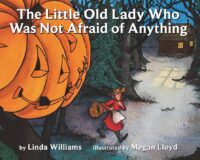
This lively tale follows an old lady walking home through the forest at night. Along the way, she encounters shoes, pants, a shirt, gloves, a hat, and finally a pumpkin head—all moving on their own and trying to scare her. Though she insists she is not afraid, she admits she is startled, and cleverly transforms the spooky clothing into a scarecrow that guards her garden. With rhythmic repetition and playful illustrations, the story raises questions about fear, bravery, and creativity in the face of challenges.
Guidelines for Discussion
The Old Lady Who Was Not Afraid of Anything is a playful story that opens up several avenues for philosophical inquiry, especially about the nature of fear and courage. The old lady insists that she is not afraid, even though the book shows that she is startled by the strange sights and sounds in the woods. This tension gives children a chance to explore whether being brave means never feeling scared, or whether it means acting wisely even while being afraid. Facilitators can draw this out by asking students to compare the old lady’s words with her reactions: Was she truly not afraid, or was she showing courage in a different way? When children share their own experiences of being startled or scared, the group can begin to tease apart the difference between fear, surprise, and bravery.
The story also models creative problem-solving. Instead of running from the moving clothes or trying to fight them, the old lady thinks of a clever way to use them as a scarecrow. This offers a natural opening to discuss how we respond to challenges: Do we try to avoid them, resist them, or transform them into something useful? Children can be encouraged to think of times when they turned a problem into an opportunity or used imagination to change how they felt about a situation. Asking “What else could she have done?” keeps the discussion open-ended and allows multiple perspectives to surface.
A third theme lies in the identity of the animated clothes. The shoes, pants, shirt, and pumpkin head move and make noise even though no one is inside them. Are they alive, or not? What makes something alive? Children may disagree here, and that disagreement can be productive. Some may argue that being able to move and make sounds means something is alive, while others may say that only humans, animals, and plants count. The story provides a safe and playful way to raise big questions about reality, imagination, and how we decide what is “real.”
For facilitators, especially those without a background in philosophy, it is helpful to remember that you do not need to provide answers. Your role is to keep the questions open, encourage children to give reasons for their ideas, and notice when different perspectives emerge. When students disagree, you might ask, “Why do you think that?” or “Does anyone see it another way?” Tying questions back to the old lady’s story keeps the conversation grounded and concrete. For example, if a child says the pumpkin head must be alive because it talks, you can ask, “How is that different from the old lady, who also talks?” or “Do all things that talk count as alive?” By rooting philosophical questions in the story itself, you help children recognize that inquiry grows naturally out of literature and their own lived experiences.
Discussion Questions
Fear and Courage
- Was the old lady really not afraid, or was she just pretending?
- Can someone feel scared and still be brave?
- What does it mean to be “not afraid of anything”?
Problem-Solving and Creativity
- Was the old lady’s solution to make a scarecrow a good one? Why or why not?
- What are other ways she could have handled the spooky clothes?
- Is it better to change something scary or to try to get rid of it?
Identity and Perception
- Were the clothes alive? Why or why not?
- What makes something alive instead of just an object?
- How do we know the difference between what’s real and what’s pretend?
Suggested Activity: Fear to Scarecrows
To help children connect personally with the story’s themes, you can guide them in transforming something frightening into something helpful, just as the old lady turned the spooky clothes into a scarecrow. Begin by setting the stage: remind students of how the old lady met moving shoes, pants, and even a pumpkin head, and how she chose not to run away but instead to reimagine them as useful. Explain that they will do something similar with their own fears.
Give each student a sheet of paper and some crayons, markers, or pencils. Ask them first to draw or describe something that frightens them. This could be something from the story, like the walking clothes, or something from their own lives, such as a shadow in their bedroom, a loud sound, or a creature they imagine. Emphasize that this is not about making scary drawings for others—it is about expressing their own idea of fear. Reassure students that if they prefer, they can keep their drawing simple or even write a word instead of illustrating.
Next, invite students to transform their fear. Ask them to change their drawing by adding new elements that make the frightening thing helpful, kind, or funny. For instance, a dark shadow might sprout a smile and become a friendly pet, or a loud noise might turn into a drum that makes music for dancing. Encourage creativity: there is no “right” answer, and every fear can be reimagined in a unique way.
Once students have finished, create time for sharing. Depending on the group, this might mean presenting to the whole class or showing their work to a partner or small group. Prompt them to explain both parts of their picture: what the original fear was and how they changed it into something new. As they share, draw connections back to the story by asking, “How is your transformation like the old lady’s idea of making a scarecrow?” or “What do you notice about how fears can change when we think differently about them?”
End with a reflective conversation. Ask students: How did it feel to turn something scary into something playful or useful? Did the fear seem smaller once it was transformed? What can imagination do to help us feel braver? This helps children recognize that fear does not always have to be met with avoidance or resistance—sometimes it can be reshaped into something manageable or even positive.
This activity not only reinforces the story’s lesson but also gives children a practical strategy they can carry with them: when something feels scary, they can try to imagine it differently and see if that helps them feel stronger.
About the Prindle Institute
The Prindle Institute for Ethics equips people to deepen their understanding of different moral perspectives and to think critically about the inescapable ethical issues of our time. Through ethics education resources and interactive experiences, we bring communities together to fully engage with the ethical dimensions of their lives.
About Teaching Children Philosophy
Teaching Children Philosophy began with the philosopher, Dr. Tom Wartenberg, whose pioneering work showed how picture books can open the door to big ethical and philosophical questions. Today, The Prindle Institute serves as the digital home for the library, expanding and maintaining this growing collection of guides so educators everywhere can bring lively, thoughtful dialogue into their classrooms.
Further Resources
Some of the books on this site may contain characterizations or illustrations that are culturally insensitive or inaccurate. We encourage educators to visit the Association for Library Service to Children’s resource guide for talking to children about issues of race and culture in literature. They also have a guide for navigating tough conversations. PBS Kids’ set of resources for talking to young children about race and racism might also be useful for educators.
Philosophy often deals with big questions like the existence of a higher power or death. Find tips for leading a philosophical discussion on our resources page.
