



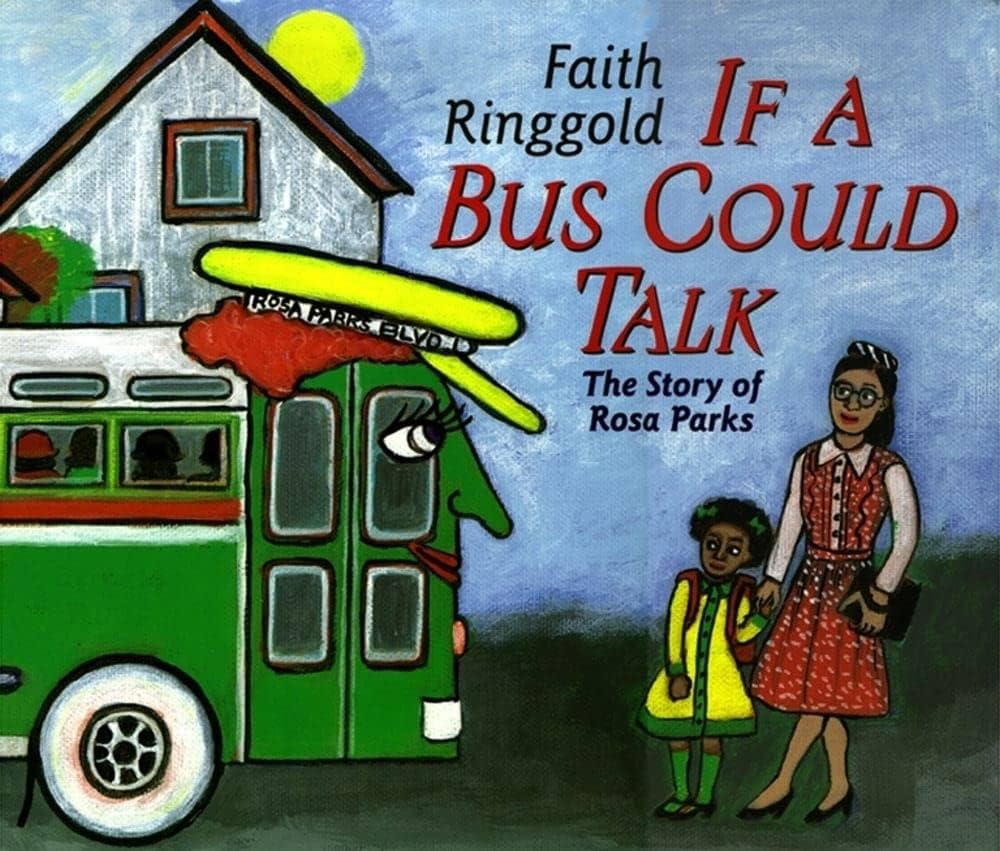
If a Bus Could Talk
Summary
If a Bus Could Talk recounts the inspiring true story of Rosa Parks, whose courageous act of defiance—refusing to give up her seat on a segregated bus in Montgomery, Alabama—sparked the Civil Rights Movement. Narrated through a magical bus ride, readers join a young girl named Marcie who learns about Rosa’s bravery and its powerful impact. This book helps young readers understand themes of justice, equality, and the strength of individual actions to create social change.
Guidelines for Discussion
If a Bus Could Talk presents an accessible yet profound opportunity to examine important philosophical questions about justice, equality, authority, and moral courage. Through the story of Rosa Parks and her quiet resistance, students are invited to grapple with what makes a rule just or unjust, how power operates in social systems, and when it is right to resist unfair treatment—even at personal risk.
Philosophical discussions can center around the distinction between legal and moral obligations: Is it always right to follow the law? What do we owe to others when the rules of our community are unfair? Rosa Parks’ defiance raises questions about civil disobedience and moral responsibility—concepts explored by philosophers like Henry David Thoreau, Martin Luther King Jr., and contemporary thinkers in ethics and political philosophy.
The book also encourages thinking about the role of individuals in shaping a more just society. Students can explore whether being a good person means going along with the crowd or standing up—even alone—for what’s right. Discussions may also reflect on how our understanding of fairness develops through historical examples, stories, and shared dialogue.
Young philosophers can be prompted to think not just about past injustice, but about their own capacity to notice and challenge unfairness in everyday life—on the playground, in their neighborhoods, or at school. In doing so, they begin to see philosophy not as abstract, but as something lived and active.
Discussion Questions
Justice and Fairness
- Was it fair that Rosa Parks had to give up her seat?
- How can you tell if a rule or law is unfair?
- Have you ever experienced something unfair? What did you do? Why?
Courage and Action
- What made Rosa Parks brave?
- Can small actions by one person lead to big changes?
- Have you ever stood up for something you believe in?
Community and Responsibility
- Why do you think Rosa Parks’ actions inspired so many people?
- Do you think it is important to take responsibility for helping others in your community? Why or why not?
- What can we do today to make sure everyone is treated fairly?
Listening to Stories from History
- Why is it important to listen to stories about people like Rosa Parks?
- What lessons can we learn from Rosa Parks’ experience?
- brave people affect the way we think and act?
About the Prindle Institute
The Prindle Institute for Ethics equips people to deepen their understanding of different moral perspectives and to think critically about the inescapable ethical issues of our time. Through ethics education resources and interactive experiences, we bring communities together to fully engage with the ethical dimensions of their lives.
About Teaching Children Philosophy
Teaching Children Philosophy began with the philosopher, Dr. Tom Wartenberg, whose pioneering work showed how picture books can open the door to big ethical and philosophical questions. Today, The Prindle Institute serves as the digital home for the library, expanding and maintaining this growing collection of guides so educators everywhere can bring lively, thoughtful dialogue into their classrooms.
Further Resources
Some of the books on this site may contain characterizations or illustrations that are culturally insensitive or inaccurate. We encourage educators to visit the Association for Library Service to Children’s resource guide for talking to children about issues of race and culture in literature. They also have a guide for navigating tough conversations. PBS Kids’ set of resources for talking to young children about race and racism might also be useful for educators.
Philosophy often deals with big questions like the existence of a higher power or death. Find tips for leading a philosophical discussion on our resources page.
