
The Man, the Bin, and the Ballot Box


 SHARE
SHARE
I think it’s safe to say that politics has, in recent years, become a bit of a sideshow. It feels like the days of the statesman, with their clear vision for their country and their ability to rally, if not inspire, the populace are now a thing of the past. Think of Churchill’s 1940 “We Shall Fight Them on the Beaches” speech, Martin Luther King Jr’s “I Have a Dream” speech of 1963, or John F. Kennedy’s 1962 “We Choose to Go to the Moon” speech. These, and so many more, will live through the annals of time not simply because of what they were about, but also who delivered them.
More recently, however, we are faced with a rather different form of political actor and world leader. In 2005, we had former French president Jacques Chirac saying you can’t trust people, namely the British and the Finns, because their culinary skills are too poor. Argentina’s current president, Javier Milei, often portrays a less-than-reserved demeanor in his role as the country’s leader, most notably in 2025 when he shared a stage with Elon Musk as the latter wielded a chainsaw. And, of course, who could forget the countless gaffes, insults, rants, and temper tantrums of the current US president. Indeed, I struggled to pick just a single illustration of Trump’s lack of statecraft, so I decided to go with a recent one in which he rambles about the Islamic Republic of Japan (spoiler alert: Japan is not an Islamic Republic).
These examples, along with countless others, help illustrate a point which has been made several times in articles and think pieces in the Medium, Compact, National Affairs, and (ironically) the New Statesman, one which I think many of us are feeling. That the days of the great, wise leader may be behind us.
Yet, as the expression goes, the night is darkest before the dawn, and in the past few years, a political upstart has emerged on the scene of UK politics. And while they have not yet had a huge amount, or any, success in the UK parliament, recent developments have meant that now could be their time. Indeed, it seems that much of the country has rallied behind this charismatic politician and their radical agenda. What makes this noteworthy, and why I wanted to write about it here, is that this revolutionary hope is a man with a bin on his head.
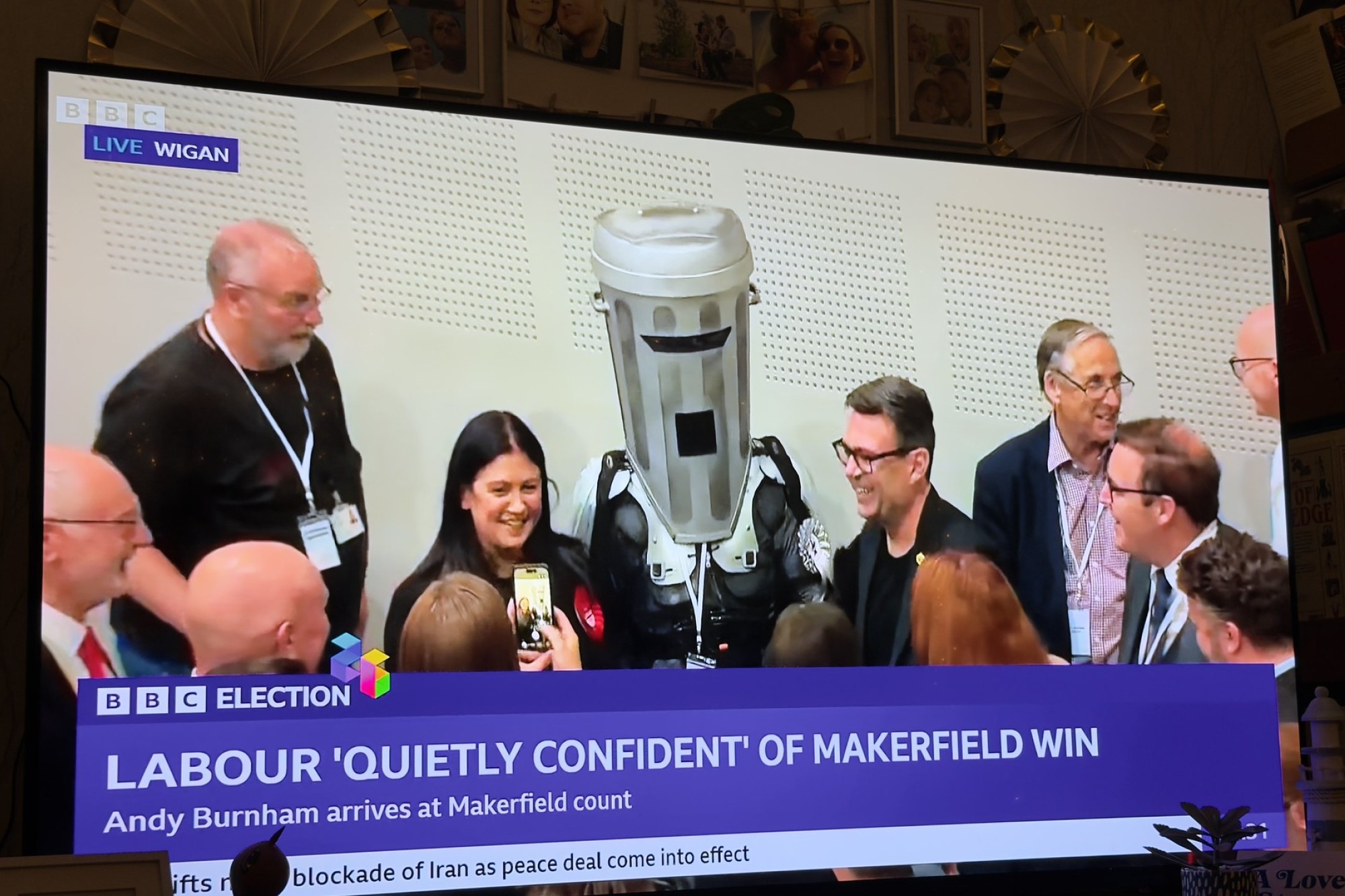
His name is Count Binface. Since emerging onto the UK political scene in 2018, he has become an idiosyncratic, yet nearly omnipresent, figure in major elections. He first gained widespread attention by standing in the 2019 UK general election, where he challenged then Prime Minister Boris Johnson. Since then, he has run against a succession of high-profile politicians, including London Mayor Sadiq Khan (twice), former Prime Minister Rishi Sunak, and presumptive incoming Prime Minister Andy Burnham in June of this year.
It is his latest exploit, however, that has garnered attention, as there is the distinct possibility that the self-styled Leader of the Recyclons from the planet Sigma IX – who is, just to reiterate, a man with a bin on his head – could end up in the House of Commons.
For context, and to draw a slightly long story short, there is a constituency in the UK called Clacton. In 2024, the leader of the right-wing populist and far-right political party Reform UK, Nigel Farage, was elected as that constituency’s MP. In recent months, there have been increased calls for an investigation into Farage’s financial affairs as it has been alleged that he failed to disclose income and gifts he received in the 12 months preceding his election; a requirement under the Rules relating to the Conduct of Members. Such an investigation was launched in May 2026 and was anticipated to conclude that Farage had breached the rules. This would likely result in a by-election for Clacton where Farage would once again have to campaign to keep his seat. Farage, however, was seemingly unhappy to wait for this to happen to him, and on July 7th, he announced he would stand down as an MP, thereby forcing a by-election, in which he would stand. Farage’s rationale was that he would let the people of Clacton decide his fate rather than be judged by anyone else. However, all the other major political parties have refused to field a candidate. So, for a moment, it looked like Farage would run unopposed. That is, until Count Binface announced that he would stand. Thus, while nominations are still open and others could put themselves forward for the election (indeed, a couple of persons whom we needn’t concern ourselves with have), the election is a two-horse race. On the one side, one of the country’s most charismatic and inexplicably popular political figures, a man who played a central, if not the central, role in driving the UK out of the European Union, and who some tout as in the running to become the next Prime Minister of the UK. And on the other side, once again, a man with a bin on his head.
Since the announcement that he will run, Count Binface has been doing the media rounds. This has been normal for years as a minor appearance of the novelty candidate. However, this time around, things have taken a weirdly serious tone, with Count Binface making appearances on the leading political and news channels and shows. Now, he’s not a quick throwaway gag that a reporter quickly talks to while they await a more serious candidate from the majority party or the opposition to become free. He’s on the Today program on Radio 4. He’s on Newsnight on the BBC. He’s on LBC talking to Andrew Marr. There was a 35-minute segment on Channel 4 News about him and the by-election. He’s on the front page of practically every newspaper in the country. This by-election has catapulted a novelty candidate into the political limelight. What’s more, Farage framed this by-election as a decision for the people of Clacton as a choice between himself and the establishment. However, as none of the major political parties are standing a candidate, that framing means that Farage’s main rival, the face of the establishment, is, once again, a man with a bin on his head.
Now, all this is extremely funny. In case you’ve forgotten, the UK is a nation that, when asked to pick a name for a polar research vessel in 2016, picked, by a huge margin, Boaty McBoatface (the popular choice was ignored, and the vessel was actually named the Sir David Attenborough). We Brits are famed for our dry and irreverent sense of comedy, and we are happy to take that to the extreme, be it in the naming of a multi-million pound ship or the very real possibility of voting into the highest echelons of the UK political system a man whose manifesto pledges have historically and currently included:
–Renaming London Bridge to Phoebe Waller-Bridge after the actress, screenwriter, and producer.
–Banning loud snacks from theaters.
–Banning the use of the speakerphone function on mobile phones in public. (Offenders will be forced to watch the film version of Cats every day for a year.)
–Moving the hand dryer in the men’s toilet at Uxbridge’s Crown and Treaty pub to a “more sensible position.”
–Nationalizing the singer, Adele.
–Reversing Brexit by inviting EU member states to join the United Kingdom.
It is, in all honesty, bizarre and terribly funny. And the seriousness of the possibility of his being elected to the parliament juxtaposed with the fact that (final time I promise) he is a man with a bin on his head, makes it even more funny. Yet, despite all this silliness, there is a serious political and philosophical point behind it all.
Count Binface is not the only candidate to mock the political establishment. There is a long tradition within the UK political electoral system of, for lack of a better word, odd peoples standing for office. The most well established is the various candidates put forward over the years by the Monster Raving Loony Party. In the recent Makerfield by-election, in which Count Binface stood against presumptive PM Andy Burnham, there was also a man dressed as a fox. Often, if there’s a serious point or process of politics being conducted, there will be a seriously unserious person there to subvert it. And that is itself an important feature of the political process.
The democratic process, for all its seriousness, has always required fools. We tend to think of politics as something that should be conducted with gravity. Parliament is filled with rituals and traditions stretching back centuries. Politicians speak from podiums covered with emblems. Campaign launches are meticulously choreographed. Leaders look to cultivate images of competence, authority, and statesmanship. The entire enterprise, both in the UK and beyond, rests upon the notion that those who seek power ought to be taken seriously.
Yet democracy depends just as much upon our willingness to refuse those that seek power that privilege.
In his 1971 book Rabelais and His World, Russian philosopher Mikhail Bakhtin argued that societies require, occasionally, what he called the carnivalesque: moments in which the normal hierarchy of society is turned upside down. Using the example of the medieval carnival, Bakhtin notes that there were occasions when kings could be mocked, priests parodied, and fools elevated, if only temporarily, above those who ordinarily commanded obedience. These festivals were not attempts to overthrow the established order. Instead, they reminded everyone that power was ultimately human. The king, whom had rule overall, was still just a man.
It is this moment of subversion, where the world flips on its axis, that Count Binface currently embodies. His candidacy functions as a modern carnival, one played out not in a medieval town square but on television studios, radio programs and ballot papers. By standing alongside prime ministers, cabinet ministers and party leaders, he punctures the carefully cultivated aura that surrounds political office. He reminds us that no office is so exalted that it cannot accommodate a joke, and no politician so important that they cannot find themselves debating public policy with a self-proclaimed extraterrestrial from the planet Sigma IX.
This is not to say that Count Binface is making politics absurd. Far from it. He reveals the absurdity that was already there.
After all, modern politics increasingly resembles performance. Election campaigns are stage-managed spectacles. Politicians spend as much time crafting social media clips as they do policy. Success is measured not only in legislation passed but in viral moments, memorable one-liners, and dominance of the news cycle. Increasingly, politics rewards charisma over competence, spectacle over substance. It gives power to those who, rather than being a statesman, are those who can sell their brand of unaware unseriousness. Who think that calling your political rivals names like Sleepy Joe or dumbocrats is high art.
In that environment, Count Binface is less an interruption than an exaggeration. Like all good satire, he simply pushes reality one step further than reality has already pushed itself.
This perhaps explains why his current campaign feels so different from his previous ones. For years, novelty candidates occupied a familiar role in British elections. They provided a brief comic interlude during the results declaration before the cameras returned to the “real” candidates. This time, however, the cameras have stayed on him. He has become a serious participant in the national conversation, not because he has abandoned the joke, but because the joke has become an unexpectedly useful lens for examining British politics itself.
There is a delicious irony in the fact that Nigel Farage sought to frame the Clacton by-election as a contest between himself and the political establishment. By refusing to field candidates, the major parties inadvertently transformed that framing into something else entirely. The principal alternative to one of the most recognizable figures in British politics became a man who is campaigning for cyclists who break the highway code to be forced to ride unicycles instead. If Bakhtin’s carnival momentarily dissolves social hierarchy, then this is surely its democratic equivalent. The distinction between the political elite and the political outsider collapses, leaving voters to confront an unsettling question: how much of politics is performance, and how much is merely costume?
Bakhtin believed that carnival possessed a peculiar kind of truth. By laughing at authority, people were not rejecting society but renewing it. Laughter strips away the facade and reminds rulers that they remained accountable to those they governed. It prevents power from becoming untouchable. That is the role Count Binface performs today.
Whether he wins in Clacton is, in many respects, beside the point. His greatest achievement has already been realized. He has reminded us that democracy is healthiest when it retains the capacity to laugh at itself. As he himself said, when asked whether he has a chance to win: “err probably not. But then, you know, my job is to celebrate and defend the wonders of British democracy.”
If there is but one lesson to be drawn from Count Binface’s rise, it is that satire is not the opposite of politics; it is one of its oldest companions. Democracies need serious politicians willing to grapple with serious problems. But they also need their muppets. Those who are willing and able to expose vanity, puncture pomposity, and remind us that, beneath the titles, the motorcades and the campaign slogans, every politician remains exactly what they have always been: an ordinary human being who probably has just as much clue about what’s happening as the rest of us.
Sometimes, that reminder just so happens to be, for the final time, a man with a bin on his head.